
Your business could be losing customers right now because of google maps citations you never built. When someone searches “plumber near me” or “best pizza nearby,” Google picks three businesses to show on the map. If your details are missing or messy across the web, that spot goes to your competitor.
The fix is simpler than most owners think. Citations are just mentions of your business name, address, and phone number on sites like Yelp, Facebook, and Bing Places. This guide shows you exactly what they are, why they still matter in 2026, and how to build them step by step, without wasting money on cheap services that backfire.
Key Points:
- Google Maps citations are mentions of your business name, address, and phone number (NAP) on sites like Yelp, Facebook, and Bing Places.
- Consistent citations build Google’s trust and help you rank in the Map Pack, which captures around 42% of local search clicks.
- Citations hold roughly 6% of ranking weight, but inconsistent NAP acts as a negative signal that caps your rankings.
- Build in three tiers: core directories first, data aggregators (Data Axle, Localeze, Foursquare) second, niche and local sites last.
- Audit your citations every 6 to 12 months, fix duplicates, and update aggregators first after a move or rebrand.
- Avoid cheap bulk citation gigs, they create spam listings and duplicates you cannot control later.
What Are Google Maps Citations?
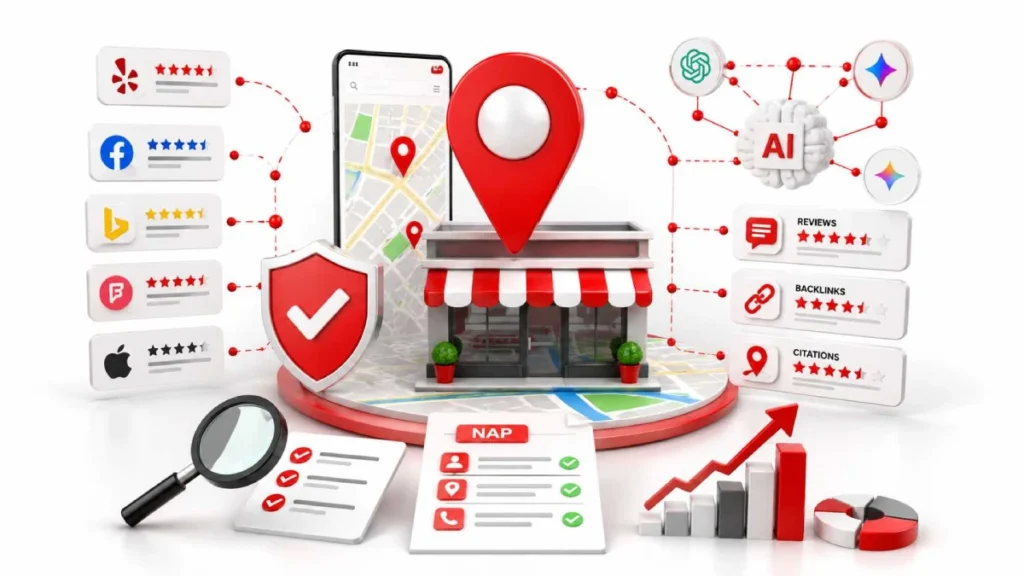
Google Maps citations are online mentions of your business name, address, and phone number (NAP). They appear on websites other than your own. Think of directories like Yelp, Yellow Pages, and Bing Places.
Google cannot visit your shop in person. So it scans the web for your details instead. When your NAP matches across 20, 30, or 40 sites, Google trusts your business more.
Here is a simple example. A bakery lists “Rosa’s Bakery, 12 Main St, 555-0134” on Yelp, Facebook, and TripAdvisor. Each of those three listings counts as one citation. A citation does not need a link to count. The text mention alone sends the signal.
Structured vs. Unstructured Citations
Structured citations are business listings placed in fixed directory fields. Platforms like Google Business Profile, Apple Business Connect, and Yelp use set boxes for your details. This clean format makes your data easy for Google to read.
Unstructured citations are mentions written inside normal text. They appear on local news sites, community blogs, and press releases. For example, a city blog writes, “Rosa’s Bakery on Main Street won our best pastry award.”
Structured citations verify your identity, while unstructured ones build authority. In fact, Whitespark’s survey ranks unstructured citation quality among the top five visibility factors for AI search tools like ChatGPT and Perplexity.
Why Citations Matter for Local SEO
Citations matter because Google uses them to confirm your business is real and located where you claim. When your details match across many sites, Google gains confidence. When they conflict, your visibility drops.
Picture two plumbers in the same city. One shows the same NAP on 30 sites like Yelp, Angi, and BBB. The other has three different phone numbers floating around the web. Google gives the first plumber more credibility, so it appears more often in local search results.
How Citations Help You Rank in the Map Pack
The Map Pack is the block of three local businesses shown under the map in search results. Google fills those spots using relevance, distance, and prominence, and consistent google maps citations feed the prominence signal. Each matching mention on sites like Facebook, Foursquare, and Apple Maps works like a vote for your location. Moreover, BrightLocal studies show the Map Pack captures around 42% of local search clicks, so missing from it means losing customers.
Citations vs. Reviews vs. Backlinks
Citations, reviews, and backlinks each play a different role in local rankings. Reviews on Google, Yelp, and Facebook carry more direct ranking weight, while backlinks from local news sites and chambers of commerce pass authority. Citations hold roughly 6% of local ranking weight, according to Whitespark’s Local Search Ranking Factors survey. However, inconsistent citations act as a negative signal that can cap your rankings, no matter how many reviews you collect.
Do Google Maps Citations Still Matter in 2026?
Yes, google maps citations still matter in 2026, but their job has changed. Their direct ranking weight has dropped, and Whitespark’s survey now places citation signals at roughly 6% of local ranking factors. Today they work as a trust layer, not a ranking lever. Messy citations quietly cap your rankings, even when your reviews look strong.
There is another reason to pay attention. AI search tools like ChatGPT, Gemini, and Perplexity now recommend local businesses to usershttp://Search Engine Land. These tools pull business details from directories like Yelp, Foursquare, and Apple Maps. Consistent citations across those sources make it easier for AI to find and suggest you.
So treat citations as basic hygiene, like keeping your store sign accurate. They will not beat competitors on their own. However, skipping them puts a ceiling on everything else you do.
Before You Build: Get Your Foundation Right
Never build citations before locking your business data in one place. Rushing into directories with unsettled details creates duplicates, typos, and mixed records. Cleaning that mess later costs far more time than preparing first.
Think of it like pouring a foundation before framing a house. Every listing you create will copy from this base. Additionally, other sites scrape and republish your data, so early mistakes spread fast across the web.
Create a NAP Master Document
A NAP master document is one file holding your exact business details. Record your official business name, full address, local phone number, and website URL in one fixed format. Small choices matter, like picking “Suite 200” over “Ste. 200” and using a local number instead of a toll-free line. Every future listing on sites like Yelp, Bing Places, and Facebook copies from this single file.
Optimize Your Google Business Profile First
Your Google Business Profile is the hub every citation points back to. It carries more local ranking weight than any other single factor, so fix it before building anything else. Select the most specific primary category, such as “Italian Restaurant” instead of simply “Restaurant,” and complete every section with your services, hours, and photos.
How to Build Google Maps Citations Step by Step
Build google maps citations in three tiers: core directories first, data aggregators second, niche sites last. This order matters because each tier feeds the next. Skipping ahead creates gaps that cost you rankings later.
Work from your NAP master document at every step. Copy and paste your details, never type them from memory. One wrong digit on a big directory can spread to dozens of smaller sites.
Step 1: Claim the Essential Directories (Top 10–15 Sites)
Start with the highest-authority platforms Google checks most often. Claim Google Business Profile, Apple Business Connect, Bing Places, Yelp, Facebook, Foursquare, BBB, and LinkedIn first. These sites also feed others, for example, Yelp syndicates business data to Apple Maps and Amazon Alexa.
Step 2: Submit to Data Aggregators
Data aggregators are companies that feed business data to hundreds of directories at once. In the US, the big three are Data Axle, Neustar Localeze, and Foursquare. Fixing your data at this source creates listings automatically and stops old, wrong details from coming back.
Step 3: Add Industry and Local Directories
Niche directories bring fewer visitors but far more qualified leads. Lawyers should claim Avvo and FindLaw, doctors Healthgrades and Zocdoc, home services Angi and Thumbtack, restaurants TripAdvisor and OpenTable. Then add local sources like your Chamber of Commerce, neighborhood associations, and city business groups.
Building Citations for Multi-Location and Service-Area Businesses
Each business location needs its own separate citation profile. Give every branch its own Google Business Profile, local phone number, and landing page. Service-area businesses like plumbers and mobile groomers should hide their address, list up to 20 service zones, and enter only city, state, and ZIP on stricter directories.
How to Audit and Fix Your Existing Citations
Auditing citations means finding every listing of your business and matching it against your master document. Citations decay over time. Public edits, scraper sites, and old records slowly pollute your data.
This is why an audit comes before any cleanup. You cannot fix listings you have not found. Plan to repeat this check every 6 to 12 months, since bad data keeps creeping back.
How to Find the Citations You Already Have
Use audit tools plus manual searches to build a full citation list. Tools like BrightLocal, Whitespark, and Moz Local scan the web and flag errors automatically. Then run manual searches to catch what tools miss, like “Business Name” + “Old Phone Number” or “Old Business Name” + “Current ZIP Code.”
Fixing Inconsistent NAP and Duplicate Listings
Fix your worst errors first, then handle formatting issues. Start with wrong phone numbers, old addresses, and misspelled names on big sites like Yelp, Facebook, and BBB. Duplicates need special care, so claim both listings and request a merge, or ask directory support to delete the extra one. Duplicate listings split your ranking power, which hurts your google maps citations across the board.
What to Do After a Move, Rebrand, or Number Change
Update your core platforms first, then push changes through the aggregators. Start with Google Business Profile, Apple Business Connect, and Bing Places on day one. Next, submit new details to Data Axle, Neustar Localeze, and Foursquare, which updates downstream sites over 30 to 90 days. Finally, audit quarterly for the first year, because old data loves to resurface.
Citation Tools and Services: Should You DIY or Pay?

DIY works fine for a single-location business with 15 to 20 core listings. Paid tools make sense when you manage multiple locations or lack the hours. The real question is time versus money.
Building citations by hand costs nothing but takes several afternoons. Meanwhile, paid services finish in days but charge monthly or per listing. Pick based on your budget, location count, and patience.
Free and Paid Tools Compared
Paid citation tools fall into two camps: subscription sync and one-time manual services. Sync platforms like Yext and Semrush Local push updates instantly through APIs, but you rent those listings. Cancel the subscription and your data can revert to old versions. Manual services like Whitespark and BrightLocal work slower, yet you own every listing permanently with full login access.
Why Cheap Bulk Citation Services Hurt More Than Help
Bulk gigs selling “350 citations for $10” usually damage your local SEO. These services blast your details to spammy, unindexed directories that pass no value to your google maps citations. They rarely check for existing listings, so they create duplicates that split your ranking power. Worse, they almost never hand over logins, leaving you locked out when your details change.
Common Citation Mistakes to Avoid
Most citation damage comes from a few repeated mistakes. Avoid these and you stay ahead of most local competitors:
- Stuffing keywords into your business name. Listing “Joe’s Plumbing | Best Plumber London” violates Google’s rules and risks suspension.
- Using call tracking numbers carelessly. Put the tracking number in the primary field and your real number in the secondary field.
- Treating citations as a one-time task. Data decays, so audit every 6 to 12 months.
- Ignoring niche directories. Sites like Avvo, Healthgrades, and Angi signal your industry to Google.
- Leaving duplicate listings alive. They split your ranking power and confuse both Google and customers.
- Paying monthly for free listings. Core directories like Yelp, Bing Places, and Facebook cost nothing to claim.
FAQs
How long until citations improve my rankings?
Citations typically take 1 to 3 months to affect local rankings. Aggregator submissions can take 30 to 90 days to spread across downstream sites.
Are citations free to build?
Yes, most core citations are free to build yourself on directories like Google Business Profile, Yelp, Bing Places, and Facebook. You only pay when you hire a service or use tools to save time.
Why does my competitor show up on Google Maps but I don’t?
Your competitor likely has stronger prominence, built from consistent citations, more reviews, and a complete Google Business Profile. Proximity also plays a role, since Google favors businesses closest to the searcher.
What are Google Maps citations in simple terms?
Google Maps citations are mentions of your business name, address, and phone number on other websites. Google counts them as proof your business is real when ranking local results.
Do Local Citations Still Impact Local SEO in 2026?
Yes, citations still matter, though they now work as a trust layer holding roughly 6% of direct ranking weight. Inconsistent citations can cap your rankings regardless of your other signals.
What happens if my NAP is inconsistent across the web?
Inconsistent NAP reduces Google’s confidence in your data, which lowers your local visibility. Customers may also call wrong numbers or visit old addresses.
Do citations help my business show up in ChatGPT and AI search?
Yes, AI tools like ChatGPT, Gemini, and Perplexity pull business data from directories like Yelp and Apple Maps. Clean, matching listings make it easier for AI to recommend you.
Should I use Yext or build citations manually?
Use Yext for multiple locations and instant automated updates, but know those listings can revert after you cancel. Build manually if you want permanent listings you own.
Can too many citations hurt my rankings?
Citations only hurt when they are duplicated, inconsistent, or placed on spammy directories. A clean profile of 40 quality listings outperforms 500 low-quality ones.
How do I check my existing citations for free?
Search Google using strings like your business name plus your ZIP code or old phone number. Free scan tools from BrightLocal and Moz Local also show your top listings.
Is paying for citation building services worth it?
Paid services are worth it when you manage several locations or your time costs more than the fee. Avoid cheap bulk gigs, which create duplicates and spam listings you cannot control.
Conclusion
Google Maps citations remain a core part of local SEO in 2026, but their job has changed. They act as the trust layer Google and AI search tools use to verify your business. Consistent NAP details across directories like Yelp, Bing Places, and Apple Maps confirm you are real and located where you claim.
The process is simple but ordered. Lock your details in a NAP master document, optimize your Google Business Profile, then build in three tiers: core directories, data aggregators, and niche sites. After that, audit every 6 to 12 months and skip cheap bulk services.
Start today by creating your NAP master document and claiming your Google Business Profile, those two steps alone put you ahead of most local competitors.

23 July 2026
Google Maps SEO: How to Rank Higher on...

23 July 2026