
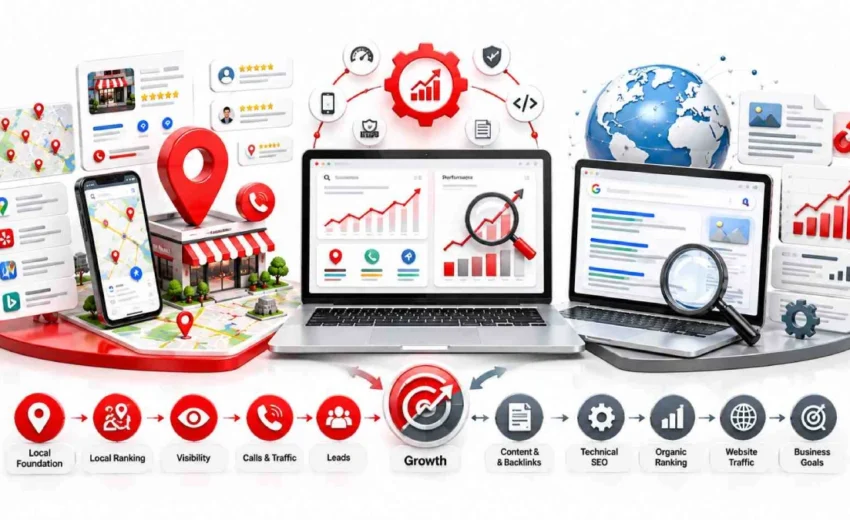
Search your own business name on Google right now. Your website probably shows up. But the map at the top likely lists three competitors instead. That gap is the whole story behind local SEO vs SEO.
Those three are taking the calls. Not because their websites are better than yours. They rank in a completely different system, one your SEO work never touched. Meanwhile, you keep paying for traffic that browses and leaves.
It is not one job done two ways. It is two jobs with separate rules. Below you will see exactly what changes, how each system ranks you, and why local can move in 2 to 8 weeks while traditional takes 6 to 12 months. Then you will know which one to fix first.
Key Points:
- Local SEO and traditional SEO are not competing approaches. Local SEO is a specialized branch of SEO that builds on the same technical foundation.
- Distance decides everything. Traditional SEO reaches anyone anywhere; local SEO reaches people close enough to call or visit.
- Google runs two ranking systems. Blue links reward content and backlinks; the map pack rewards your Google Business Profile, proximity, and reviews.
- Local moves faster and costs less. Fixing your category, hours, or phone number can shift map rankings in 2 to 8 weeks, against 6 to 12 months for traditional.
- The numbers you watch change. Local runs on calls and direction requests; traditional runs on sessions, rankings, and sales.
- Most businesses need both. Start with whichever side brings the money in today.
What Is Traditional SEO?
Traditional SEO is the work that gets your website ranking in normal Google results, no matter where the searcher is sitting. Most people just call it organic SEO. You find the words your buyers type, build pages that answer them properly, keep the site fast and clean, and earn links from other websites so Google starts trusting you.
Distance gives you nothing here. Someone in Multan and someone in Manchester can search “best accounting software” and see almost the same list. That is why it suits online stores, software companies, blogs, and brands that ship nationwide. The catch is who you are up against. Not three shops on your road, but every site in your industry. So a newer site usually waits 6 to 12 months before the numbers move.
What Is Local SEO?
Local SEO helps your business appear when nearby customers search for the products or services you offer. You are not chasing the whole country. You are chasing the people close enough to call you, visit you, or book you today. The work sits on three things: your website, your Google Business Profile, and your reviews.
The results also look different. Local searches often pull up a map with three businesses on top, called the local pack. Below that are the standard blue links, tailored to your local area. So a bakery in Multan competes with other Multan bakeries, not with every bakery in Pakistan. That smaller pool is the whole reason local work moves faster.
The Three Kinds of Local Searches
Local searches come in three types, and each one works differently.
- City named: “dentist in Multan,” “car repair Cantt.” Google uses the named place, not the phone location.
- Nothing named: “barber shop,” “pharmacy.” Google reads location off the phone and shows the closest option.
- Condition added: “best biryani near me,” “clinic open now.” Google checks ratings, hours, and category first.
Most businesses only target the first type. So the other two stay open for competitors.
Local SEO vs SEO: Side-by-Side Comparison
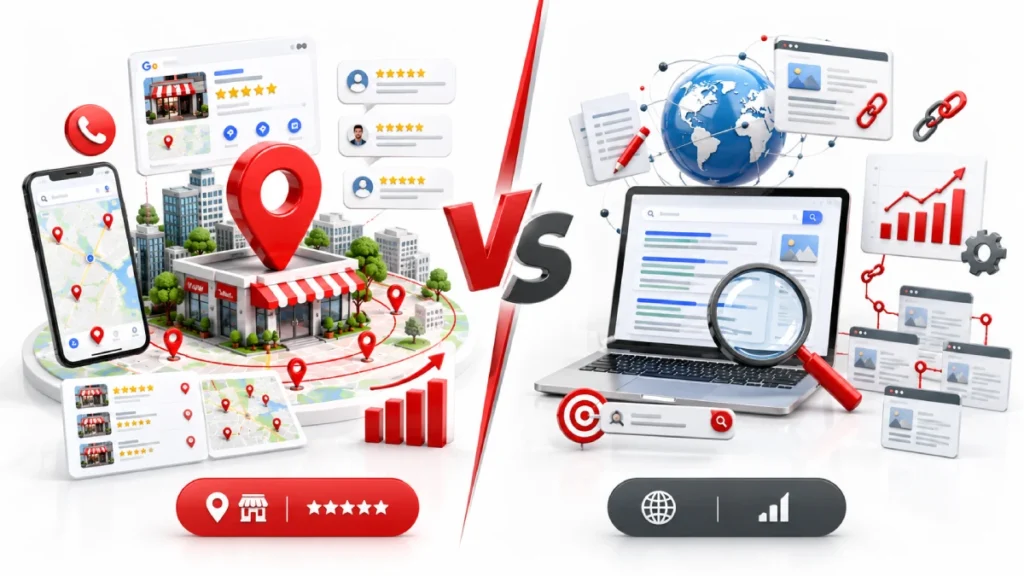
In local SEO vs SEO, one thing decides everything: how close your customer is standing. Change that, and your keywords change, your main asset changes, and the numbers you watch change with them.
| Traditional SEO | Local SEO | |
| Who you reach | Anyone, anywhere | People near you |
| Where you appear | Normal Google results | Google Maps and local pack |
| Main asset | Your website | Google Business Profile |
| Keywords | “buy running shoes” | “shoe shop near me” |
| Competition | Every site in your industry | A few businesses around you |
| What you track | Sessions, rankings | Calls, direction requests |
| Time to results | 6 to 12 months | 2 to 8 weeks |
Two rows deserve a closer look.
Reviews: In normal SEO they mostly build trust with buyers. In local, they lift you inside the map pack. Research puts review signals at close to 20% of what decides map pack position. straightnorth
Speed: Local moves quicker because the fixes are small. Correct your category, clean up an old phone number, fix your hours. Traditional SEO offers no shortcut like that.
Why Local SEO Matters
Local SEO matters because nearby searchers are already close to buying. Someone typing “plumber near me” is not reading up on plumbing. They have a leak and want a number to call now. That intent is why a little local traffic often beats a lot of general traffic.
The competition is smaller too. A clinic in Multan competes with eight or ten clinics nearby, not every clinic in the country. Many of them have wrong hours, no photos, and unanswered reviews. So fixing yours moves you up fast, while skipping it hands those calls to whoever ranks above you.
Where the Work Actually Differs
In local SEO vs SEO, the difference is that local adds three jobs sitting outside your website. Traditional SEO keeps you inside your own site. You write pages, fix speed, chase links. Local pulls you onto Google Maps, into directories you do not own, and into a review inbox you cannot switch off.
Your website still holds everything up. But a fast, well written site with a half filled profile loses the map pack to a plain site with a complete one.
Google Business Profile
Your profile is the strongest lever you control in local search. It feeds Google Maps and the local pack directly, and your website has no say in that. A clinic listed as “Doctor” instead of “Dermatologist” will not show for skin searches, however good the site is.
Citations and NAP Consistency
A citation is any online page that lists your name, address, and phone number. Yelp, Apple Maps, Facebook, and old directory profiles all count.“ Shop 12, Bosan Road” on one site and “Shop No. 12, Bosan Rd” on another can make Google think they are different businesses.
Reviews
Reviews rank you in local search, not only reassure buyers. Whitespark’s Local Search Ranking Factors survey puts review signals at roughly a fifth of map pack position. Ten reviews from this month beat 200 from 2021, so keep them coming and reply to each one.
Keywords, Content, and Links
Local points all three at your area instead of your industry. So “AC repair Multan” replaces “how AC compressors work,” and each city gets its own page with its own text and photos. Duplicate a page and swap the city name, and you have built a doorway page Google ignores.
What Stays the Same in Both
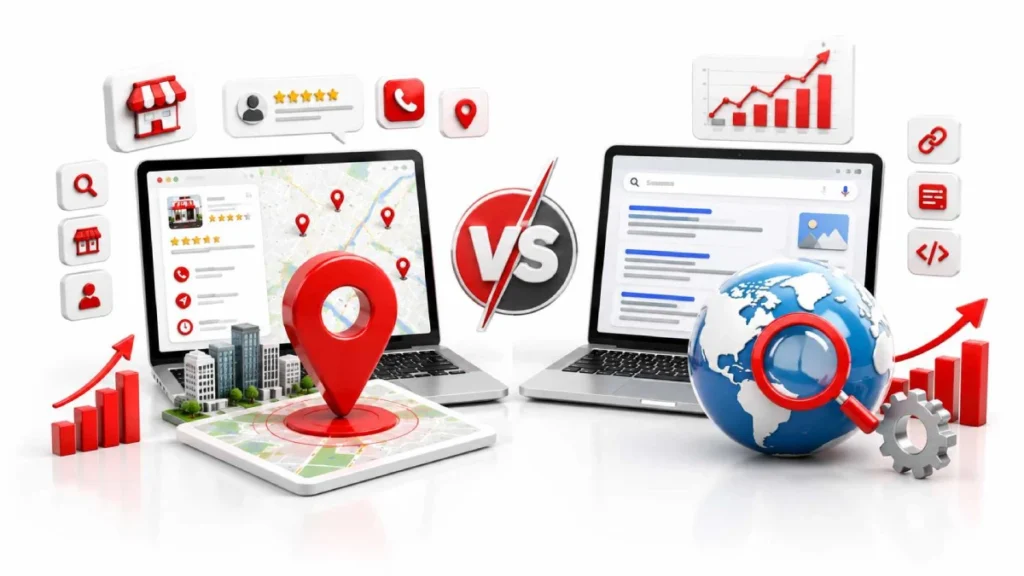
Most of the groundwork is identical, and you only build it once. Site speed, mobile display, clean links, safe HTTPS, and pages Google can crawl. None of that changes because your customer lives two streets away. A slow site loses map rankings the same way it loses normal ones.
Content and intent stay shared too. Both need dedicated pages and schema markup to help Google understand your details. So the real work in local SEO vs SEO is not two separate projects. It is one foundation, with local extras stacked on top.
How Ranking Works in Each
Google runs two separate ranking systems, and each one judges you differently. One decides the blue links. The other decides who lands in the map pack. That is why a business can sit at number one in normal results and still be missing from Maps.
Once you see both systems, the local SEO vs SEO question gets much simpler. You stop guessing why you show up in one place and not the other.
What Decides Traditional Rankings
Content and backlinks do most of the work here. Google checks whether your page answers the question fully, then checks which sites vouch for you. Speed and crawlability set the floor, so a slow page never gets a fair look.
What Decides Local Rankings
Google names three things: relevance, distance, and prominence. Relevance means your profile matches the search, distance means how far you sit from the searcher, and prominence means how trusted you look online. Whitespark’s survey puts profile signals at roughly a third of map pack rankings, with reviews near a fifth.
Which One Does Your Business Need?
Answer one question and you have your answer: where does the sale actually happen? If the customer comes to you, or you drive out to them, you need local. If the whole deal finishes online, traditional SEO carries it.
Most small businesses land somewhere in the middle. A shop with a delivery service, a clinic with an online booking page. In local SEO vs SEO, that usually means doing both, just not equally. Start with whichever side brings the money in today.
If You Have No Public Address
You can still rank locally, but you must hide your address. Google calls you a service area business, and showing a home address or PO Box risks suspension. Adding service areas tells customers where you work, though it will not stretch your rankings into far off towns.
If You Sell Online and Have a Storefront
You run two campaigns on one website. Product pages chase national keywords the normal way. Your store page and profile chase nearby buyers. Keep them apart, because stuffing city names into product pages helps neither side.
If You Have Multiple Locations
Each branch should have a dedicated page and its own business profile. A single “Our Locations” page will not rank for individual cities. So give each branch unique text, real photos, its own phone number, and point that profile straight to its own page.
Which One Does Your Business Need?
Ask yourself one thing: where does the sale finish? If the customer walks into your shop, or you drive to their house, local search brings the work. If the payment happens on a screen and the parcel goes anywhere, traditional SEO does the job.
Plenty of businesses sit on both sides. A furniture store that also ships, a tutor teaching online and at home. In local SEO vs SEO, the honest answer for them is both, just not in equal amounts. Put your first three months into whichever side pays the bills right now.
If You Have No Public Address
Hide your address and you can still rank locally. Google treats you as a service area business, which fits plumbers, electricians, and mobile mechanics. Showing a home address or PO Box invites suspension, so switch it off and list the towns you cover instead.
If You Sell Online and Have a Storefront
Run both, but keep them in separate lanes. Your product pages fight national searches like “office chair price.” Your shop page and profile fight nearby searches like “furniture shop near me.” Mixing city names into product pages just weakens both.
If You Have Multiple Locations
Each branch needs its own page and its own profile. One shared “Our Branches” page rarely ranks for any single city. Write fresh text for each location, add real staff photos, use a local phone number, and link the profile straight there.
Cost, Timeline, and How to Measure Results
Local costs less and moves faster, because the fixes are smaller. Correcting a wrong category or an old phone number takes an afternoon, and your map position can shift in 2 to 8 weeks. Traditional SEO offers no such shortcut. You are writing content and earning links, so expect 6 to 12 months on a newer site.
Measuring them differs too. Local runs on calls, direction requests, and map position, while traditional runs on sessions, rankings, and sales. One catch: normal rank trackers check from a single point, so they miss how far your map visibility actually reaches. Grid tools like Local Falcon or BrightLocal check dozens of spots across your city instead.
How AI Search Is Changing Both
AI answers are taking clicks from informational searches, while local searches hold up better. Someone asking “how do I fix a leaking tap” now reads the answer on screen and never visits a site. But someone who needs a plumber tonight still needs to find a real business and call.
What feeds those answers has changed too. Tools like Google AI Overviews and Perplexity read your review text, not only your star rating. So clear headings, short answers, FAQ blocks, and matching listings across the web make you easier to quote.
FAQs
What is the difference between local SEO and SEO?
Local SEO targets people inside a specific area, while traditional SEO targets anyone searching anywhere. Local runs on your Google Business Profile and reviews, traditional runs on content and backlinks.
What are the four types of SEO?
The four main types are on-page, off-page, technical, and local SEO. Local is the branch that handles geographic searches through your profile, citations, and reviews.
Is Local SEO Worth It for Small Businesses?
Yes, if customers visit you or you travel to them. You compete with eight to fifteen nearby businesses instead of thousands, so basic fixes can lift your map visibility within 2 to 8 weeks.
Do backlinks matter for local SEO?
Backlinks matter, but relevance beats authority here. A link from a local chamber of commerce or city newspaper carries more weight than a high-authority national blog.
How long does local SEO take to work?
Local SEO usually shows movement in 2 to 8 weeks. Fixes like correcting your category or hours work fast because they are data corrections, not authority building.
How much does local SEO cost compared to traditional SEO?
Local SEO costs less because the work is narrower and much of it is manageable in-house. Traditional SEO needs ongoing content and outreach, which usually means paying a writer or agency.
What tools do I need for local SEO?
Google Business Profile, Search Console, and Analytics cover the basics for free. For map rank tracking, grid tools like Local Falcon or BrightLocal check visibility across multiple points in your city.
What happens if my business details are inconsistent across directories?
Inconsistent details weaken Google’s confidence that you are one verified business. Old phone numbers also send paying customers to dead lines.
Conclusion:
It comes down to how close your customer is standing. Traditional SEO puts your website in front of anyone, anywhere, and runs on content, links, and a clean site. Local SEO puts your business in front of people nearby, and runs on your Google Business Profile, listings, and reviews.
The groundwork underneath both is the same, so you build it once. If people call or visit you, local work pays back in 2 to 8 weeks. If the sale finishes online, expect 6 to 12 months. Most businesses need both, so start with whichever brings the money in today.
Open your Google Business Profile now and check your category, hours, and last review date.
8 September 2026
Local SEO for Digital Marketing Agencies

8 September 2026