
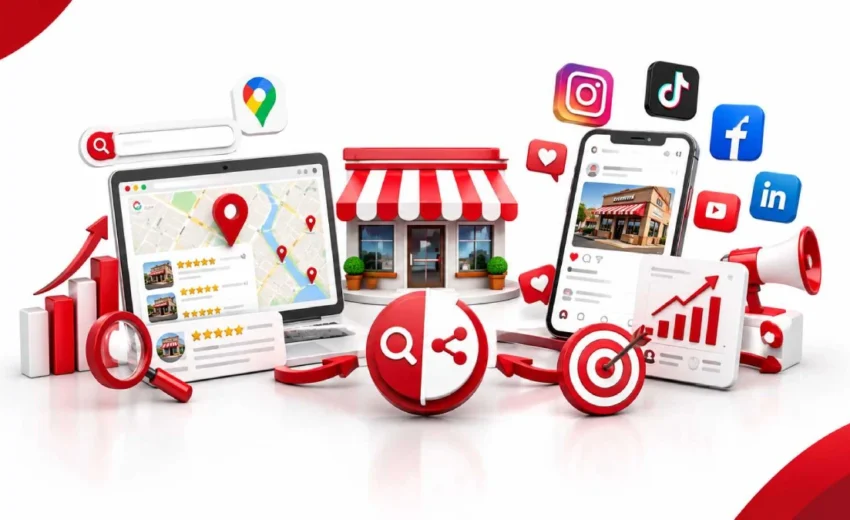
The local seo vs social media debate has a simple starting fact. About half of all Google searches are people looking for something nearby. Yet most small business owners spend their week posting on Instagram instead. The likes come in. The phone stays quiet.
Meanwhile, a competitor down the road sits at the top of Google Maps. They post far less than you. They still get the calls. Every month you guess wrong costs you leads and hours you cannot get back.
This article settles it with numbers, not opinions. You will see what each channel costs, how long each takes to work, and which one suits your type of business. You also get a starting checklist for your first 30 days.
Key Points:
- Local SEO targets people who are already searching with buying intent. Social media reaches people before they start looking.
- Local SEO takes 3 to 6 months for real rankings. Social shows activity in days, but steady leads take 6 to 12 months.
- Agency local SEO runs $300 to $1,500 a month. Social management runs $250 to $1,500, plus ad spend.
- Service businesses like plumbers, clinics, and law firms should start with local SEO. Visual brands should start with social.
- Social media alone does not directly influence Google search rankings. It helps indirectly through branded searches and links.
- Reviews are the only asset that lifts rankings and sales at the same time.
What is Local SEO in Simple Terms?
Local SEO means setting up your online presence so nearby customers can find your business on Google. It runs on three things: your Google Business Profile, your listings on other sites, and website pages that name your service area. When someone types “emergency plumber near me” or “best coffee shop downtown,” those pieces decide whether you appear in the map pack and the results below it.
Google picks who to show based on how close you are, how well you match the search, and how well known you are. The people searching are not browsing. They need a solution right now.
What is Social Media Marketing in Simple Terms?
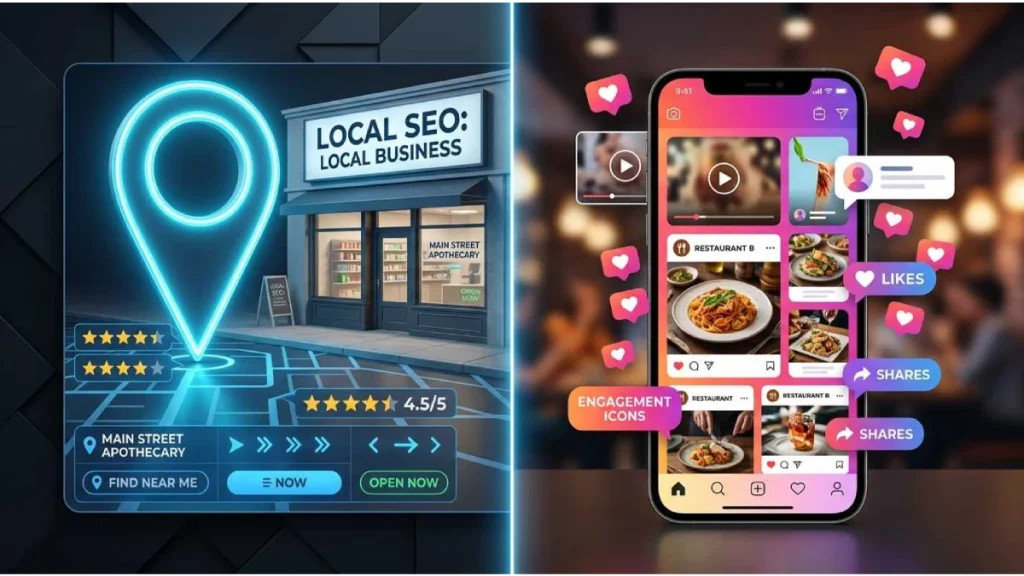
Social media marketing means promoting your business on platforms where people scroll, not search. You build a presence, post content, and reply to people on Instagram, TikTok, Facebook, and LinkedIn. Nobody opens these apps to find a plumber. The algorithm pushes your content into feeds based on what users like and watch. So your posts have to earn attention, not answer a question. Video, faces, and before-and-after shots work best here.
Social does one thing local SEO cannot. Sprout Social reports that 58% of consumers discover new businesses through social platforms. It builds awareness before anyone searches. But there is a catch. Organic reach has dropped hard, and Facebook Pages now reach under 3% of their own followers per post. Posting alone rarely gets seen anymore, so most local businesses pair it with a small ad budget.
Local SEO vs Social Media Marketing: What Should You Focus On
Local SEO wins on buyer intent and staying power. Social media wins on speed and reach. That is the short answer for most small businesses.
Two rows decide most of it. Buyer mindset and lifespan. Someone searching “emergency electrician near me” has already decided to hire. Google reports 76% of local mobile searchers visit a business within 24 hours. A person watching a kitchen reel had no such plan.
Lifespan matters just as much. A ranking page works while you sleep. A post fades in three days. And the cost row covers paid help. Doing it yourself costs 4 to 8 hours a week instead.
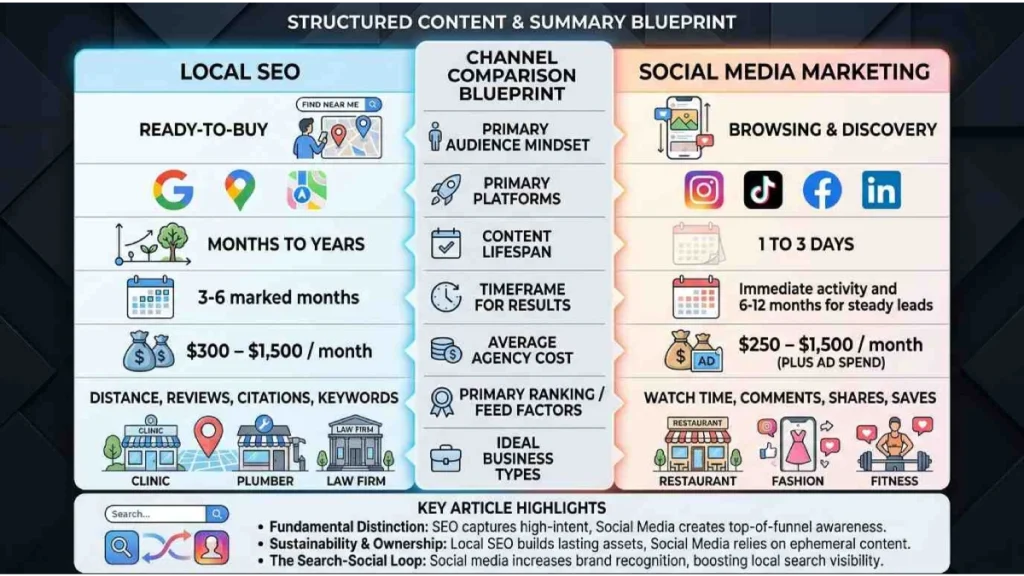
| What to compare | Local SEO | Social Media Marketing |
| Buyer mindset | Ready to act. “I need this now.” | Browsing for ideas or entertainment |
| Where it happens | Google Search, Google Maps, Apple Maps, Yelp | Instagram, TikTok, Facebook, LinkedIn |
| How long content lasts | Months or years once a page ranks | A day or three, then it fades |
| What drives visibility | Distance, reviews, keywords, and business listings | Watch time, shares, comments, and saves |
| Works best for | Shops, home services, clinics, and law firms | Visual brands, restaurants, salons, and B2B services |
How Long Each One Takes to Work
Local SEO takes 3 to 6 months for real ranking movement. Social media shows activity in days but steady leads in 6 to 12 months. Neither one pays off in week two.
Local SEO moves in stages. Fix your Google Business Profile and clean up wrong listings on Yelp, Apple Maps, and Bing Places. Calls and direction taps can rise within 4 to 8 weeks. Ranking in the map pack for competitive terms takes longer, usually 3 to 6 months. Reviews are the slow part, since you need a steady flow, not one big batch.
Social media is the opposite shape. One good reel can bring 5,000 views tomorrow, but views are not customers. Building a following that actually books you takes 6 to 12 months of consistent posting. The trap is quitting at month three, right before either channel starts paying.
What Each One Really Costs
Local SEO runs $300 to $1,500 a month with an agency. Social media management runs $250 to $1,500, plus ad spend on top. Doing either yourself costs 4 to 8 hours a week instead. Neither channel is free. That is the part most owners get wrong when weighing local seo vs social media.
Money, Time, and Skill
Local SEO costs technical attention. Social media costs creative output. The skills barely overlap.
- Local SEO work: matching your name, address, and phone across Google, Yelp, and Apple Maps, adding schema, and chasing reviews. Time-consuming, but it stays done.
- Social media work: filming, editing, writing captions, and replying to comments every single week. It never stays done.
- The hidden cost: Facebook Pages now reach less than 3% of their followers per post, forcing many businesses to spend more to gain visibility.
What Your Budget Actually Buys
With local SEO you buy an asset. With social media you buy attention. That difference matters more than the monthly figure.
- Local SEO budget: site audit, listing cleanup, local backlinks, and a review system. These continue working after you stop paying.
- Social media budget: cameras, editing tools, posting hours, and ads. Stop paying and the reach stops with you.
- If you have $500 a month: put roughly $350 into local SEO first. A claimed Google Business Profile and steady reviews cost least and return fastest.
Which One Fits Your Type of Business
Sell something people search for, and local SEO comes first. Sell something people need to see, and social media comes first.
- Go heavy on local SEO if: you run a service business like plumbing, HVAC, roofing, or law. Same for clinics, restaurants, and shops where location drives the revenue.
- Go heavy on social media if: you ship products nationally, or sell a visual service like interior design, fashion, or fitness coaching.
Most local businesses belong in the first group, even when they feel like the second. Google reports 46% of all searches carry local intent. A quick check: ask your last 10 customers how they found you.
Where to Start If You’re Starting From Zero
Start with local SEO if you serve a specific area. Start with social media if your product sells on looks. Pick one, do it properly, then add the second.Most owners try both at once and do neither well. That is the real mistake in the local seo vs social media debate.
Start With Local SEO If…
You have a shop or a service area, tight cash flow, and you need leads that convert now. Catching someone who searches for your exact service in your city beats trying to sell to a random scroller.
Start With Social Media If…
You sell something customers need to see, not hear about. Think visual work, storytelling, or trend-led contentIt also works when your buyers live across the country and location does not matter.
Your First 30 Days
- If you picked local SEO: claim, verify, and fully complete your Google Business Profile. Add photos, correct hours, and your service list. Then collect your first 5 to 10 reviews from past clients.
- If you picked social media: choose one platform where your buyers already spend time. Write a bio with searchable words. Commit to 3 short videos or useful posts every week.
How Local SEO and Social Media Feed Each Other
Social media builds name recognition, and local SEO turns that recognition into bookings. They work as a loop, not as rivals. Someone sees your name on Instagram, then searches it on Google a week later.
That loop runs on three links. Social builds brand awareness, awareness drives branded searches, and branded searches signal trust to Google. Add content repurposing on top, where one blog post becomes five short videos.
Does Social Media Help Your Google Rankings?
Yes, but indirectly. Likes, shares, and follower counts are not ranking factors. What helps is brand awareness. When people see your name on Instagram or Facebook, they search that name on Google later. Google reads rising branded searches as a sign of trust and authority.
There is a second gain. Your social profiles often rank on page one beside your website, so you take up more space in the results. Strong social content also earns links from local blogs and news sites, and those links do count directly.
Reviews: The One Thing That Powers Both
Reviews are the one asset that can boost both your rankings and sales. Nothing else in the local seo vs social media debate does both jobs.
- In local SEO, a steady flow of Google reviews is one of the strongest signals for the map pack. Google weighs the count, the rating, the freshness, and whether you reply.
- On social media, screenshots of reviews and short video testimonials work as proof. They stop the scroll, cut doubt, and lift ad conversion rates.
Two factors matter more than your total count. Steady flow beats a big batch, so 3 reviews a month works better than 30 in one week. And replies count, since Google confirms that responding to reviews supports local ranking.
The easiest system is simple. Ask every happy customer within 24 hours of the job, send a direct Google review link by text, and reply to each review inside two days.
How to Tell Which Channel Is Working
Track actions that lead to money, not likes or impressions.
- For local SEO, track: Google Business Profile insights like calls, direction requests, and website clicks. Add rankings for core local keywords and form fills from your location pages.
- For social media, track: engagement rate, profile visits, click-through rate to your site, and promo code redemptions.
- Set up call tracking: most local leads arrive by phone and never show in analytics.
- Tag social links with UTM parameters: this lets Google Analytics separate that traffic cleanly.
Attribution still won’t be perfect. Someone finds you on Instagram, Googles your name weeks later, and search takes the credit. So keep asking new customers how they heard about you.
Mistakes That Waste Time and Money
- Spreading yourself too thin: posting daily on Instagram, Facebook, TikTok, and LinkedIn while your Google Business Profile sits half empty.
- Treating reviews as an afterthought: waiting for them to arrive instead of asking every happy customer.
- Chasing the wrong numbers: tracking likes and impressions when calls, walk-ins, and booked jobs are what actually bring in revenue.
- Sending traffic to a slow website: people tap your map listing or ad, wait five seconds, then leave for a competitor.
What’s Changing in 2026: AI Search and New Habits
Fewer people click through to websites, and more of them search inside apps. Google’s AI Overviews now answer many questions on the page itself, so searches end without a click. Younger buyers open TikTok and Instagram to find cafés, salons, and gyms. Short video also pulls more reach than static posts, while voice search stays heavily “near me.”
None of this kills local SEO. It only changes where you get seen. AI tools build their local answers from Google Business Profiles, reviews, and listings on Yelp and Apple Maps. So fill your profile properly, keep reviews coming, and answer real customer questions on your site. That is what gets a business named inside an AI answer.
FAQs
Which is better, local SEO or social media marketing?
Local SEO is better for capturing customers ready to buy, while social media is better for building awareness. Local SEO reaches people actively searching for your service, and social media reaches people before they start looking.
When should you use local SEO?
Use local SEO when your customers live nearby and search for what you sell. It covers businesses like plumbers, dentists, restaurants, law firms, salons, and other location-dependent services.
Do I need a website if I already have a Facebook page?
Yes, a website is still necessary even with an active Facebook page. You control your website as an asset, while platforms can restrict or remove your social profile.
How many social media platforms should a small business use?
One platform is enough for most small businesses starting out. Choose where your customers already spend time, post three times a week, and add a second platform only after the first performs.
Are Google reviews more important than social media followers?
Google reviews matter more than follower counts for local businesses. Reviews influence map pack rankings and purchase decisions, while follower counts affect neither search visibility nor revenue.
How much should a small business spend on local SEO and social media?
Agency-managed local SEO typically costs $300–$1,500 per month, while social media management ranges from $250–$1,500, excluding ad spend. On a $500 budget, put roughly 70 percent into local SEO first.
Will AI search replace local SEO?
AI search will not replace local SEO, but it shifts where visibility happens. AI tools build local answers from Google Business Profiles, reviews, and listings on Yelp and Apple Maps.
Conclusion:
Local SEO catches people already searching and ready to book. Social media reaches people who have not thought about you yet. If you serve a specific area, local SEO deserves your first move. It costs technical work instead of daily content, and the results keep working after you stop paying.Expect noticeable progress within 3 to 6 months.
Social media earns its place when your product sells on looks or you need awareness fast. Plan for steady posting and a small ad budget, since organic reach alone rarely gets seen now. The strongest setup uses both in order: build the search foundation first, then add one platform your customers actually use.
Start this week by claiming your Google Business Profile and asking your last five happy customers for a review.
10 September 2026
Local SEO vs PPC: Which is Better for...
10 September 2026