


Most small businesses buy local SEO services without knowing what they are paying for. About 46% of Google searches show local intent. Still, your competitors sit in the map results while you stay invisible. You claimed your listing, added photos, and asked for reviews.
So you start calling agencies. One quotes $300 a month. Another quotes $2,000. Neither explains what you get for it. Meanwhile every week you wait, those competitors collect the calls that should be yours. Six months from now, they will be even harder to catch.
This guide fixes that confusion. You will learn exactly what these services include and exclude, what they cost, and how long results take. You will also get the red flags to avoid, and a 20-minute check on your current provider.
Key Points:
- Local SEO services cover six core jobs: Google Business Profile, citations, reviews, local keywords, local links, and location pages.
- They exclude paid ads, website rebuilds, branding, and social media posting.
- Most single-location businesses pay $500 to $1,500 a month, while competitive cities run higher.
- Expect setup in month 1, ranking movement by months 3 to 4, and steady calls between months 5 and 7.
- Judge results by calls, direction taps, and form fills, not by rankings you check from your own desk.
- Walk away from guarantees, “secret methods,” or any provider who keeps your accounts in their name.
What Local SEO Services Are
Local SEO services are marketing services that help your business show up when nearby customers search for what you sell. They work on three things at once: your Google Business Profile, your website, and your listings on sites like Yelp, Apple Maps, and Bing Places. Think of someone searching “dentist near me” at 9pm. Google shows a map with three businesses on top. Getting your business into that map is the job.
Google picks those results using three signals. Relevance means you match the search. Distance means how close you sit to the searcher. Prominence means how trusted you look online. The intent is strong, too. A Google and Ipsos study found 76% of people who search “near me” on a phone visit a business within a day.
Local SEO vs. Regular SEO
Regular SEO tries to rank you everywhere. Local SEO tries to rank you where your customers actually are. The biggest split is the main asset: regular SEO leans on your website, while local SEO leans on your Google Business Profile. The goals differ too, since national campaigns chase form fills and online orders, but local campaigns chase phone calls, direction taps, and walk-ins for trades like plumbing, roofing, and pest control.
| Regular SEO | Local SEO | |
| Main goal | Rank nationally for broad terms | Win nearby buyers ready to call or visit |
| Who you reach | Anyone, anywhere | People within a set radius, often 5 to 25 miles |
| Top ranking factors | Backlinks, site structure, content depth | GBP category, distance, reviews, matching business details |
| What counts as a win | Form fills, downloads, online sales | Calls, direction requests, bookings, store visits |
| Core asset | Your website | Your Google Business Profile, plus location pages |
One practical note. These two are not rivals. Google checks your website before it trusts your listing, so most local businesses need both.
What’s Included in Local SEO Services
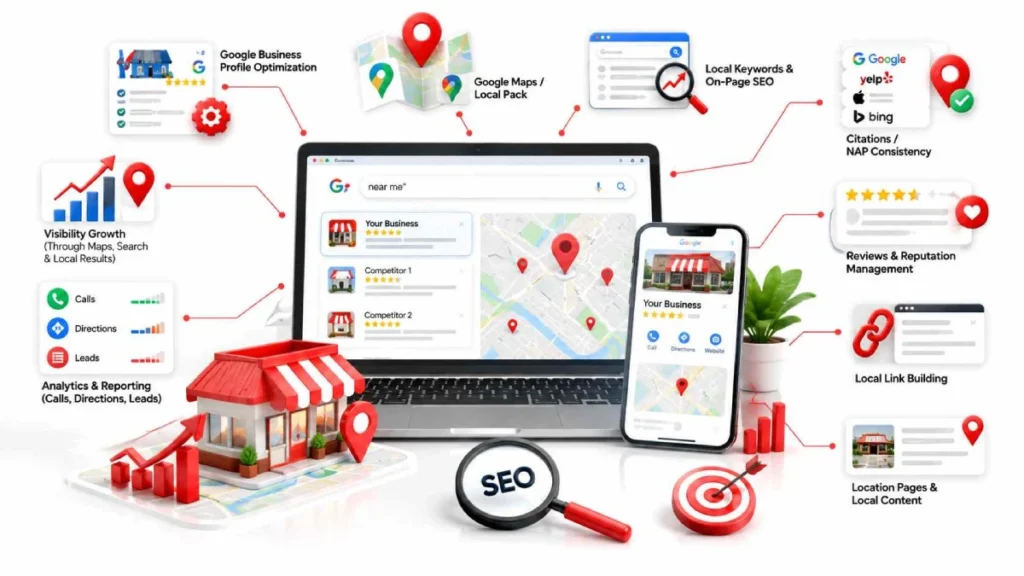
Most local SEO services include six core tasks: Google Business Profile work, citation cleanup, review management, local keyword and on-page work, local link building, and location content. Some providers add a monthly audit and reporting on top. The names change from one agency to another, but the work behind them stays the same.
Here is the useful part. Each task feeds a different Google signal. Your profile and reviews build prominence, your citations confirm your location, and your pages and links prove relevance. Ask a provider which signal a task supports, and you will quickly learn how well they understand the job.
Google Business Profile Optimization
This is the single biggest lever in local SEO, so it gets the most attention. Your provider claims and verifies the profile, then fills in every field: categories, hours, service areas, and attributes like wheelchair access or free parking. Google reports that a complete profile earns 7 times more clicks than an empty one. The primary category matters most, since a “pizza restaurant” and an “Italian restaurant” rank for different searches even on the same street.
Citations and NAP Consistency
A citation is any mention of your name, address, and phone number on another website. Your provider builds these on platforms like Yelp, Apple Maps, Bing Places, and MapQuest, plus niche ones like Avvo for lawyers or Angi for contractors. Cleanup usually matters more than building new ones. Old addresses, dead phone numbers, and duplicate listings confuse Google about which business is real.
Reviews and Reputation Management
Your provider sets up a system that asks customers for reviews, then monitors and replies to what comes in. That usually means automated SMS or email requests tied to your booking system or point of sale. Replies should go out within 48 hours, positive and negative alike. BrightLocal’s Local Consumer Review Survey has consistently found that most buyers skip businesses rated under 4 stars, and freshness counts too.
Local Keyword Research and On-Page Optimization
This is the website side of the work: finding local search terms, then placing them correctly. Your provider targets buying searches like “emergency plumber Austin” instead of general ones like “how to fix a pipe.” Those terms then go into your titles, headings, meta descriptions, and page copy. Local schema markup usually sits here too, since it tells Google your address, hours, and coordinates in code it reads easily.
Local Link Building
Local link building earns links from websites tied to your city or your industry. Common sources include chambers of commerce, local charities you sponsor, neighborhood blogs, and regional news sites. A link from your town’s newspaper does more for local rankings than a random national blog. Expect two or three good links a month, because anyone promising 50 is running automated software.
Local Content and Location Pages
Location pages target each area you serve, while local content targets people in those areas. Each page needs its own text, testimonials, photos, and contact details. Copy the same page 20 times with the city name swapped, and Google treats it as thin content. Meanwhile, useful local topics include area guides, permit rules, and project case studies with real photos.
What’s Not Included in Local SEO Services
Local SEO services do not usually include paid ads, website redesigns, branding, social media posting, or customer service. Those are separate jobs with separate budgets. Most agencies assume you already know this, so it rarely shows up in the proposal.
That gap causes most client complaints. An owner pays $900 a month, then wonders why nobody rebuilt the website. Ask what sits outside the scope before you sign.
- Paid advertising, like Google Ads, Facebook Ads, and Local Services Ads. These need ad spend on top of your fee.
- Full website redesigns. Your provider updates titles, schema, and location pages. Rebuilding the site is a development project.
- Branding and design, like logos, business cards, and vehicle wraps.
- Daily social media posting on Instagram, Facebook, and TikTok.
- Customer service. Your agency flags a bad review, but will not handle the refund behind it.
Local Services Ads confuse people the most. That is Google’s pay-per-lead product with the green checkmark, sitting above the map results. It runs on its own budget, so it is not organic local SEO. Trades like plumbing, HVAC, and locksmiths often run both, which works fine if you budget separately.
A few items sit in a grey zone and usually cost extra. Call tracking software like CallRail runs $45 to $150 a month. Listing tools add $10 to $30 per location, and review platforms add $50 to $200. Agencies usually charge extra for additional location pages and profile photography.
One last check. Ask whether these tool costs sit inside your retainer or arrive as a separate invoice. A $700 package with $200 in tools attached is really a $900 package.
How the Package Changes for Your Business
Your package changes based on two things: whether customers come to you or you go to them, and what industry you sell in. A dental clinic and a mobile locksmith need different work, even in the same city. Any provider selling one fixed package to both is not paying attention.
Google treats these business types differently, so the tactics split early at profile setup. Ask a provider how they handle your model before you compare prices.
Storefront vs. Service-Area Business
A storefront shows its address publicly, while a service-area business hides it and sets a travel radius instead. Storefronts like restaurants, dental clinics, and auto repair shops rank strongest near their pin, so photos and driving directions matter most. Service businesses like plumbers, electricians, and cleaners must hide the address under Google’s rules, then target ZIP codes or a radius of 10 to 25 miles. Consequently, they need separate pages for each town they serve.
What Changes by Industry
Industry changes your review approach, your directories, and how fast you must answer a lead. Home services like plumbing, HVAC, and roofing live on speed, since a missed call at 8pm goes to the next result. Medical and dental practices face HIPAA limits on review replies, while law firms lean on directories like Avvo and Justia plus suburb pages. Restaurants depend on fresh photos and review volume more than links.
One number worth knowing. Google has reported that around 46% of all searches carry local intent. Your industry does not change that demand, it only changes how you compete for it.
What to Expect: A Month-by-Month Timeline
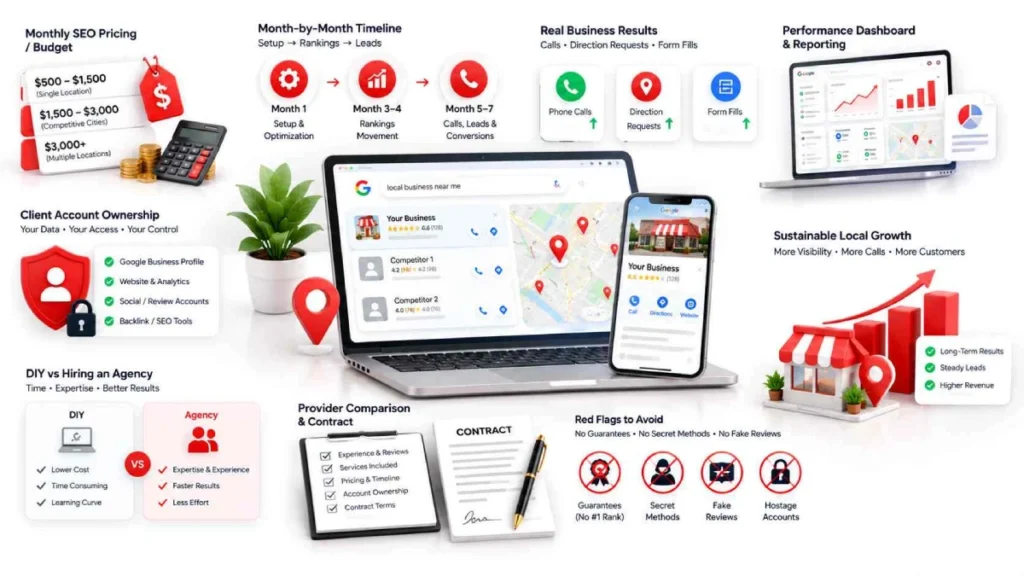
Expect setup in month 1, early ranking movement around months 3 to 4, and steady lead flow between months 5 and 7. Nothing meaningful happens in the first 30 days, and that is normal. Google takes time to recognize and trust these changes.
Two clocks run at once, which trips people up. Rankings and map impressions move first. Calls and form fills follow later.
1. Month 1: Audit and setup
- Local audit, competitor check, and baseline rankings recorded
- Google Business Profile, Apple Maps, and Bing Places claimed and fixed
- Tracking installed, usually Google Analytics 4 and a call tracking number
2. Months 2 to 3: Cleanup and pages
- Citation fixes across Yelp, MapQuest, and the data aggregators
- Review requests sent to past customers
- Titles, meta descriptions, and service pages rewritten around local terms
3. Months 4 to 5: Authority and content
- Link outreach to chambers of commerce, sponsors, and neighborhood blogs
- Location pages and local articles published
- Map impressions rise, and a few keywords enter the top 10
4. Month 6 and beyond: Results and scale
- Map Pack positions settle for your main terms
- Calls, direction taps, and form fills climb
- Expansion into nearby suburbs and longer service terms
Several things stretch this timeline. A new domain, heavy competition in cities like Houston or Miami, messy citations built over 10 years, a past profile suspension, or slow review collection on your side.
One honest note. Published estimates vary. Some agencies report traction near 90 days, others say revenue turns predictable around months 5 to 7. Consequently, treat any promise of fast results as a warning sign.
How Results Are Measured
Results are measured by calls, direction requests, form fills, and map visibility, not by keyword rankings alone. Rankings show the work is moving, but leads show it is paying. Here is the part most owners miss. Your rankings look different depending on where you stand. Search from your own shop and you may sit at number one. Drive 3 miles away and you might vanish.
That is proximity bias, and it fools people constantly. Agencies handle it with grid tracking tools like Local Falcon or BrightLocal, which check your rank from dozens of map points and show it as a heat map. Green means you rank there, red means you do not, and your real goal is watching the green area widen.
Track these each month:
- Grid rankings. Are you visible across more of your area than last month?
- Profile actions. Calls, direction taps, and website clicks inside your dashboard.
- Tracked calls. A separate number through CallRail shows which calls came from local search.
- Form fills and bookings. Tracked in Google Analytics 4 or your CRM.
- Review growth. New reviews per month and your average rating.
One warning. Impressions rise easily and prove very little. If your report shows growing impressions but flat calls, ask your provider why.
What You Need to Do (Your Side of the Work)
You need to hand over account access, supply real photos, ask customers for reviews, and answer leads quickly. Local SEO services are not fully hands-off. Your provider runs the strategy, but there are only a few jobs only you can do.
Skip these and results slow down, no matter how good the agency is. A campaign with no new reviews and no fresh photos stalls by month 3.
- Give access, keep ownership. Admin rights to your profile, Analytics, and website, all in your name.
- Send real photos. Your team, your shop, your trucks, your finished jobs.
- Ask for reviews. Train staff to ask on the spot, using a QR code or text link.
- The report changes fast. New number, new hours, new address, new services.
- Answer your leads. A missed call at 6pm becomes someone else’s job.
- Complete Google verification. Postcards, phone codes, and video checks need you on site.
The review part matters most. Google weighs review count and freshness, and buyers read them before calling. Consequently, 4 or 5 new reviews a month beats 30 collected once in 2023.
One simple habit helps. Block 15 minutes each week to check your profile, reply to a review, and send new photos.
What Local SEO Services Cost
Most local SEO services cost between $500 and $1,500 a month for a single location. Low-competition markets start near $200, while competitive cities and multi-location brands run $1,500 to $3,500 or more. Price depends on four things: your competition, your city size, your number of locations, and how much content the plan includes. Published ranges vary too, since some agencies quote $300 to $2,000 while others start professional work near $1,600.
Watch the low end carefully. Anything under $150 a month for “full service” usually relies on automated software or provides little to no actual service. Consequently, ask two questions before you sign. Is this month to month, and do you keep your Google Business Profile, website, and Analytics if you leave?
How to Choose a Local SEO Provider
Pick a provider who shows real client results, explains their plan in plain words, and lets you keep your own accounts. Price matters less than clarity. A cheap package you cannot understand is not a bargain.
Talk to 2 or 3 providers before deciding. Ask each one the same questions, then compare the answers.
Questions to Ask Before You Sign
Ask about proof, methods, ownership, and reporting. Request grid tracking case studies from clients in a similar industry and city size, then ask how they earn local links with real examples. Confirm you keep your Google Business Profile, Analytics, and website if you leave. Finally, ask what the monthly report shows, since a good answer names calls and form fills, not impressions.
Red Flags to Walk Away From
Walk away from guarantees, secrets, hostage accounts, and prices under $150 a month. Nobody controls Google, so no one can guarantee a number-one ranking in 30 days. “Secret methods” usually means private blog networks or fake reviews, and both can get your profile suspended. Volume offers like 500 citations a month are another warning sign, because nobody audited what you already have.
Already Paying an Agency? How to Check If It’s Working
Run a 4-step check yourself, in about 20 minutes. Open your last report and see whether it shows calls and form fills or only impressions. Then log into your Google Business Profile and check for posts, photos, or answered questions in the past 30 days. Finally, run a citation tool like BrightLocal or Whitespark, and request a grid map to see if your green area has widened.
Should You Hire Someone or Do It Yourself?
Do it yourself if you run one location in a quiet market and can give it 5 hours a week. Hire someone if you compete in a busy city, run 2 or more locations, or your own time is worth more than the fee. You can handle plenty alone, since claiming your Google Business Profile, adding photos, asking for reviews, and fixing wrong listings all cost nothing but time. The harder parts are schema code, link outreach, and grid tracking.
A middle path suits many owners. Pay for a one-time audit and setup, usually $500 to $2,500, then run the monthly upkeep yourself. Consequently, you get the technical work done right without a long retainer. One honest warning though. Half-done local SEO services rarely work, so a profile you claimed in January and forgot by March will not rank.
Is Local SEO Still Worth It in 2026?
Yes, for most local businesses it remains one of the cheapest ways to get customers. People still search before they call, and map results still sit above everything else. What changed is where those results appear. AI tools like Google AI Overviews, ChatGPT, and Gemini now recommend businesses directly, pulling from your profile, reviews, and directory listings. Consequently, clean and current data matters more than it did in 2023.
Here is the honest side. Local SEO services are not worth it for everyone. Skip them if you sell nationally online, if referrals fill your calendar, or if you cannot commit for 6 months. For everyone else the math stays simple, since one extra customer a month usually covers the fee. Meanwhile, the profile and reviews you build stay yours, even if you pause the work.
FAQs
Why isn’t my business showing up on Google Maps?
Your listing is either unverified, suspended, or ranking too low for the search you tested. Distance also matters, so you may appear near your address but disappear across town.
Do you need a physical address to rank in local search?
No, but you need a verified address Google can confirm, even if you hide it publicly. Service-area businesses like plumbers and cleaners must hide the address and set a service radius instead.
How Many Google Reviews Do You Really Need?
Match or slightly beat the review count of the businesses ranking above you in the map results. Steady growth of 4 to 5 new reviews a month matters more than a large one-time total.
Can a competitor damage my rankings?
Competitors cannot harm your profile directly, but anyone can suggest false edits to your hours, address, or category. Check your profile monthly and reject incorrect edits quickly.
What Happens When You Stop Paying for Local SEO?
Your rankings hold for a few months, then decline as competitors keep working. Your profile, reviews, and published pages stay yours, but visibility usually drops within 3 to 6 months.
Can I do local SEO for free?
Yes, the core tasks cost nothing but time, including claiming your profile, adding photos, and requesting reviews. Paid help becomes worthwhile for schema markup, link outreach, and grid tracking.
What tools do I need to track local SEO results?
Google Business Profile Insights, Google Analytics 4, and Search Console cover the basics for free. Grid tools like Local Falcon or BrightLocal show map rankings, while CallRail tracks phone leads.
Conclusion :
Local SEO services cover six core jobs: your Google Business Profile, citations, reviews, local keyword and on-page work, local links, and location pages. They do not cover paid ads, website rebuilds, branding, or social media, so check the scope before you sign. Expect setup in month 1, ranking movement around months 3 to 4, and steady calls between months 5 and 7. Most single-location businesses pay $500 to $1,500 a month.
Judge the work by calls, direction taps, and form fills, not by rankings you check from your own desk. Your part still matters too, since a provider cannot fix a phone nobody picks up. Hand over access while keeping ownership, send real photos, and keep the reviews coming.
Start this week: claim your Google Business Profile, fill in every field, and ask 3 recent customers for a review.

29 September 2026
Best Local SEO Courses Online (Free and Paid)

29 September 2026