


AI SEO means two things at once. It covers using AI tools like ChatGPT and Semrush to do your SEO work faster. It also covers structuring your site so AI answers cite it. The second meaning matters most right now, because Google answers questions on the results page itself. SparkToro found 58.5% of US searches end without a click.
To get cited, answer questions early, add real numbers, name your sources, and earn mentions on trusted third-party sites. Basic SEO still decides everything, since AI tools cannot cite pages Google cannot crawl.
This guide covers both meanings of what is AI SEO, since people confuse them constantly. You will learn how AI Overviews, AI Mode, and ChatGPT choose sources. You will also learn the exact steps to earn citations and a simple way to track your results.
Key Points:
- AI SEO means two things: using AI tools to do SEO work, and optimising your site so AI answers cite it.
- AI Overviews and AI Mode pick sources differently, and Moz found 88% of AI Mode citations sit outside the top 10.
- Direct answers, real numbers, and named sources lifted AI visibility by up to 40% in the Princeton study.
- Third-party mentions matter most, since ChatGPT and Perplexity cite the same domains only around 11% of the time.
- Basic SEO still decides everything, because AI tools cannot cite pages Google cannot crawl.
What Is AI SEO?
AI SEO means two things at once. It covers using AI tools to do your SEO work, like keyword research, drafting, and site audits. It also covers optimising your site so AI tools such as ChatGPT, Google AI Overviews, and Perplexity mention it in their answers.
Both meanings are in daily use, which is where most of the confusion starts. One saves you hours each week. The other decides whether an AI answer names your business or a competitor’s. Small business owners usually arrive wanting the first. They stay for the second, because that is where the traffic went.
The Two Meanings of AI SEO
Word order tells you which meaning someone intends. “AI for SEO” means using tools like ChatGPT, Semrush, or Screaming Frog to speed up your own work, while “SEO for AI” means structuring your site so AI answers cite it. A study from Princeton, Georgia Tech, and the Allen Institute for AI tested 10,000 queries and found that adding statistics and clear source citations lifted visibility inside AI answers by up to 40%.
AI SEO, GEO, AEO, LLMO: What Should You Call It?
There is no agreed name yet, and GEO is the closest thing to a standard in 2026. GEO means getting cited inside AI answers, AEO covers direct answer slots, and LLMO covers how models describe your brand. Watch out for one trap: many people still read GEO as geographic SEO, so check which one they mean before agreeing to buy it.
How Google Search Has Changed
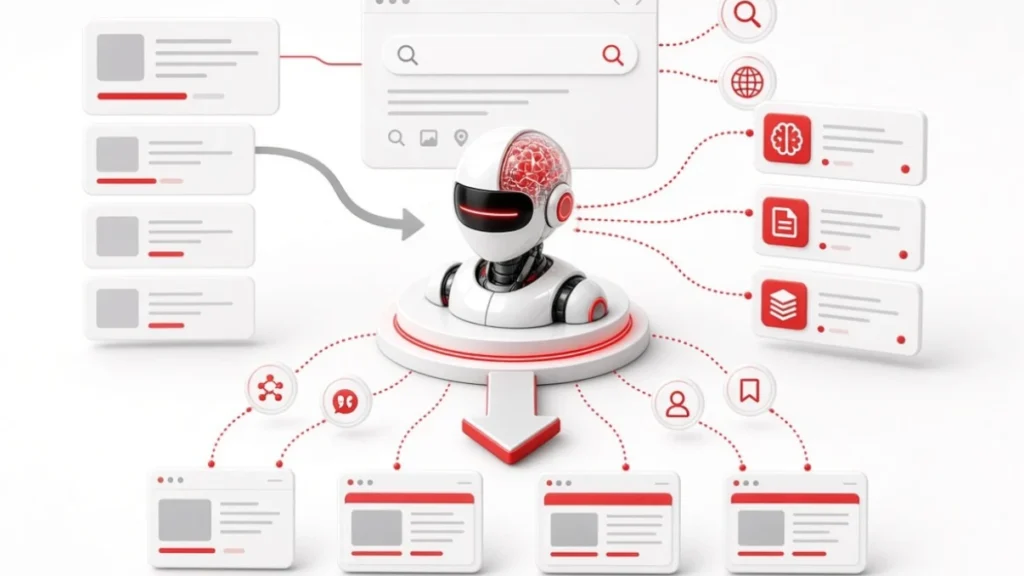
Google now answers questions on the results page instead of just listing links. An AI layer sits between your search and the websites below it. The ten blue links are still there, but they start further down the page.
This changes the goal of SEO.A top ranking no longer guarantees a click. AI platforms often value naming your brand in the answer more than its position below.
AI Overviews and AI Mode
These are two separate Google features, and they pick sources differently. AI Overviews appear automatically above normal results and pull mostly from top-ranking pages, while AI Mode is a conversational tab built for longer questions. Moz found that 88% of URLs cited in AI Mode do not appear in the top 10 organic results, so ranking well in one does not mean ranking well in the other.
What Zero Click Search Means for Your Traffic
More people now get their answer without clicking any website. SparkToro measured 58.5% of US Google searches ending with no click, and that rate climbs higher when an AI Overview appears. Informational pages like guides and how-to posts lose clicks first, while branded, local, and buying pages hold up better.
What Hasn’t Changed
AI answers still come from the normal web index, so basic SEO still decides whether you qualify. If Google cannot crawl or render your pages, no AI tool can cite them either. Clean site structure, fast loading, and Google’s E-E-A-T signals all feed the same system, so AI SEO builds on those basics rather than replacing them.
How to Get Your Website Featured in AI Answers
Answer the question early, support it with facts, and earn mentions on trusted sites. AI tools pick sources that are easy to extract and easy to verify. Keyword placement matters far less than it used to.
The Princeton, Georgia Tech, and Allen Institute study tested 10,000 queries across several AI engines. Adding statistics and named source citations gave the biggest visibility lift, up to 40%. Here’s how this works in practice.
Answer in the first 30% of the page. Put a clear 40 to 60 word answer under your heading, before the background detail.
- Add real numbers. Prices, dates, percentages, and study results give AI systems something concrete to quote.
- Cite your sources by name. Link to studies, official guidance, or industry data instead of making unsupported claims.
- Use clean structure. Proper H2 and H3 headings, short paragraphs, bullet lists, and tables are easier for models to read.
- Add schema markup. Article, FAQPage, Product, and LocalBusiness schema help systems understand what your page covers.
- Keep your business details consistent. Your name, address, and services should match across your site, Google Business Profile, and directories.
- Earn third-party mentions. Reviews, local news, industry blogs, and comparison sites carry more weight than your own claims.
The last point matters more than most people expect. Different AI tools cite different sources for the same question. ChatGPT and Perplexity overlap on only around 11% of cited domains. Your own website alone will rarely be enough.
Do You Need an llms.txt File?
Probably not urgently, and it is not a ranking factor. llms.txt is a plain text file at your root domain that lists your key pages for AI systems, proposed by Jeremy Howard of Answer.AI in September 2024. Google confirmed that it does not use the file, so make sure your robots.txt does not block GPTBot, ClaudeBot, or PerplexityBot.
How to Use AI in Your Own SEO Work
Use AI for the slow, repetitive parts, and keep the thinking for yourself. Tools like ChatGPT, Claude, Semrush, and Screaming Frog handle grouping, sorting, and first drafts well. They handle judgement and original insight badly.
Most small business owners start here, and it is a sensible entry point. The time saved is real. The risk is publishing work nobody checked.
Where AI genuinely helps:
- Keyword grouping. Paste 200 keywords and get them sorted into topics in seconds.
- Content briefs. Turn a topic into a list of questions your page should answer.
- Competitor gaps. Compare your page against three competitors and list what you missed.
- Technical checks. Spot broken links, missing meta descriptions, and slow pages across a large site.
- Internal links. Find related pages you should be linking together.
Where AI falls short:
- Original data, customer stories, and first-hand experience
- Accurate facts, since models still invent numbers and sources
- Your brand voice, which usually needs a human edit
One rule keeps you safe. Google does not penalise content just for being AI-written. It penalises unhelpful content, whoever wrote it. So treat every AI draft as a starting point, then add what only you know.
That last part is what earns citations anyway. The Princeton study found that original statistics and named sources lifted AI visibility by up to 40%. A model cannot supply those. You can.
How to Check If You’re Showing Up in AI Answers

Ask the AI tools directly, then check your analytics for referral traffic.There’s no single dashboard available for this yet. Manual testing is still the most reliable method for a small business.
Start with ten questions your customers actually ask. Type each one into ChatGPT, Google AI Mode, Perplexity, and Gemini. Track whether AI platforms name or link to your business. Repeat monthly, because answers shift over time.
What to track:
| What to check | How to check it |
| Are you mentioned in AI answers? | Run your 10 test questions across 3 or 4 AI tools |
| Is AI sending you visitors? | In GA4, filter referrals for chatgpt.com, perplexity.ai, gemini.google.com, and claude.ai |
| Are you losing clicks, not rankings? | In Search Console, compare impressions against clicks on informational pages |
| Are people searching your brand more? | Track branded search volume in Search Console over 3 to 6 months |
Two things to know before you start. Google Search Console does not report AI Overview visibility separately. So you cannot see those citations in your own data yet.
Also test more than one tool. ChatGPT and Perplexity cite the same domains only around 11% of the time. Appearing in one says little about the others.
Is SEO Dead? What Comes Next
No, but the scoreboard has changed. SEO isn’t dying; it’s evolving from chasing top rankings to earning mentions and recommendations. Traffic and visibility have split apart, so you can hold position one and still lose clicks. SparkToro measured 58.5% of US searches ending without a click, and that number climbs when an AI Overview appears.
Expect fewer visitors with better intent, since informational pages lose clicks first while service and pricing pages hold up.Studies shows that 88% of Google AI Overviews appear for informational queries, while commercial and navigational queries are becoming more common. So treat every figure in this space as a range, and watch your own data instead.
Common AI SEO Mistakes to Avoid
Most mistakes come from either ignoring AI search completely or chasing it while the basics stay broken. Both cost you citations.
- Blocking AI crawlers. Blocking GPTBot, ClaudeBot, or PerplexityBot in robots.txt removes you from those answers entirely.
- Publishing AI drafts unedited. Generic content has no original data, so AI tools have nothing worth quoting.
- Skipping the basics. Slow pages, broken links, and blocked rendering keep you out of the index, and out of AI answers.
- Only making claims on your own site. AI tools trust third-party sources like reviews, local news, and directories more.
- Testing one tool only. ChatGPT and Perplexity cite the same domains around 11% of the time.
- Tracking rankings alone. Position one means little if the answer above it takes the click.
- Treating every page the same. Definition posts need rewriting for extraction. Service pages usually need far less.
- Chasing acronyms. GEO, AEO, and LLMO describe the same work, so the label matters less than the execution.
FAQs
Is AI SEO different from regular SEO?
AI SEO extends regular SEO rather than replacing it, since the same fundamentals of crawlability, speed, and authority still apply. The goal changes from ranking first to earning citations in AI answers.
Will Google penalise my AI-written content?
Google does not penalize AI-generated content; it penalizes unhelpful content. AI drafts fail when they lack original data, first-hand experience, and accurate sourcing.
Is AI SEO Worth It for Small Businesses?
Yes, because most of the work overlaps with normal SEO and costs little beyond time. The only new expense is monitoring, which you can do manually before paying for a tool.
Do keywords still matter in AI search?
Keywords still matter for finding topics, but placement matters far less. AI systems match meaning and context, so cover the full question instead of repeating a phrase.
How Long Does It Take to Appear in AI Answers?
Expect three to six months on an established site, since AI systems rely on the existing web index. Third-party mentions carry the most weight and take longest to build.
Do I need an llms.txt file?
No, llms.txt is not a ranking factor and Google has confirmed it does not use the file. Verifying AI crawler access in your robots.txt delivers far more value.
Will AI replace Google search?
No evidence supports full replacement, and Google Search remains the dominant discovery channel. The real shift is fragmentation, meaning visibility now needs monitoring across several surfaces.
Conclusion
AI SEO covers two jobs. You use AI tools to work faster, and you structure your site so AI answers cite it. Google now answers questions on the page itself, so rankings no longer guarantee a click. Moz found 88% of AI Mode citations sit outside the top 10 results.
The work itself does not require much effort. Answer questions early, add real numbers, cite named sources, and keep your site fast and crawlable. Earn mentions on review sites and local news, because AI tools trust outside sources more than your own claims.
Pick your biggest traffic page this week, add a direct 40 to 60 word answer at the top, then run your top ten customer questions through ChatGPT and Perplexity to see where you stand.

5 October 2026
Local SEO Packages: What to Look For Before...
5 October 2026