

AI SEO is now the reason your traffic drops while your rankings hold steady. Around 58.5% of Google searches end without a click. Your page still ranks. The visitor just never arrives.
It gets worse if you ignore it. Ranking in Google’s top 10 no longer guarantees a mention in the AI answer above it. Meanwhile, competitors use ChatGPT and Perplexity to win customers before they ever see your link.
This guide separates what actually changed from what did not.You will learn how AI tools choose which businesses to mention. You will also see which tactics work, which waste money, and what you should fix first.
Key Points:
- AI SEO means two things: using AI tools for SEO work, and getting AI systems to mention your business. This guide covers the second.
- Around 58.5% of Google searches now end without a click, so your rankings can hold while your traffic drops.
- Ranking in Google’s top 10 no longer guarantees a mention in the AI answer above it.
- AI tools pull passages, not whole pages, so each section must answer its heading in the first sentence.
- Blocking retrieval bots like OAI-SearchBot removes you from AI answers while your Google rankings look completely normal.
“AI SEO” Means Two Different Things

AI SEO means two different things: using AI tools to do your SEO work, and optimizing your site so AI systems mention you. The first is about speed. You use ChatGPT or Semrush to draft content, cluster keywords, and run audits faster. The goal stays the same, which is ranking higher on Google.
The second is about visibility inside AI answers. Here you change your content so ChatGPT, Perplexity, and Google AI Overviews quote your business. You may get a mention without ever getting a click. This guide covers that second meaning, because it explains why traffic drops while rankings hold steady.
What Is Traditional SEO?
Traditional SEO helps your pages rank higher in Google and Bing search results. Search bots like Googlebot and Bingbot crawl your site. They index your pages. Then they decide where you appear when someone searches.
It rests on three parts. Technical SEO keeps your site fast and crawlable. On-page SEO helps Google understand each page. Off-page SEO builds trust through backlinks from sites like industry blogs, news outlets, and directories.
The goal is a click. Someone searches, sees your link, and visits your site. You measure it with rankings, impressions, clicks, and conversions. Position still matters a lot here, since the top three organic results take around 68% of all clicks.
One thing to keep in mind. Traditional SEO is not the old way of doing things. It forms the base for AI answers. AI cannot quote pages it cannot find or trust.
What Is AI SEO?
AI SEO is the work of getting your business named or cited inside AI answers.AI tools like ChatGPT, Perplexity, Gemini, and Google AI Overviews provide these answers. The user asks a question. The tool writes one answer, pulling facts from several sites.
The unit is different here. Google ranks whole pages. AI tools pull out small passages and stitch them together. So your job is making single sections clear enough to lift out on their own.
Ranking well helps, but it does not guarantee anything. Studies show many pages cited in AI Overviews never appear in Google’s top 10 results. That gap makes AI SEO a separate discipline, not just a new label.
AEO, GEO, and the Other Acronyms
AEO gives direct answers to questions, GEO gets your content cited in longer AI explanations, and AI SEO covers both. In practice the work overlaps a lot, so the labels matter less than people think. One term to skip: if an article still says “Search Generative Experience” or SGE, it is out of date, because Google renamed that feature AI Mode.
AI SEO vs Traditional SEO: Quick Comparison
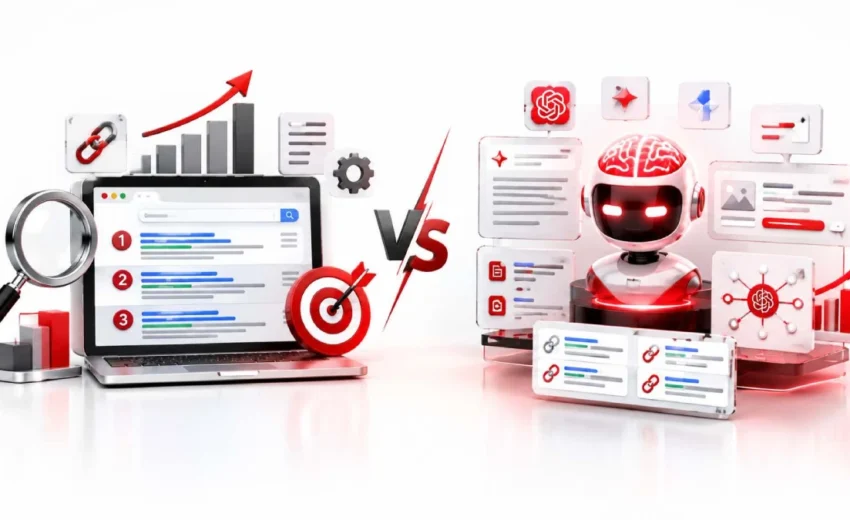
The short version: traditional SEO wins you a click, AI SEO wins you a mention. Both use the same base signals, like good content, a healthy site, and real authority. The difference lies in what you optimize and how you measure results.
| Traditional SEO | AI SEO | |
| Goal | Rank in search results | Get cited in AI answers |
| Where it shows | Google, Bing | ChatGPT, Perplexity, Gemini, AI Overviews |
| What you optimize | Whole pages and keywords | Passages, entities, direct answers |
| Key signals | Content, backlinks, technical health | The same, plus schema and brand mentions |
| What you get | A visitor on your site | A mention, often with no click |
| How you measure | Rankings, clicks, conversions | Citations, brand mentions, share of voice |
Notice how much overlaps. Technical health, useful content, and authority sit on both sides. AI SEO adds work on top of traditional SEO. It does not replace it.
One number worth remembering. Around 58.5% of Google searches now end without a click. So the click is no longer the only thing worth measuring.
What Has Actually Changed
What changed is where the answer appears.It used to live on your site. Now it often sits on the search page itself. Google shows an AI Overview. ChatGPT writes a summary. The user reads it and moves on.
Around 58% of Google searches now end without a click. Field studies also found organic clicks drop by roughly 38% when an AI Overview appears. So a business can hold its rankings and still lose traffic.
Two more shifts matter. Some people now start in ChatGPT, Perplexity, or Gemini instead of Google. And ranking in the top 10 no longer guarantees you appear in the AI answer above it.
Ranking and citation now represent two separate outcomes.The old goal was to earn the click. The new goal is to earn the mention, then the click when one still exists.
How AI Decides Which Sites to Mention
AI tools do not rank pages. They pull passages. The tool searches, grabs small chunks of text from several sites, then builds one answer. Your page competes chunk by chunk, not as a whole.
Researchers from Princeton, Georgia Tech, and IIT Delhi tested this in 2024. They ran thousands of queries to see which changes lifted citations. Three things helped most.
Researchers from Princeton, Georgia Tech, and IIT Delhi tested this in 2024. They ran thousands of queries to see which changes lifted citations. Three things helped most.
- Adding attributed quotes. Naming a real expert or source.
- Adding statistics. Replacing “many customers” with a real number.
- Citing your sources. Linking to where your facts came from.
Keyword stuffing did the opposite. It lowered citation rates by around 10%. Worth noting, the study used a controlled test setup, not live ChatGPT, so treat it as direction rather than proof.
One finding stands out for smaller sites. Adding citations helped lower-ranked pages far more than top-ranked ones. You don’t need to rank first to earn a mention.
There is a catch, though. Ask the same question twice and you often get different sources. Consistency across repeat sessions sits near 30%. That is why checking once tells you almost nothing.
What Is Genuinely New
Four things are actually new: how you write your answers, how clearly you define your business, unlinked brand mentions, and AI crawler access. Everything else on your SEO list stays the same. These four are the additions worth your time.
Writing Answers AI Can Lift Out
Write each section so it makes sense on its own, because AI tools pull single passages, not whole pages. Answer the heading in your first sentence, then explain. A chunk that starts with “as we mentioned above” is useless to them.
Being Clear About Who You Are
AI systems need to know exactly who your business is before they can recommend it. Add Organization schema to your site. Then keep your details identical everywhere else, on Google Business Profile, LinkedIn, Wikidata, and Crunchbase.
Mentions Without Links
A mention of your brand now counts even when nobody links to you. Research across large brand sets found unlinked mentions correlate more strongly with AI visibility than backlink counts do. That makes press coverage, review sites, directories, and forum threads worth chasing.
Letting AI Crawlers Read Your Site
AI crawlers split into two types, and blocking the wrong one makes you disappear from AI answers. Training bots like GPTBot collect data for future models. Retrieval bots like OAI-SearchBot and PerplexityBot fetch pages live, so blocking those removes you from AI citations while your Google rankings stay untouched.
What Has Not Changed
Most of your SEO checklist still works exactly as before. AI systems build answers from pages that already rank and earn trust. The old fundamentals now serve as the entry ticket, not an outdated practice.
- Technical health. Crawlable pages, fast loading, clean structure. An AI cannot quote a page it cannot reach.
- Content that matches intent. If it does not answer the question, neither Google nor ChatGPT will use it.
- Backlinks and authority. Links still signal trust. They just share the job with brand mentions now.
- E-E-A-T signals. Named authors, real credentials, honest sourcing.
- Your money pages. Service, pricing, and contact pages still need traditional search to bring buyers in.
Most small sites have not maxed out the basics yet. Around 96% of pages get no Google traffic at all. So fix the foundation first, because AI visibility usually follows.
How to Check Whether AI Mentions You
Ask the AI tools directly, but ask the same questions repeatedly instead of once. Answers shift between sessions. Consistency across repeat runs sits near 30%, so a single check tells you almost nothing.
Here is a simple monthly routine:
- Write 10 to 20 real customer questions. The ones people actually ask before buying from you.
- Run them across three tools. ChatGPT, Perplexity, and Google AI Mode cover most of it.
- Record two things. Were you mentioned, and which competitors were.
- Repeat the same list next month. The trend matters more than any single answer.
You should also watch three numbers in your own analytics:
- Referral traffic from chatgpt.com, perplexity.ai, and gemini.google.com in GA4.
- Branded searches in Google Search Console. A rise often means AI mentioned you.
- Direct traffic. People who saw your name in an answer, then typed it in later.
One honest limitation. Most AI visibility leaves no trace at all. Someone reads your name in ChatGPT and never clicks. You cannot measure that, so treat branded search and direct traffic as your best proxy.
AI SEO Myths That Waste Your Money
Four AI SEO claims sound convincing but have no evidence behind them. This field moves faster than the research does. Tactics spread through LinkedIn posts and agency pitches long before anyone tests them.
- “Publish 100 AI-written articles and AI will find you.” It works in reverse. Search engines filter out thin, repeated content, while keyword stuffing lowered citation rates by around 10% in testing.
- “Buy backlink packages to rank in AI answers.” AI tools weigh brand mentions across news sites, review platforms, and forums. Bought links do not create those.
- “If you rank in Google’s top 10, you will appear in the AI Overview.” Often false. Many cited pages sit well outside the top 10.
- “SEO is dead, so stop doing it.” Backwards. AI systems build answers from pages that already rank.
When AI Gets Your Business Wrong
AI tools sometimes state wrong prices, outdated hours, or services you no longer offer. You cannot edit an AI answer directly. But you can fix the sources it pulled from, which are usually old directory listings, review sites, or details that conflict between your website and your Google Business Profile.
Start by asking the tool where it got the information, since most will cite sources. Update those pages, add Organization schema to your own site, and make your details match everywhere. Fixes are not instant, because AI tools refresh on their own schedule. Expect weeks, not days.
What to Stop, Keep, and Start

Most small businesses do not need a bigger SEO plan. They need to move a few hours from the wrong work to the right work. Here is that swap in one place.
| Stop | Keep | Start |
| Mass-publishing AI-written posts | Technical health and site speed | Answering each heading in the first sentence |
| Stuffing keywords into pages | Pages that match search intent | Adding real numbers, dates, and named sources |
| Buying backlink packages | Earning links from real publications | Chasing brand mentions on review sites and forums |
| Judging success by rankings alone | Tracking clicks and conversions | Running a monthly prompt check in ChatGPT and Perplexity |
| Paying for llms.txt setup | Organization schema on your site | Checking robots.txt for blocked AI crawlers |
Two matter more than the others. Fix your crawler access first, because blocking retrieval bots removes you from AI answers completely.
Then rewrite your top five pages so each section answers its heading directly. That single change does more than any tool you can buy.
Frequently Asked Questions
How much does AI SEO cost?
Most of the work costs nothing extra if you already do SEO, since it means rewriting existing pages rather than buying tools. Paid AI visibility trackers start around $50 to $200 per month.
How long before I see results?
Expect 8 to 12 weeks before AI answers reflect your changes. AI tools re-crawl on their own schedule, and entity signals take time to settle.
Does Google penalise AI-generated content?
Google does not penalise AI content; it penalises content made to manipulate rankings.
Can AI replace SEO experts?
No, AI tools speed up research and drafting but cannot set strategy or verify accuracy. Judgment calls still need a person.
What happens if I block AI crawlers?
You disappear from AI citations while your Google rankings stay unchanged. That makes the problem hard to spot, since nothing looks broken.
Which tools track whether AI mentions my business?
Semrush, Ahrefs, and Profound offer AI visibility tracking, and Search Console shows branded search lift for free. You can also run a prompt list manually across ChatGPT and Perplexity.
Do backlinks still matter for AI SEO?
Yes, but they now share the job with unlinked brand mentions. Links still signal trust, while AI tools also weigh how often your brand appears across news sites and forums.
How do I know if AI SEO is actually working?
Track branded searches, direct traffic, and referrals from chatgpt.com and perplexity.ai. Most AI visibility produces no click, so branded search lift is often the earliest signal.
Conclusion:
AI SEO has not replaced traditional SEO. It sits on top of it. The fundamentals still determine whether people find you, because AI answers use trusted pages that already rank.
What changed is the goal. You are now working for a mention as well as a click. That means writing sections that answer their heading directly, keeping your business details consistent everywhere, earning brand mentions, and checking that AI crawlers can actually reach your site.
Start with one thing this week: open your robots.txt file and confirm you are not blocking the retrieval bots that put you in AI answers.

14 October 2026
LLM Optimization: How to Get Cited by AI...

14 October 2026