


LLM optimization is the work of getting AI tools like ChatGPT, Perplexity, and Google AI Overviews to name and cite your business. It works differently from Google SEO.Only 6.82% of ChatGPT citations appeared in Google’s top 10, while 83.39% did not appear in Google’s organic results. To get cited, allow the right crawlers, write self contained sections, and earn mentions on sites like Reddit and G2.
You rank on page one of Google. Your traffic is still falling. Meanwhile, ChatGPT recommends three competitors and never says your name. Your rankings won’t reach AI answers, while competitors earn mentions.. Most advice on fixing this is guesswork or a tool pitch.
This guide gives you the real steps. You will learn how AI picks its sources, which crawler settings quietly block you, and how to write sections AI can quote. We also name the popular tactics with no proof behind them.
Key Points:
- LLM optimization means getting AI tools like ChatGPT, Perplexity, and Claude to name your business in their answers.
- Google rankings do not carry over. 6.82% of ChatGPT citations appeared in Google’s top 10, while 83.39% did not appear in Google’s organic results
- AI pulls single sections, not whole pages, so every section must answer one question and stand alone.
- Check your robots.txt first. Blocking OAI-SearchBot removes you from AI answers, while blocking GPTBot costs nothing.
- Most brand mentions come from other sites, like Reddit, G2, and Google Business Profile, not your own pages.
- Skip llms.txt and keyword stuffing. Track 20 prompts monthly instead, since answers change between identical runs.
What Is LLM Optimization?
LLM optimization is the work of getting AI tools to name your business in their answers. Tools like ChatGPT, Perplexity, Claude, and Google AI Overviews answer questions directly now. They pull facts from a handful of web pages. Your job is to become one of them.
Traditional SEO fights for a spot on a results page. This is different. Most AI answers cite only four or five sources, so the space is tight. Research from Princeton and the Allen Institute for AI tested 10,000 queries and found simple content changes lifted visibility by 22% to 41%.
Mentions vs Citations
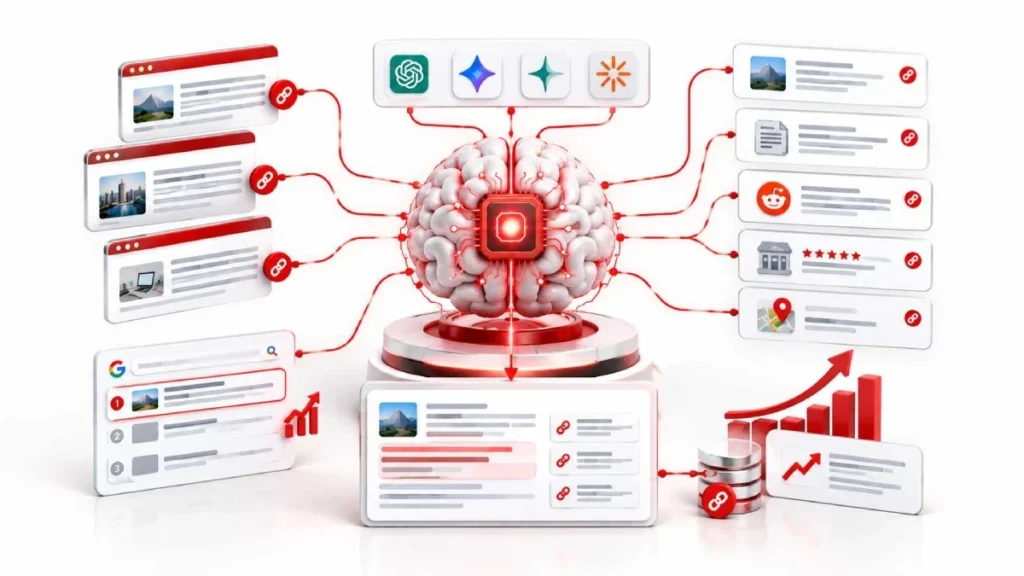
A mention is your brand name inside the answer text, and a citation is a clickable link back to your site. Ask ChatGPT for the best local plumbers, and the three names it gives are mentions. A link may not exist at all.
A citation is the small source link beside the answer, and it sends real visitors to your page. Mentions come from places you do not own, like Reddit threads, G2 profiles, and industry roundups. Citations come from your own pages, so you need work in both.
How AI Models Choose What to Cite
AI models pick sources through a quick search that happens while they write the answer. The tool splits your question into smaller ones first. Then it searches for each part, grabs a few pages, and keeps the best passages.
Here is the part most people miss. The model does not judge your whole page. It pulls out single sections and scores them on their own, so each section has to stand alone.
Two things decide whether you show up:
- Live search. The tool fetches pages in real time. New content can appear here within days.
- Training data. What the model already learned about you. This takes months to show results.
Platforms also search different places. ChatGPT leans on Bing, Google AI Overviews use Google’s index, and Perplexity mixes live results with Reddit and Quora.
Why Ranking on Google Is Not Enough
Ranking first on Google helps in some AI tools and does almost nothing in others. 6.82% of ChatGPT citations appeared in Google’s top 10, while 83.39% did not appear in Google’s organic results. The reason is simple: AI Overviews run inside Google’s index, but ChatGPT, Claude, and Perplexity do not.
Write Content That Is Easy to Quote
AI systems quote content when each section answers one question clearly and stands alone. Put the answer first, in 30 to 60 words, right under the heading. The model lifts single sections, so each one must make sense alone.
Five habits make a page easy to quote:
- Answer first. Open every heading with a full answer, not a warm up.
- Use question headings. AI questions run about 11 words, not 3.
- Keep sections independent. Avoid “as mentioned above” and vague words like “it” or “this tool.”
- Add real numbers. Prices, dates, and study names give the model something to cite.
- Link your sources. The Princeton study found source links raised visibility by 115% for pages at position five.
AI systems pull tables and short comparisons more often than long paragraphs. Write plainly too, because keyword stuffing lowered visibility by 10% in Perplexity tests.
Make Sure AI Can Reach Your Site

AI tools can only cite pages their crawlers can fetch and read as plain HTML. Many sites fail here without knowing. The page looks fine to visitors, but the bot sees nothing.
| Bot type | Examples | Cost of blocking |
| Search crawlers | OAI-SearchBot, PerplexityBot, Claude-SearchBot | You vanish from AI answers |
| User fetchers | ChatGPT-User, Claude-User | Users cannot paste your link into a chat |
| Training bots | GPTBot, ClaudeBot, Google-Extended | Nothing. You only skip future training |
Blocking GPTBot is safe, but blocking OAI-SearchBot is not. Also turn JavaScript off and check your text still shows, remove login gates, add JSON-LD schema, and submit your site to Bing Webmaster Tools.
Get Mentioned Where AI Already Looks
Most brand mentions in AI answers come from other websites, not your own. Your site earns citations, but third party pages earn the mentions. Calling yourself the best plumber in town proves nothing until review sites and forums say it too.
Focus on review platforms like G2, Capterra, and Google Business Profile, communities like Reddit and Quora, industry roundups, and YouTube. Ahrefs studied roughly 75,000 brands and found branded mentions matter far more than backlink counts. Keep your name, services, and prices identical everywhere.
How to Tell If It Is Working
Track it by testing a fixed list of prompts every month and logging where you appear. Google Search Console will not show this. Write 20 to 30 questions your customers would actually ask, then run them in ChatGPT, Gemini, Claude, and Perplexity while logged out.
Record two things separately, mentions and citations. Then add an AI channel group in GA4 for chatgpt.com, perplexity.ai, claude.ai, and gemini.google.com. Watch your branded searches too, since many people hear your name in an answer and search it later.
One warning. Answers change between identical runs, so never judge your llm optimization from a single test.
What Does Not Work
Several popular tactics have no evidence behind them, and one of them is llms.txt. The file gets widespread recommendations, but only about 10% of sites adopt it. Google states that it neither helps nor hurts visibility.Retrieval crawlers barely request it, and most files get no traffic at all. It has real value for developer documentation, not for a local business chasing citations.
Four more to skip:
- Keyword stuffing. It lowered visibility by 10% in Perplexity tests.
- Copying your whole site as markdown files. Indexing them creates duplicate content.
- Optimizing for ChatGPT only. The engines share few sources, so you miss many others.
- Expecting steady results. Citation lists turn over month to month, even when nothing changes on your site.
Your First Week: A Simple Checklist
Start with five tasks, in this order. Each one takes an hour or less, and together they cover the basics of llm optimization.
- Check your robots.txt. Make sure OAI-SearchBot, PerplexityBot, and Claude-SearchBot are allowed. Check your CDN too.
- Fix your three most important pages. Add a 30 to 60 word answer under every heading.
- Write 20 prompts your customers would ask. Run them in ChatGPT, Gemini, and Perplexity. Note where you show up.
- Update your outside profiles. Google Business Profile, G2, Capterra, or whichever fits your industry.
- Add your site to Bing Webmaster Tools, then set a reminder to rerun your prompts in 30 days.
FAQs
What is the difference between LLM optimization, GEO, and AEO?
They describe the same work using different names. GEO, AEO, and AI SEO all help content earn AI citations.
Does LLM optimization replace traditional SEO?
No, it builds on top of it. Your pages still need to be crawlable and indexed before any AI tool can find them.
How long does it take to see results?
Live search changes can appear within days or weeks. Brand recognition inside the model takes months, so give any change 30 to 90 days before judging it.
What happens if my site uses JavaScript to load content?
AI crawlers will likely see an empty page, because most fetch raw HTML and do not run JavaScript. View your page with JavaScript disabled to check what the bot actually sees.
Conclusion:
Getting cited by AI comes down to three jobs. Make sure the right crawlers can reach your pages. Write sections that answer one question clearly and stand alone. Then earn mentions on the sites AI already trusts, like Reddit, G2, and Google Business Profile.
Skip the shortcuts. Keyword stuffing and llms.txt files will not move the needle, and a single test tells you nothing. Track 20 prompts each month instead, and watch the trend over 30 to 90 days.
Start with your robots.txt today, because it takes ten minutes and decides whether anything else matters.

13 October 2026
AI SEO Tools: Best Tools for 2025

13 October 2026