

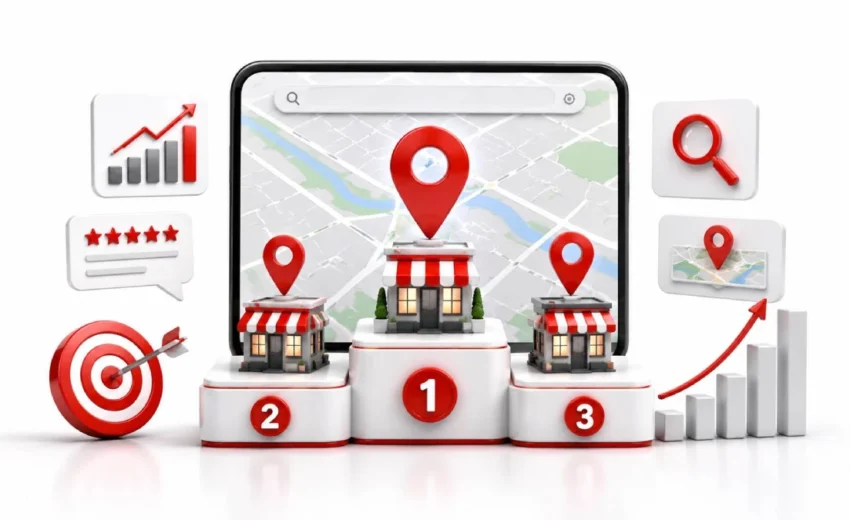
This guide breaks down what it takes to rank in the Google 3-Pack in 2026. You’ll learn how to set up your profile, build reviews, fix citations, and track your progress. No fluff. Just what moves the needle.
Key Points:
- Google 3-Pack shows three local listings with a map, above organic results.
- Ranking depends on relevance, distance, and prominence.
- 3-Pack listings get 126% more traffic and 93% more actions.
- Verify and optimize your Google Business Profile first.
- Fresh reviews matter more than total review count.
- Consistent NAP and citations boost trust and AI visibility.
- Common mistakes like fake reviews can drop you fast.
What Is the Google 3-Pack?
The Google 3-Pack displays three local business listings alongside a map. It sits at the top of Google search results. It shows up for searches like “dentist near me” or “coffee shop open now.” Google pulls this data from each business’s Google Business Profile.
This box sits above regular website listings. It shows ratings, hours, photos, and a “Call” or “Directions” button. Businesses that earn a spot here see real results. They get 126% more traffic and 93% more calls, clicks, and direction requests than businesses ranked outside the top three.
Also Known As: Local Pack, Map Pack
People use “Google Local Pack” and “Map Pack” to mean the same thing as the Google 3-Pack. Every listing pulls from the same Google Business Profile system. Update your hours or photos, and the change shows up everywhere at once. That includes Search, Maps, and voice assistants.
Google 3-Pack vs. Organic Results vs. Local Service Ads
The Google 3-Pack, organic results, and Local Service Ads are three separate features. Each has its own rules. Local Service Ads sit at the top and cost per lead. The Google 3-Pack sits just below and is free to appear in. Organic results, like blog posts and service pages, show up last. They depend on website content and backlinks.
Each feature ranks businesses differently too. Local Service Ads reward budget and response time. The Google 3-Pack rewards relevance, distance, and prominence. Knowing this difference helps you focus your effort where it counts.
Why Ranking in the Google 3-Pack Matters for Small Businesses
Ranking in the Google 3-Pack puts your business in front of people ready to buy. Nearly half of all Google searches, about 46%, carry local intent. Searches like “bakery near me” or “plumber in [city]” make up a huge share of daily traffic.
These searches turn into visits fast. Studies show 76% of people who run a local search visit a store within 24 hours. If your business shows up in the Google 3-Pack, you catch customers at the exact moment they’re ready to act.
The Google 3-Pack also changes how people use the rest of the page. When it appears, clicks on the top organic result drop from 39.8% to 23.7%. Searchers trust the map listings first. Staying out of the Google 3-Pack means losing customers to the plumbers, dentists, or cafes sitting right above you.
The 3 Ranking Factors Behind Every Google 3-Pack Listing
Google ranks every Google 3-Pack listing using three core factors: relevance, distance, and prominence. These work together, not alone. A business can be close by, but if it’s missing reviews or the right category, it still won’t rank.
Some parts you can control directly, like your business category. Others, like distance, you can only influence.
Relevance
Relevance measures how well your business matches what the searcher typed. Google checks your business category, description, and services. If someone searches “emergency electrician,” Google looks for a business that offers 24/7 emergency service. General electrical work isn’t enough.
Distance
Distance refers to how close your business is to the searcher’s location. It’s one of the strongest factors in local ranking, and it shifts often. A business can rank first for someone nearby. That same business can disappear for someone searching two miles away.
Prominence
Prominence measures how well-known and trustworthy your business is, both online and offline. Google looks at review count, review recency, citations across directories like Yelp and BBB, and links from other websites. The more your business shows up as credible across the web, the stronger this signal gets.
Step 1: Create and Verify Your Google Business Profile
The first step to ranking in the Google 3-Pack is claiming and verifying your Google Business Profile. Search your business name first, before creating a new one. Google often auto-generates profiles from old web data. You may already have an unclaimed profile waiting for you.
Once your profile is set up, Google needs to confirm it’s real. Video verification is now the default method for most businesses. You’ll record a short, live video, usually 30 to 90 seconds. It should show your storefront sign, your address, and proof you manage the location.
Keep the video simple and unedited. Avoid showing customer faces or private conversations. Don’t submit a pre-recorded clip, since Google rejects those. Service-area businesses without a storefront can film local landmarks instead, along with branded vehicles or tools.
Step 2: Optimize Your Google Business Profile
Once verified, full optimization is what moves your ranking. A complete profile tells Google what you offer and to whom.
Choose the Right Primary and Secondary Categories
Pick the most specific primary category for your main service. A pizza shop should choose “Pizza Restaurant,” not “Restaurant.” Then add secondary categories, like “Catering Service,” to catch related searches.
Write a Complete Business Description
Your description should state what you do and where, in the first two sentences. Use Google’s 750-character limit naturally. Keyword stuffing here can trigger a suppression flag.
Add Photos, Services, and Attributes
Photos and service details prove your business is active. Add at least 15 clear photos, like your storefront or team at work. Fill in your services and attributes too, such as free parking or wheelchair access.
Use Google Posts and Q&A to Stay Active
Regular posts show Google your business is active. Post at least twice a month. Note that Google retired public Q&A in late 2025, replacing it with an AI feature called “Ask Maps.” It pulls answers from your profile, reviews, and website, so accuracy matters more than ever.
Step 3: Build a Local Review Strategy
A strong review strategy is one of the fastest ways to move up in the Google 3-Pack. Reviews signal trust to both Google and real customers. This step needs ongoing attention, not a one-time push.
How Many Reviews Do You Actually Need?
There’s no fixed number, since review recency matters more than total count. Google gives full ranking weight to reviews under 30 days old. That value fades over time. A business with 50 reviews and steady new feedback can outrank one with 500 old reviews and no recent activity.
How to Request and Respond to Customer Reviews
Ask every customer for a review, using a direct link or QR code. Reply to every review you get. Google’s policies ban review gating, the practice of only asking happy customers for feedback. Keep your requests consistent. Responding within a week builds trust too, since most customers expect a reply that fast.
Step 4: Fix Your NAP and Build Local Citations
Fixing your NAP means your business Name, Address, and Phone number must match everywhere online. Even small differences, like “Suite A” on one directory and “Ste A” on another, can confuse Google and weaken your listing.
Local citations are mentions of your NAP on other sites, like Yelp, BBB, or industry directories. Start by setting one accurate version of your details as the source of truth. Submit that same information to major directories. Clean up any old or incorrect listings you find.
This matters more with AI search tools in the mix. Generative engines match NAP data across sources to confirm a business is real before recommending it. Consistent citations now support both traditional rankings and AI visibility.
Step 5: Optimize Your Site for Better Local Search Rankings
Your website complements your Google Business Profile rather than replacing it. The page linked from your profile’s website button plays a real role in how Google judges your local relevance.
Local Landing Pages and Schema Markup
Single-location businesses can link straight to their homepage. Multi-location brands need a dedicated page for each location. Add schema markup, like your address, hours, and service type, so Google can read your details. Use the most specific schema type available, such as “Dentist” instead of “LocalBusiness.” Validate it before publishing.
Ranking Without a Storefront (Service-Area Businesses)
Service-area businesses, like mobile mechanics or home cleaners, should hide their home address. Define a clear service area instead. Set your coverage by specific cities or postal codes, not a broad radius. Build local landing pages for each area you serve. Encourage customers to mention their location in reviews, since that gives Google real signals to expand your reach.
Step 6: Build Local Backlinks and Local Authority
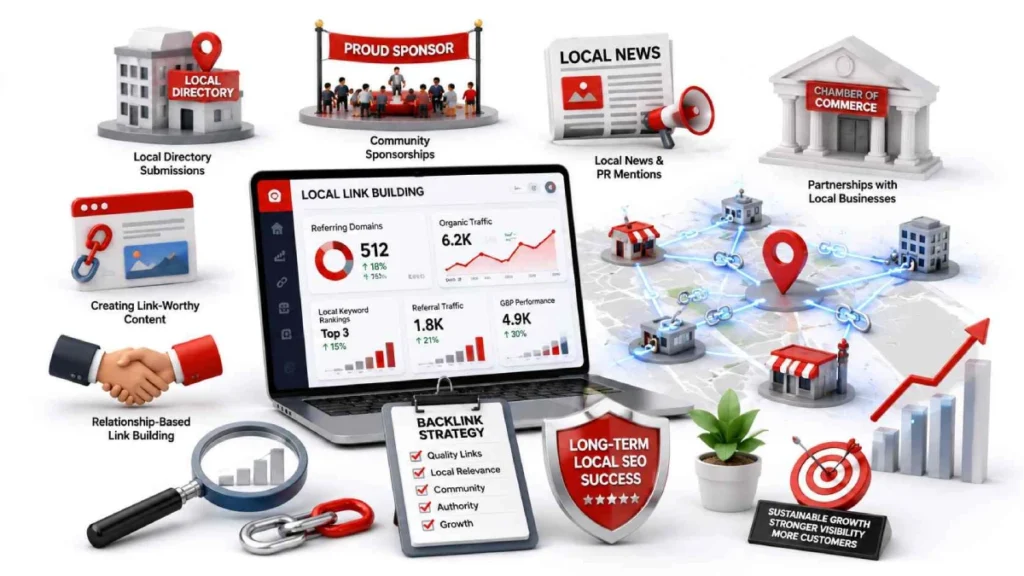
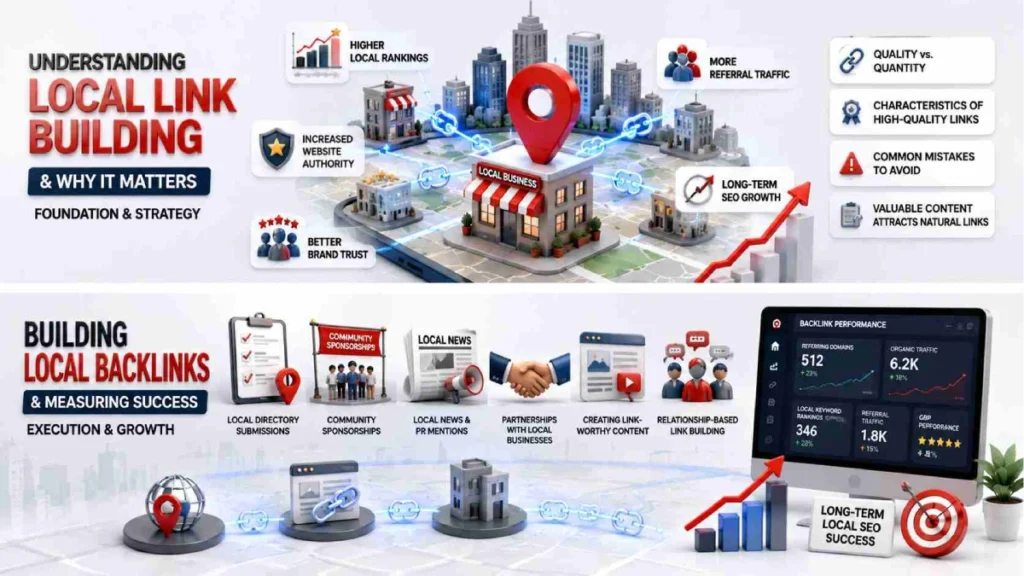
Local backlinks come from community sites, local news, and industry pages that link back to your business. These links act as endorsements, telling Google that real organizations trust you. Local search rewards quality over quantity here. One link from a local news site can outweigh dozens of generic directory links.
Earn them by sponsoring local events, like youth sports teams or charity runs. Get listed on niche directories, like a chamber of commerce. Pitch regional media for quotes. Partner with nearby businesses on shared guides or cross-promotions. One 2026 local SEO study found that businesses with 10 high-quality local backlinks, from sources like a chamber of commerce, outrank competitors with 200 generic directory links.
Building authority takes time, but it pays off.Paid ads stop working the moment you stop paying. Local backlinks keep supporting your Google 3-Pack ranking long after you’ve earned them.
Common Mistakes and Why Businesses Drop Out of the 3-Pack
Most businesses drop out of the Google 3-Pack due to a few repeated mistakes. A strong ranking can slip fast once one of these creeps in.
- Keyword stuffing the business name. Adding terms like “Best Plumber in Austin” violates Google’s guidelines and risks suspension.
- Wrong or inconsistent hours. Google favors businesses open at the time of search. Outdated hours can filter you out.
- Ignoring review recency. Old reviews lose ranking weight fast. A quiet review pipeline drags your position down.
- Review gating or fake reviews. Cherry-picking happy customers or buying reviews can trigger removal or suspension.
- Mismatched NAP details. A wrong suite number or old phone number confuses Google and weakens trust.
- Duplicate listings. Multiple profiles for one location split your signals and hurt both.
- A stale, inactive profile. No new photos, posts, or responses tells Google your business isn’t engaged.
Catch these early. Small fixes now prevent bigger drops later.
How Much Does Ranking in the Google 3-Pack Cost?
Ranking in the Google 3-Pack costs anywhere from a few hundred dollars a month to several thousand. It depends on your competition and approach. For most small businesses, a basic local SEO package runs $300 to $1,000 a month. That covers profile management, review requests, and citation building. Competitive fields, like lawyers or dentists, often pay $1,000 to $3,000 a month for more aggressive work.
One-time costs matter too. A citation cleanup, fixing mismatched NAP details, usually costs $300 to $1,500. Local landing pages run $300 to $1,000 per page.
The upside: this spend compounds over time. Paid ad costs stay flat no matter how long you run them. Local SEO tends to get cheaper per lead as your profile builds authority.
How to Track Your Google 3-Pack Ranking
Tracking your Google 3-Pack ranking means checking your position across multiple locations, not just from your office. A single search from one spot won’t show the full picture. Rankings shift block by block based on distance.
This is where geo-grid tracking helps. It scans your ranking across a grid of GPS points, often 9 to 169 points, spread across your service area. Tools like BrightLocal, Nightwatch, or Localo turn this data into a heatmap. It shows exactly where you rank strong and where you’re falling short.
Beyond position, watch real engagement too. Calls, direction requests, and website clicks from your Google Business Profile matter just as much as your rank. They show whether people act after finding you.
Is the Google 3-Pack Still Relevant in 2026?
Yes. The Google 3-Pack is still relevant in 2026, especially for straightforward local searches. Local packs still appear for more than 90% of simple local intent queries, like “primary care clinic Phoenix” or “coffee shop near me.” For anyone ready to visit, call, or book right now, the Google 3-Pack remains the first thing they see.
That said, the search page around it has changed. AI Overviews now answer many informational queries directly. Sometimes they pull in one or two business mentions instead of the traditional three. This shows up more for research-style searches, like “how much does a dental implant cost,” than for direct transactional ones.
Both systems pull from the same source: your Google Business Profile. Complete details, active reviews, and consistent citations feed both the Google 3-Pack and the AI layer above it. Keep your profile strong, and you’re ready for wherever the searcher lands.
FAQs
What is the Google 3-Pack?
The Google 3-Pack is a set of three local business listings with a map at the top of Google search results. It pulls data directly from each business’s Google Business Profile.
Is the Google 3-Pack free?
Yes, appearing in the Google 3-Pack is free. Costs only arise if you hire help, like an agency or SEO tools.
How Long Does It Take to Reach the Google 3-Pack?
Most businesses see movement within 4 to 8 weeks. Full stability in competitive markets can take 3 to 6 months.
How do I rank in the Google 3-Pack without a physical storefront?
Hide your home address and define a precise service area in your profile. Local landing pages and location-specific reviews strengthen visibility further.
What Happens When Your Google Business Profile Is Suspended?
A suspended profile disappears from the Google 3-Pack and Maps. Common triggers include keyword-stuffed names or fake reviews. Reinstatement requires a request through Google.
What tools can I use to track my Google 3-Pack ranking?
Geo-grid tools like BrightLocal, Nightwatch, and Localo work well for this. They scan rankings across multiple GPS points to show where you rank strong or weak.
Can AI replace local SEO experts?
No, since strategy and review management still need human judgment. AI tools speed up tasks like reporting but work best alongside expert oversight.
Conclusion
Ranking in the Google 3-Pack comes down to consistency, not tricks. A verified, optimized Google Business Profile forms the foundation. Steady reviews, accurate NAP details, and a supportive website build on that base. Distance sits partly outside your control, but relevance and prominence are yours to build. Do it one profile field, one genuine review at a time.
Ready to start? Audit your Google Business Profile today. Fix any missing details, and request a few fresh reviews this week. Small, consistent steps now earn you a spot in the Google 3-Pack.

21 July 2026
What is Google Local Pack and How to...
21 July 2026