

Imagine you search for a nearby coffee shop. Google instantly shows three options with ratings, hours, and directions. The Google Local Pack places local businesses directly in front of potential customers.
If your business isn’t showing up here, you’re losing customers to competitors who are. This guide covers what the Local Pack is, how Google ranks businesses in it, and simple steps to get noticed.
Key Points:
- The Google Local Pack shows 3 business listings with a map at the top of search results.
- Google ranks businesses using rhttp://Google Business Profile Helpelevance, distance, and prominence.
- Google Ads doesn’t get you into the organic Local Pack.
- Ranking needs an optimized profile, fresh reviews, and consistent business details.
- Service-area and multi-location businesses need different strategies.
- The Local Pack still matters in 2026, even with AI search on the rise.
What Is the Google Local Pack?
The Google Local Pack is a group of three business listings at the top of local search results. It comes with a map, phone numbers, addresses, and star ratings. You’ll see it for searches like “plumbers near me” or “bakeries in Chicago.”
This block sits above regular search results and grabs attention fast. Almost 46% of Google searches focus on local information.That’s why ranking in the google local pack matters so much for small businesses.
Why It’s Also Called the 3-Pack, Map Pack, or Snack Pack
People call it the 3-pack, Map Pack, or Snack Pack based on how it looks. The “3-pack” name comes from the three listings it always shows, like a bakery, a dentist, or a hardware store. The “Map Pack” name comes from the map placed beside those listings. The “Snack Pack” name fits because it gives searchers quick information without a website click.
Local Pack vs Google Maps, Local Finder, and GBP: What’s the Difference?
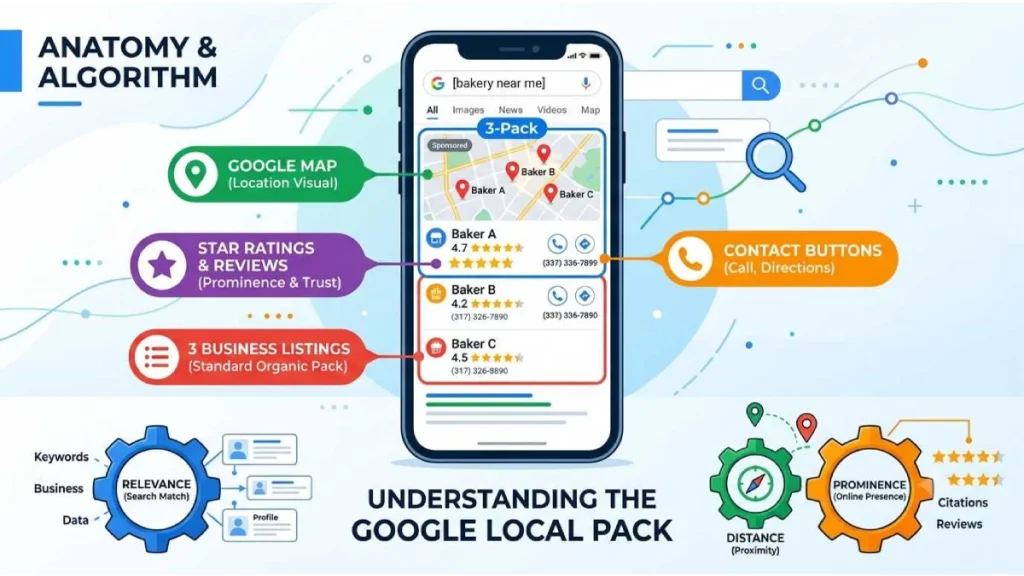
The Google Local Pack, Google Maps, Local Finder, and GBP are four tools with four different jobs. The Local Pack is the 3-listing box on the search page. Google Maps is a navigation app for directions and routes. Local Finder is the expanded list you see after clicking “More places.”
Google Business Profile, or GBP, works differently. It’s the dashboard business owners use to manage their listing. GBP feeds the data that the Local Pack, Maps, and Local Finder all display.
Here’s how they differ:
- Google Local Pack: shows 3 businesses on the search page, like a plumber, an electrician, and a locksmith
- Google Maps: a navigation app used by over 1 billion people every month
- Local Finder: an extended list of nearby businesses, shown after clicking “more places”
- Google Businhttp://Google Business Profile Guidelinesess Profile (GBP): the free dashboard owners use to add hours, photos, and services
Does Google Ads Get You Into the Local Pack?
No, Google Ads does not get your business into the organic Local Pack. The Local Pack is earned through relevance, distance, and prominence, not ad spend. Paid campaigns and organic rankings run on two separate systems.
Google does allow sponsored listings near the Local Pack. These are Local Search Ads, and they carry a small “Sponsored” label. Plumbers, dentists, and moving companies often use them, but the ads don’t touch organic rankings.
A separate program called Local Service Ads uses a green “Google Guaranteed” badge. This is a different paid system entirely. For lasting visibility, focus on your Google Business Profile instead of ads alone.
How Google Ranks Businesses in the Local Pack
Google ranks businesses in the local pack using three main factors: relevance, distance, and prominence. These factors work together every time someone runs a search. No single factor determines your ranking on its own.
Google also checks supporting signals like reviews, business categories, and website content. A bakery with strong ratings and an optimized profile stands a better chance. The same applies to electricians, roofers, and landscapers.
Relevance, Distance, and Prominence Explained
Relevance measures how closely your business matches a user’s search, while distance refers to how close your business is to the searcher. Prominence reflects how well known your business is online.
A well-known dentist with strong reviews can outrank a closer competitor. That’s because prominence can outweigh distance. Together, these three factors shape almost every local pack result.
How to Rank in the Google Local Pack
You rank in the Google Local Pack by combining a strong profile, real reviews, consistent business details, and a solid website. These four pieces work together, not separately. Skipping one weakens the others.
Small businesses like cafes and salons often see results within weeks. Bigger gains, like backlinks and review growth, take a few months. Either way, steady effort beats quick fixes.
Claim and Optimize Your Google Business Profile
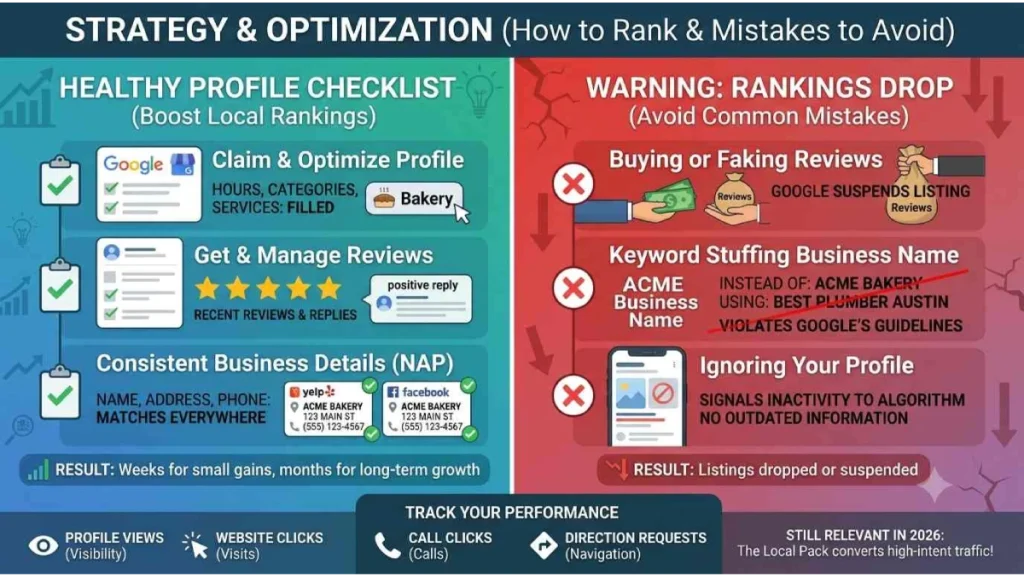
Claiming your Google Business Profile is the first step. Fill in every section, including hours, categories, and services. Add real photos of your storefront or team. Choose your primary category carefully, since it affects relevance, like picking “Bakery” instead of “Restaurant.”
Get and Manage Google Reviews
Fresh Google reviews boost your position in the local pack. Ask happy customers, like repeat clients or first-time buyers, to leave feedback. Recent reviews carry more weight than old ones. Reply to every review, even negative ones, to show Google your business stays active.
Keep Your Business Info Consistent (NAP & Citations)
Your name, address, and phone number must match everywhere. Mismatched details across Yelp, Facebook, or Bing Places confuse Google. Even small differences, like “St.” versus “Street,” can hurt rankings. Check your listings regularly and update every directory when your business moves.
Strengthen Your Website’s Local SEO
A locally optimized website supports your local pack rankings. Add your city name across service pages, contact pages, and headings. Include a clear map, address, and phone number. Fast loading speed matters too, especially on mobile, since slow sites drive visitors away.
Ranking Tips for Service-Area and Multi-Location Businesses
Service-area and multi-location businesses need different strategies. Plumbers, cleaners, and mobile mechanics often work without a storefront. Gyms, clinics, and retail chains face a different challenge: managing many listings at once.
For service-area businesses, hide your exact address and set a clear service radius instead. List specific cities or zip codes rather than one broad region. This helps Google match your business to nearby searches, even without a physical location.
For multi-location businesses, create a separate Google Business Profile for each branch. Avoid duplicate content across location pages. Give each branch its own photos, hours, and reviews.Location-specific details help each branch compete on its own merits.
Common Mistakes That Hurt Local Pack Rankings
Fake reviews, inconsistent details, and neglected profiles hurt local pack rankings the most. Even a wrong phone number can quietly push your business down. Most of these mistakes are easy to fix once you spot them.
Here are the biggest ones to avoid:
- Buying or faking reviews: Google can detect unnatural review patterns and may suspend your listing.
- Keyword stuffing your business name: Adding keywords such as “Best Plumber Austin” to your business name instead of using your official business name violates Google’s guidelines.
- Inconsistent NAP details: Mismatched addresses or phone numbers confuse the algorithm.
- Ignoring your profile: No new photos, posts, or replies signals inactivity to Google.
- Using duplicate listings: Multiple profiles for one business split your ranking signals.
- Hiding a real address unnecessarily: This weakens trust if you’re not a true service-area business.
- Slow website speed: A laggy site frustrates visitors and hurts your rankings.
- Skipping review replies: Ignoring reviews, especially negative ones, makes your business look inactive.
How to Track Your Local Pack Performance
You track local pack performance by checking rankings, insights, and customer actions. Google Business Profile shows data on calls, clicks, and direction requests. This shows how customers interact with your listing.
Ranking tools like Local Falcon, BrightLocal, and Whitespark show how you rank across different areas. One check isn’t enough, since results shift by location. Test multiple points around your city for a clearer picture.
Watch these numbers:
- Profile views: how many people saw your listing
- Website clicks: how many visitors went to your site
- Call clicks: how many people called directly from Google
- Direction requests: how many people asked for directions
Review these monthly to catch drops early and adjust fast.
Is Local SEO Worth the Cost?
Yes, local SEO is worth the cost for businesses that rely on nearby customers. It targets people ready to buy, not casual browsers. This makes it more cost-effective than national campaigns.
Costs vary by goal. A basic profile cleanup costs little if you do it yourself. Hiring an agency costs more but saves time and effort.
Dentists, salons, and repair shops often see returns within a few months. Higher rankings bring more calls, more visits, and more direction requests. For most local businesses, the value outweighs the cost.
Is the Local Pack Still Relevant in 2026?
Yes, the local pack is still relevant in 2026, even with AI search on the rise. Google still shows it for searches like “coffee shop near me” or “emergency plumber.” It remains one of the fastest ways for customers to find real businesses.
AI tools like ChatGPT and Google’s AI Overviews are changing how people search. But these tools still pull local information from Google Businhttp://Google Business Profile Guidelinesess Profiles. A strong profile helps you rank well in both traditional search and AI results.
For small businesses, staying visible in the local pack still drives calls, visits, and direction requests. Ignoring it means losing easy, high-intent traffic. The local pack keeps a central role as search evolves.
FAQs
What is the Google Local Pack?
The Google Local Pack is a set of three business listings at the top of local searchhttps://support.google.com/business/answer/7091 results, with a map. It appears for searches with local intent, like “electrician near me.”
What happens if my business information is inconsistent across directories?
Inconsistent information confuses Google’s ranking system and weakens trust signals. This lowers your visibility in the Local Pack.
What happens if my business details are inconsistent across online directories?
Buying fake reviews breaks Google’s guidelines and risks suspension. Google detects unnatural review patterns and often removes them.
What tools can I use to track my Local Pack rankings?
Tools like Local Falcon, BrightLocal, and Whitespark track rankings across multiple locations. They show how your visibility changes by area.
Is investing in local SEO worthwhile for small businesses?
Yes, local SEO pays off for businesses that depend on nearby customers. It targets high-intent searchers, which leads to steady returns.
Conclusion
The Google Local Pack stays one of the best spots to win local customers. It rewards businesses that stay relevant, stay close, and build real trust through reviews. Ranking well takes a complete profile, fresh reviews, and accurate details.
The same basics work for one location or many. Avoid common mistakes, track your results, and keep your profile active. Start optimizing your Google Business Profile today and turn more local searches into real customers.

20 July 2026
Chamber of Commerce Links: Are They Worth It...
20 July 2026