
Link building is often the missing piece when big brands keep dominating local search while your business stays invisible. Local PR link building changes that. It connects you with local journalists and helps you earn backlinks from news sites your community already trusts.
This guide covers everything you need to start: finding journalists, pitching stories that get picked up, and earning links through community partnerships. You’ll also get a ready-to-use template and tips to measure results.
Key Points:
- Local PR link building earns backlinks from local news sites, blogs, and directories tied to your area
- Nearly 46% of Google searches have local intent, making regional links a strong ranking signal
- A personalized pitch built on real journalist research gets better response rates than mass outreach
- Community sponsorships, charity partnerships, and chamber of commerce listings build trust-based links naturally
- Tracking referring domains, keyword rankings, and branded search shows whether your outreach is actually working
What Is Local PR Link Building?
Local PR link building is the process of earning backlinks from local sources, such as regional newspapers, community blogs, and city directories. It connects your business to the news outlets your neighbors already read and trust.
This is different from regular link building. Traditional link building chases links from any high-authority site, no matter where it’s based. Local PR link building only targets sources tied to your city or region, like a neighborhood food blog or your chamber of commerce page. Local PR link building puts your business right where those searches happen.
Why Local News Links Matter for SEO?
Local news links matter for SEO because they show Google that your business has earned trust within its local community. Search engines treat these links as proof, not only promotion.
Regional outlets like local newspapers, city TV stations, and neighborhood blogs carry real weight. They’re crawled often and trusted by readers. A single mention can boost both rankings and trust.
The numbers back this up. Nearly 46% of all Google searches have local intent, and 88% of mobile users who search locally visit or call a business within 24 hours. Local PR link building helps you show up right when people are searching nearby.
Local Backlinks vs. Other Local SEO Links
Local backlinks differ from citations and brand mentions in structure and SEO value. Each one plays a different role in your local link building plan.
Backlinks vs. Citations vs. Brand Mentions
A backlink is a clickable link, a citation is a directory listing, and a brand mention is just your business name in text. Backlinks pass direct ranking power, especially from sites like local news pages and community blogs. Citations work differently. Sites like Yelp, the Better Business Bureau, and your chamber of commerce list your Name, Address, and Phone number (NAP) to build trust without a clickable link.
Does a Nofollow Link From a News Site Still Help?
Yes, a nofollow link from a news site still helps, even without passing direct ranking power. Google now treats the nofollow tag as a hint, not a hard rule. A 2026 survey found that 78.8% of SEO experts believe nofollow links still affect search performance. These links also drive referral traffic and help your pages get indexed faster.
How to Find Local Journalists and Media Contacts
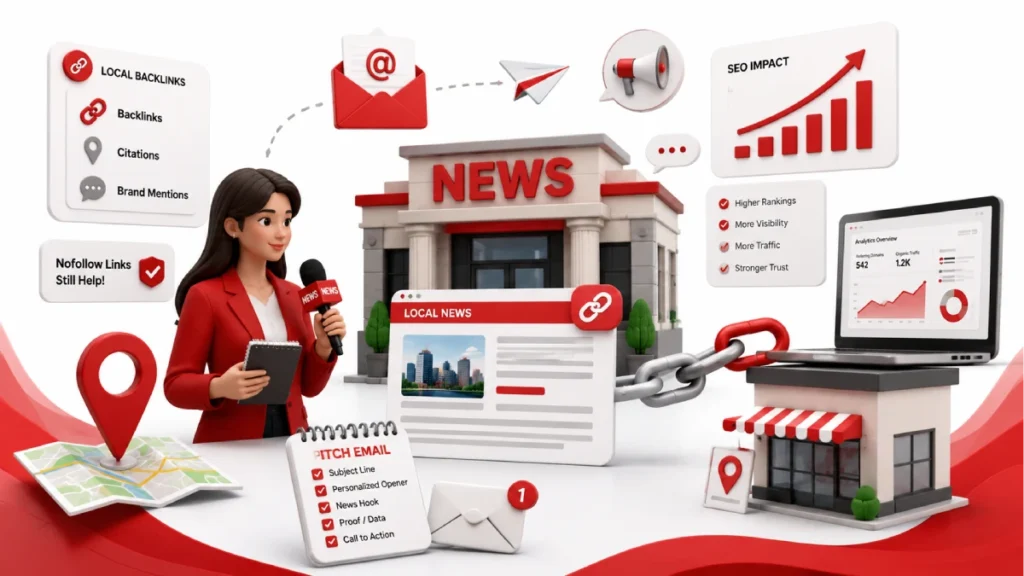
You can find local journalists through media databases, Google News searches, and staff directories on news websites. Media databases like Muck Rack, Prowly, and CisionOne let you filter writers by city and beat. You can also check staff pages on local newspaper sites for direct editor emails.
Before reaching out, check each journalist’s recent articles from the past 90 days. This confirms they still cover your topic and haven’t already written something similar. A personalized pitch built on real research works better for any link building effort.
What Makes a Local Business Newsworthy
A local business becomes newsworthy when its story connects to timing, impact, or original data. Journalists look for angles that matter to their readers, not only promotions.
Timeliness counts a lot. A landscaping company sharing tips during a storm warning fits this idea well. Local impact matters too. Stories like new job openings, office expansions, or charity partnerships often catch attention.
Human interest stories work just as well. A founder’s journey or a customer’s story can stand out fast. Original data helps too. Local surveys, pricing studies, and small market reports often get picked up by regional news sites.
How to Pitch Local Journalists (With Template)
You pitch local journalists by sending a short, personalized email that leads with your news hook. A clear structure makes it easy for busy editors to say yes.
Pitch Email Structure and Example
A strong pitch email has six parts: subject line, opener, hook, proof, call to action, and signoff. The subject line should be short, around 6 to 10 words. The opener should mention the journalist’s recent work to show real interest. Here’s a simple template you can copy and adjust:
Following Up Without Being Pushy
A single follow-up sent 3 to 5 business days later is normal and expected. Journalists get dozens of pitches daily, so a gentle nudge rarely annoys them. Keep it short and add one new detail, like fresh data or an updated quote. A good local PR link building campaign usually sees an 8% to 15% reply rate.
Do Press Releases Still Help With Links?
Yes, but mostly as a trigger for real news coverage, not as a direct source of links. Mass-distributed press releases rarely carry strong link value anymore. The real win happens when a journalist reads your release and writes an original story about it. Adding images or short videos to your release can boost journalist engagement by up to 6 times.
Earning Local Links Through Community Involvement
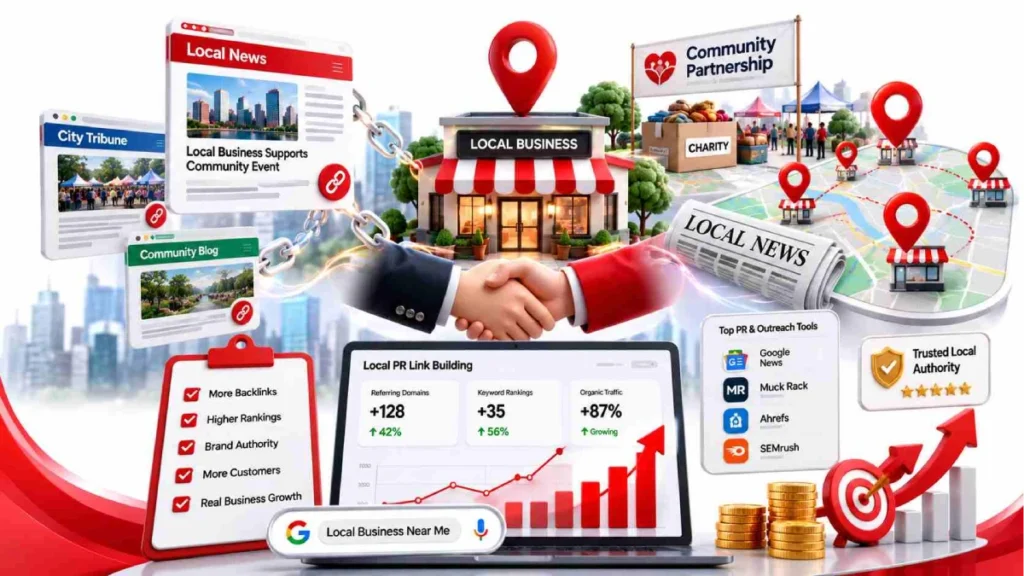
Local businesses earn links through community involvement by sponsoring events, schools, and nonprofits. These links carry real trust because they come from genuine local partnerships, not paid placements.
Sponsoring a school fundraiser or donating to a local charity often gets you a mention on their website. Chambers of commerce work well too. Joining one usually gets your business a spot in their member directory with a clickable link.
Community events also help. Sponsoring a city festival, a local sports team, or a charity run can earn you a link plus foot traffic. To get the most value, ask the organization to link using your actual business name instead of a logo.
Reclaiming Unlinked Brand Mentions
You reclaim unlinked brand mentions by finding places that name your business without linking to it, then asking for a link. These mentions show real interest, so turning them into links is easier than starting from scratch.
Start by tracking mentions with tools like Google Alerts or Ahrefs. Watch for your business name, common misspellings, and key team members. Once you spot an unlinked mention, check the source. Focus on sites that are relevant and well-trusted, like local blogs or regional news pages.
Next, reach out politely. Thank the writer for the mention and ask if they’d add a link to your homepage or a helpful page. Keep the message short, under 120 words works well. Even without a link, these mentions still help. Search engines read them as a sign of trust in your local PR link building efforts.
Common Local PR Link Building Mistakes
Common local PR link building mistakes include buying cheap links, ignoring local relevance, and using inconsistent business details. These errors can quietly hurt your rankings instead of helping them. These are some common mistakes :
- Buying bulk links or PBNs. Search engines catch these fast and may penalize your site.
- Ignoring local relevance. Random directories with no city connection don’t help local SEO.
- Inconsistent NAP details. Mismatched name, address, or phone info breaks trust.
- Duplicate location pages. Copy-pasted content across city pages looks like spam.
- Over-optimized anchor text. Phrases like “best plumber in Dallas” feel forced and unnatural.
Tools to Support Local PR Outreach
Tools like BuzzStream, Prowly, and BrightLocal support local PR outreach by helping you find contacts, manage pitches, and track results. The right tool depends on what stage of outreach you’re focused on.
For finding journalists, platforms like Muck Rack and Prowly let you filter writers by city and beat. BuzzStream works well for managing the outreach itself, since it tracks emails and follow-ups in one place. Hunter.io helps you verify email addresses before sending pitches.
For monitoring results, tools like Ahrefs and Semrush show which links you’ve earned and which mentions still need a link. BrightLocal and Whitespark focus on citations, helping you fix gaps across local directories. Using even two or three of these tools can make local PR link building much easier to manage.
How Much Does Local PR Link Building Cost?
Local PR link building can cost anywhere from $0 to over $10,000 a month, depending on how you approach it. The price changes based on whether you do it yourself or hire outside help.
DIY outreach is the cheapest option, usually $0 to $500 a month. It takes real time though, often 10 to 15 hours per earned link. Hiring a freelancer costs more, around $500 to $1,500 a month, and can bring basic directory listings or guest post placements.
Full agencies charge $1,500 to $5,000 a month for a complete local SEO approach. Larger digital PR campaigns, built around data studies and journalist outreach, can run $3,000 to $10,000 or more per campaign. Avoid cheap automated link packages priced under $300. They often carry more risk than reward for local PR link building.
How to Measure Local PR Link Building Success
You measure success by tracking referring domains, keyword rankings, and branded search growth. These numbers show if your outreach is working. Start with referring domains. Count new, locally relevant sites linking to you each month. Check that links stay active over time.
Watch keyword rankings next. Local link building should move your target keywords up in Maps and search results. Branded search matters too. More searches for your business name means your press coverage is working.
Referral traffic is another clear signal, especially when visitors turn into leads. Also track AI search visibility. Tools like ChatGPT and Google AI Overviews cite businesses with real local mentions.
Scaling Local PR for Growing or Multi-Location Businesses
You scale local PR by building unique location pages, using a 70/30 content split, and creating separate media lists for each city. This keeps every branch visible without duplicating effort.
Start with location pages. Each branch needs its own page with real local details, like reviews, hours, and a map. Adding LocalBusiness schema helps search engines verify each spot faster.
For press releases, use the 70/30 rule. Keep 70% of the message the same across cities for brand consistency. Localize the rest with local quotes, data, or events. This avoids duplicate content while still feeling relevant.
Media lists matter too. Build separate contact lists for each city instead of one generic list. Local link building works best when outreach actually matches the area you’re targeting.
Is Local PR Link Building Still Worth It in 2026?
Yes, local PR link building is still worth it in 2026, even as search keeps shifting toward AI. Real, earned links from trusted local sources still carry strong ranking power.
What’s changing is how these links get used. Tools like ChatGPT, Perplexity, and Google AI Overviews don’t just count links. They look for consistent mentions, community trust, and real-world authority. This is often called Generative Engine Optimization, or GEO.
A business that sponsors local events, earns genuine press coverage, and builds real community ties checks both boxes. It satisfies traditional SEO and shows up in AI-driven search. Local PR link building isn’t fading. It’s becoming the foundation both systems rely on.
FAQs
What is local PR link building in simple terms?
Local PR link building is earning backlinks from local news sites, blogs, and directories tied to your area. It connects your business to sources your community already trusts.
How many local news links do I need to see SEO results?
Most businesses see ranking movement after earning 5 to 10 quality local links. Quality matters more than quantity here.
Can one local news mention actually help my SEO?
Yes, a single mention from a trusted local news site can help SEO, even without a link. Search engines use NLP to read brand mentions as trust signals.
Is local PR link building still effective in 2026?
Yes, local PR link building remains effective in 2026, even with AI search growing. Earned links from trusted local sources still influence rankings and AI-generated answers.
What happens if I rely only on AI tools for local outreach?
Relying only on AI tools often produces generic, low-response pitches. Journalists notice templated emails and ignore them.
Is buying local backlinks risky for SEO?
Yes, buying local backlinks is risky and violates search engine guidelines. It can lead to ranking penalties or manual action.
Conclusion
Local PR link building works because it combines real community trust with measurable SEO value. Earning links from local news sites, sponsorships, and genuine media coverage builds authority that generic backlinks can’t match. It supports rankings, drives traffic, and shapes how AI search tools recommend businesses.
The process takes patience. Finding the right journalists, pitching with a real local angle, and avoiding shortcuts like bought links keeps your SEO foundation strong.
Start small! Pick one local journalist or community partner and reach out this week to begin building real local press coverage.
16 July 2026
How to Use Local Sponsorships for Link Building

16 July 2026