


Chamber of commerce SEO is one of those strategies that sounds outdated until you look at what it actually does for your rankings. Should you pay $300 a year just to get listed on a chamber of commerce website? It sounds like an old-school move.
Businesses joined chambers for networking lunches, not search rankings. But search engines still treat these links as strong local trust signals.
This article breaks down what a chamber link does for your rankings. We’ll cover the cost too. You’ll also learn how to spot a chamber worth joining before you pay. By the end, you’ll know if this old-school move still earns its place in your local SEO strategy.
Key Points
- Chamber links are part backlink, part citation. They combine your NAP details with a real clickable link from a trusted .org domain.
- They boost prominence, not just rankings. Chamber links strengthen the trust signal Google uses. They contribute roughly 13% to 15% of local ranking weight.
- Nofollow doesn’t mean worthless. Google treats nofollow as a hint. So chamber links still pass local context and trust.
- Crawlability matters more than cost. You’ll waste a $300 membership if the chamber blocks its directory with JavaScript or iframes.
- Cost stays reasonable at $200 to $400 a year. That’s far cheaper than digital PR or guest posting. You also get added consumer trust as a bonus.
- Best used alongside other local sources like CVBs, sponsorships, and consistent NAP details. Don’t treat it as a standalone strategy.
What Is a Chamber of Commerce Link?
A Chamber of Commerce link is a backlink your business gets from a local business association’s website. You get it after you join. When you sign up, the chamber adds your business to its online directory. That listing includes your name, address, phone number, and a link to your site.
Search engines treat these links as local trust signals. Chambers are non-profit groups tied to a specific city or region. This is different from random web directories. It makes a chamber of commerce link more credible than a typical paid listing.
A strong profile usually includes a clear business description, category, and contact info. Some chambers also let you add photos and business hours. Getting these details right helps search engines understand what your business actually does.
Chamber Link vs. Citation — What’s the Difference?
A citation lists your business details. A chamber link adds an actual clickable backlink too.A citation is any online mention of your business name, address, and phone number (NAP). Sites like Yelp create these automatically. They often skip a working link.
A chamber of commerce link combines a citation with a real backlink from a trusted .org domain. Citations mostly confirm your business exists. Chamber links go further. They pass actual link equity, not just confirm details.
How Chamber of Commerce Links Fit Into Local SEO
Chamber of commerce links support local SEO by boosting your prominence score. This score is part of Google’s ranking system. Google ranks local businesses using three factors: relevance, distance, and prominence. Chamber links mainly strengthen prominence. This reflects how trusted your business looks online.
Most business owners underestimate its importance. Backlinks and citations make up roughly 13% to 15% of local ranking signals, according to industry studies. A chamber link contributes directly to that share.
Prominence builds over time through consistent signals. These include reviews on platforms like Google and Yelp. They also include mentions in local news sites and directory listings. Chamber memberships add one more trusted piece to that puzzle.
Connection to Google Business Profile and Local Pack Rankings
A chamber of commerce link helps validate your Google Business Profile. This drives Map Pack rankings. Google Business Profile signals account for nearly 32% of Map Pack visibility. Still, Google checks outside sources like chamber listings to confirm those details.
When your chamber profile matches your Google Business Profile, search engines trust the data faster.Ensure your name, address, and phone number match across both. Small mismatches can quietly slow down your rankings.
Do Chamber of Commerce Links Actually Help Your Rankings?
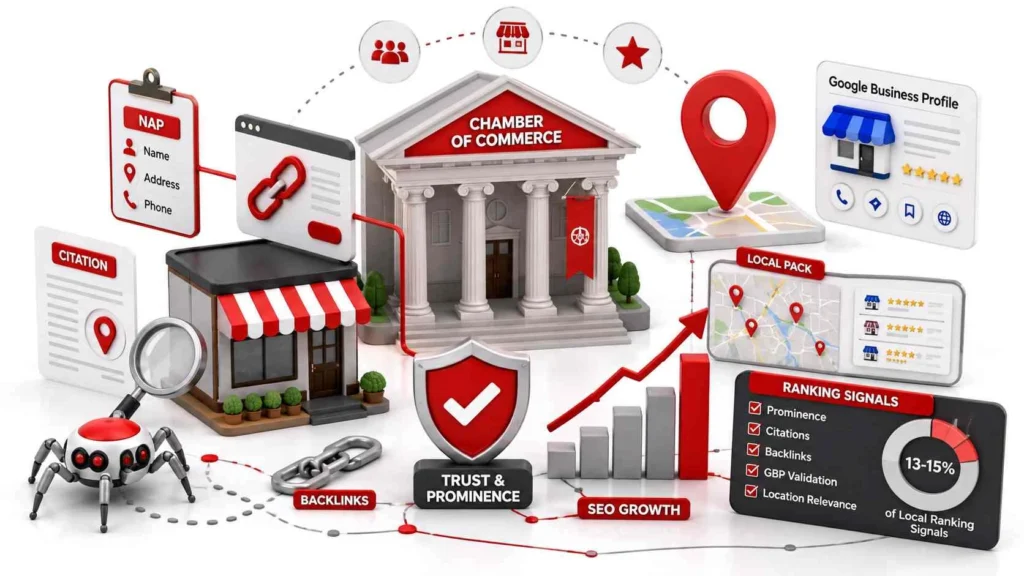
Yes, chamber of commerce links genuinely help local rankings. They add geographic trust signals. These links tell search engines your business is active in a specific area. This matters for location-based searches like “plumber near me” or “best bakery in Austin.”
Service-area businesses benefit the most from this signal. Companies like HVAC contractors, roofers, and mobile dog groomers often lack a storefront. Chamber links help them build local proximity signals. They can’t get this signal any other way.
The geographic relevance here outweighs raw domain authority. A chamber link from your own city carries more local SEO weight than a high-authority link from an unrelated industry blog. Location match matters more than link size.
Does Dofollow vs. Nofollow Matter?
Nofollow links still matter. Google treats nofollow as a hint, not a strict block. Many chamber websites add nofollow tags to their outbound links. Older SEO advice claimed these links passed zero value.
That advice no longer fully applies today. Google now uses nofollow links for context and discovery. It does this even without passing direct authority. A relevant nofollow link from a trusted local source still helps more than an unrelated dofollow link. Visitors clicking these links also call businesses or request directions. This sends positive signals back to local search.
How to Evaluate a Chamber Before You Join (SEO Checklist)
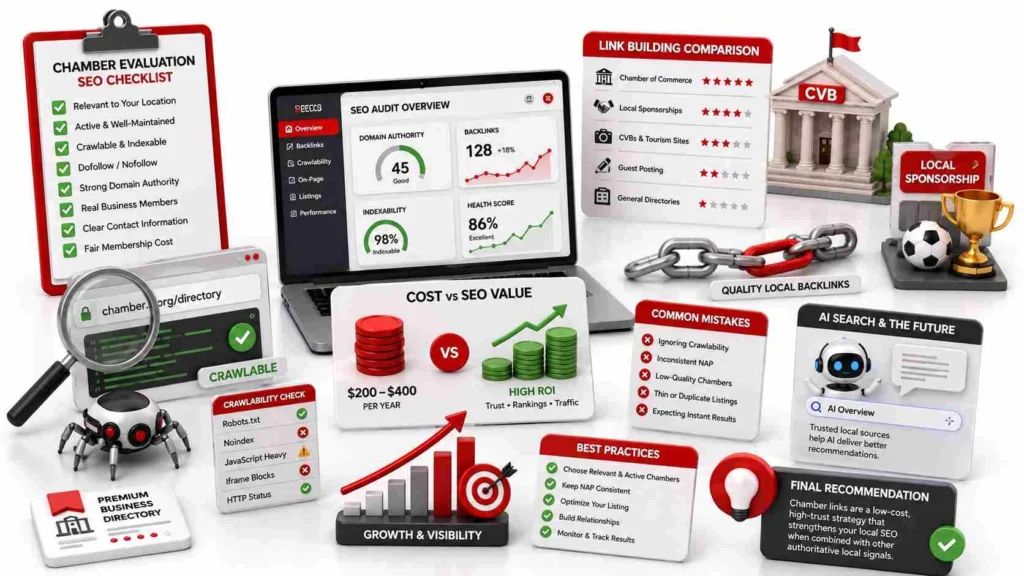
You evaluate a chamber by checking if Google can actually crawl its directory pages. Many older chamber websites run on outdated platforms like ChamberMaster or GrowthZone. These platforms sometimes hide links inside JavaScript or iframes. This blocks search engines from reading them. Run a quick site search, such as “site:chambername.org directory,” to see whether search engines index the profiles at all.
Beyond crawlability, check a few other things too. Look at the chamber’s domain authority using free tools like Ahrefs or Moz. Also confirm the chamber actually covers your target area. A county-wide chamber may not help if you only serve one city.
A $300 membership with a broken directory link offers zero SEO value. Spending ten minutes checking these details before joining can save you a wasted year of dues.
Chamber of Commerce Membership Cost vs. SEO Value
Chamber of commerce membership usually costs between $200 and $400 a year for small businesses. Entry-level tiers often start around $200. Larger companies or businesses in big cities like Chicago or Dallas may pay $1,000 to $5,000 annually.
Compared to other link-building options, this cost looks reasonable. Digital PR campaigns or guest posting can cost $3,000 to $12,000 a year. There’s no guarantee of local relevance either. A chamber membership delivers a trusted local backlink for a fraction of that price.
The value also extends beyond SEO. A consumer trust study by the Schapiro Group found chamber members get 49% more favorable brand perception. Customers are also 80% more likely to buy from them. That combination makes the annual fee easy to justify for most small businesses.
Chamber Links vs. Other Local Link-Building Options
Chamber links work best alongside other local link sources. Don’t treat them as your only strategy. Options like community sponsorships, local news features, and Convention and Visitors Bureaus all add unique value. Each one targets a slightly different trust signal.
Convention and Visitors Bureaus, often called CVBs, are an underused option. These sites promote regional tourism. They often link to local businesses for free. Unlike chambers, CVBs usually skip membership fees entirely.
Educational links also deserve a mention here. Sponsoring a scholarship at a university like your local state college can earn a powerful .edu backlink. These links carry high trust. But they take more effort to secure than a simple chamber signup.
The smartest approach combines a few of these sources together. A chamber membership, one local sponsorship, and a CVB listing build a stronger link profile. It looks more natural too. Relying on just one source rarely creates lasting local SEO results.
Common Mistakes and Risks With Chamber of Commerce Links
The biggest mistake is using the same business description across every chamber profile you join. Copying identical text onto multiple directories can look like duplicate content to search engines.
Watch out for these common errors:
- Duplicate descriptions: Same text copied across listings like ChamberMaster and GrowthZone profiles.
- Generic homepage links: Pointing every chamber profile to your homepage instead of city-specific pages.
- Inconsistent NAP details: Using “Suite 100” on one listing and “Ste. 100” on another.
- Set-and-forget profiles: Never updating photos, hours, or descriptions after joining.
- Skipping the crawl check: Joining a chamber without confirming the directory link is actually indexable.
Each mistake may seem minor, but together they limit the SEO value of your chamber membership.
Is Chamber of Commerce SEO Still Relevant Today?
Yes, chamber of commerce SEO remains relevant. This holds true even as AI search tools like ChatGPT and Google Gemini grow. Some industry estimates suggest traditional search volume could drop by 25% as people shift to AI-generated answers. This shift hasn’t erased the value of trusted local data.
AI search engines need verified information to give accurate answers. Tools like Google’s AI Overviews and Perplexity pull from hand-curated directories. They don’t just rank pages. Research from Whitespark backs this up. Three of the top five factors driving AI visibility involve citations and third-party mentions.
Real-time accuracy matters more now than ever. Whitespark also found that showing correct business hours has become a top-five ranking factor. Chamber directories that sync live data help keep your listing accurate. This works across both traditional and AI search.
FAQs
What is a chamber of commerce link?
A chamber of commerce link is a backlink from a local business association’s website. You get it through a member directory listing after joining.
Are chamber of commerce links nofollow?
Many chamber links do carry a nofollow tag. Google still treats nofollow as a hint. So these links still pass local trust signals.
How much does chamber of commerce membership cost?
Most small businesses pay between $200 and $400 a year. Larger companies or metro-area businesses can pay $1,000 to $5,000 annually.
Is chamber of commerce membership worth it for SEO?
In most cases, it’s a worthwhile investment for small businesses. You get a trusted backlink, a verified citation, and added consumer trust for a low annual cost.
Conclusion
Chamber of commerce links offer real local SEO value. This holds true when you pick the right chamber and set up your profile correctly. They strengthen your prominence signals. They validate your Google Business Profile. They pass local trust even when tagged nofollow. All this comes at a low annual cost compared to other link-building methods.
Success depends on choosing a chamber with a crawlable directory. Write unique descriptions. Keep your business details consistent everywhere.
Start by auditing your nearest chamber’s directory using the checklist above. Then build out your profile today.

17 July 2026
Local PR Link Building Strategy: Get Mentioned in...

17 July 2026