


Local seo for law firms is the reason some firms get flooded with calls while others sit invisible on page two. Every day, people in your city search for a lawyer the moment they need one, after an accident, a divorce filing, or an arrest. If your firm doesn’t show up, someone else gets the client.
This guide breaks down exactly how local SEO works for law firms, what actually moves your rankings, and how to start attracting more local clients today.
Key Points:
- Local SEO puts your firm in front of high-intent clients searching for “lawyer near me” right when they need help.
- Your Google Business Profile carries 32% of your ranking weight, making it the top priority.
- Reviews and NAP consistency across directories like Avvo, Justia, and FindLaw build trust and rankings.
- Location and practice area pages help you rank for exact city and service combinations.
- Local SEO returns $13 for every $1 spent, outperforming paid ads over time.
- Results take 3 to 6 months, but visibility lasts far longer than any ad campaign.
What Is Local SEO for Law Firms?
Local SEO for law firms means optimizing your online presence so local clients find you first. It helps your firm rank when someone searches for “divorce lawyer near me” or “car accident attorney in Atlanta.” Local intent drives 46% of all Google searches. About 98% of consumers use search engines to find local services.
It works through a few pieces together: your Google Business Profile, website location pages, and directory listings on sites like Avvo, Justia, and FindLaw. Reviews and local backlinks add credibility too. A great website alone won’t rank you if these pieces are missing.
Why Local SEO Matters for Law Firms
Local SEO matters because it puts your firm in front of clients who are ready to hire right now. People searching “personal injury lawyer near me” need help fast. Local search campaigns return $13 for every $1 spent, far more than most paid ads.
Compare that to platforms like Google Ads or Local Services Ads, where costs per click can hit $181 or more. Local SEO builds visibility that lasts. Once you rank well, that spot keeps working for you every day.
How Google Ranks Local Law Firms
Google ranks local law firms using three main signals: your Google Business Profile, your reviews, and your proximity to the searcher. Proximity matters most.It drives roughly 55% of local map pack rankings. A firm two miles away often beats one twenty miles out, even with a stronger site.
Your category choice matters too. Picking “Personal Injury Attorney” over generic “Law Firm” sharpens relevance. This is why local seo for law firms depends on clear signals, not just a good website.
Set Up and Optimize Your Google Business Profile
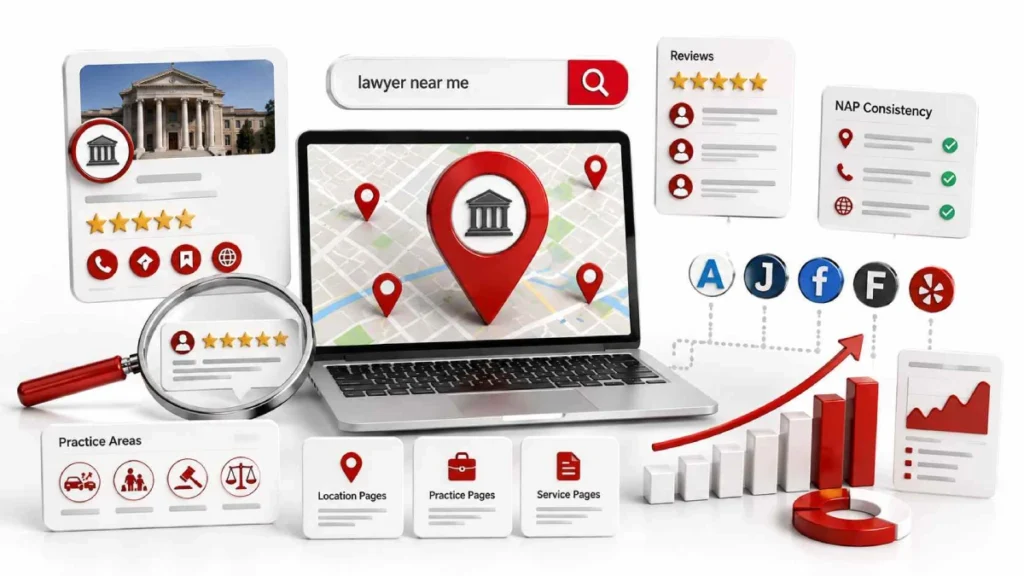
Setting up your Google Business Profile means claiming your listing, verifying your address, and filling in accurate details. This one profile carries 32% of your local ranking weight. Skipping it means losing most of your visibility.
Start with a specific category, like “Personal Injury Attorney,” not only “Law Firm.” Add real photos, correct hours, and a clear description.
A few rules matter too. Google requires a real, staffed office, not a virtual address. Your business name must match your official registered name exactly.
Do Local Keyword Research the Right Way
Doing local keyword research means finding the exact phrases clients type before hiring a lawyer near them. Tools like Google Keyword Planner, SEMrush, and Ahrefs show these search terms clearly. Look for phrases that combine a service with a city, like “Chicago divorce lawyer.”
Focus on intent, not just volume. A phrase like “car accident lawyer Houston” signals someone ready to call. Broader terms like “personal injury law” attract researchers, not clients.
Avoiding Keyword Cannibalization
Keyword cannibalization occurs when multiple pages on the same website target the same keyword. This splits your ranking power and confuses Google. Assign one clear keyword per page to fix it.
Build Location and Practice Area Pages
Building location and practice area pages means creating separate pages for each city and service you handle. This helps Google match your firm to exact searches, like “Miami slip and fall lawyer.” Structure your site in layers: a main practice page, service pages like car accidents, and location pages for each city.
Create unique content for every page instead of reusing the same text with a different city name. This helps search engines identify the most relevant page and improves search visibility.
Get More Client Reviews
Getting more client reviews means asking happy clients directly, right after their case closes. Reviews play a key role in local search rankings and help build credibility with potential clients.Firms with 50 or more reviews get 4.4 times more clicks than firms with fewer than 5.
Reviews also build trust fast. According to BrightLocal, 89% of consumers use online reviews as part of their buying process.
How to Ask Clients for Reviews
Asking for reviews works best through a simple, timed request after the case ends. Send a text or email with a direct link to your Google profile. Keep the message short and personal, not generic.
Responding to Negative Reviews
Responding to negative reviews requires caution, since attorney ethics rules limit what you can say. According to ABA Formal Opinion 496, lawyers should avoid revealing client information publicly, as it may violate confidentiality rules. A safe reply simply states, “Professional obligations prevent a detailed public response.”
Keep Your NAP Information Consistent
Keeping your NAP consistent simply means your name, address, and phone number match everywhere online. Mismatched details across directories like Avvo, Justia, and FindLaw confuse Google.
You can still track calls though. Use a tracking number as your primary phone, and keep your real number listed as secondary. That way, tracking works without hurting your consistency.
Earn Local Backlinks and Get Listed in Directories

Earning local backlinks means getting trusted sites, like legal directories, to link back to your firm. Justia, Avvo, and FindLaw are great places to start. Justia alone holds nearly 39% of top organic spots for competitive legal terms.
Local news sites, bar associations, and community sponsorships help too. These links show real local presence, not only online activity.
Make Your Website Mobile-Friendly and Add Schema Markup
Making your website mobile-friendly simply means it loads fast and works well on phones. Most people use their phones instead of desktops when searching for lawyers. A slow, clunky site loses clients before they even call.
Schema markup helps too. It’s code that tells Google your address, hours, and services clearly. Adding LegalService schema connects your website directly to your Google Business Profile.
Local SEO vs. Paid Ads: Cost, Timeline, and Which to Choose
Local SEO costs less over time, but paid ads bring faster results upfront. Local search campaigns return $13 for every $1 spent. Paid ads like Google Ads or Local Services Ads can cost $181 or more per click.
Local SEO usually takes 3 to 6 months to show real ranking gains. Paid ads work instantly, but stop the moment your budget runs out.
| Factor | Local SEO | Paid Ads |
| Cost model | One-time investment, lasting results | Ongoing cost per click |
| Speed | 3 to 6 months | Immediate |
| Long-term value | Builds lasting visibility | Stops when budget ends |
Most firms benefit from both. Use paid ads for quick leads, and let local seo for law firms build steady, long-term visibility.
Getting Started With Local SEO for Your Firm
Getting started with local SEO means fixing your Google Business Profile first, then building out from there. Start with your primary category, address, and photos. This one step covers 32% of your ranking weight.
Next, clean up your NAP details across directories like Avvo, Justia, and FindLaw. Then focus on gathering reviews and building location pages for each city you serve.
FAQs
What is local SEO for law firms?
Local SEO for law firms is optimizing your online presence to rank higher in geographic searches. It includes Google Business Profile, location pages, directories, and reviews.
Is local SEO worth it for small law firms?
Yes, local SEO is worth it for small law firms competing against bigger budgets. It returns $13 for every $1 spent, more cost-effective than paid ads.
How do I improve my law firm’s local SEO?
Improve your local SEO by optimizing your Google Business Profile first, since it carries the largest ranking weight. Keep NAP consistent across directories like Avvo, Justia, and FindLaw.
What happens if my law firm has inconsistent NAP information?
Inconsistent NAP confuses Google and weakens your local rankings. Firms with mismatched details across three or more directories face up to 74% exclusion from AI search answers.
What tools help with local SEO for law firms?
Google Business Profile, SEMrush, and Ahrefs are the primary tools for local SEO. Legal directories like Avvo and Justia also function as citation-building tools.
Does local SEO actually generate more clients for law firms?
Yes, local SEO generates more clients by placing firms in front of high-intent searchers. Firms with 50 or more reviews get 4.4 times more clicks than firms with fewer than 5.
What happens if a law firm relies only on AI tools for SEO?
Relying only on AI tools risks compliance errors and generic, duplicate content. Human oversight is still required for ethical accuracy and quality control.
Conclusion
Local SEO for law firms works best when a few core pieces come together. Start with your Google Business Profile since it carries the biggest share of your ranking weight. Keep your NAP details consistent across directories like Avvo, Justia, and FindLaw, and build separate location pages for each city and practice area you serve. Reviews matter too, both for building trust and signaling prominence to Google.
Add schema markup and a mobile-optimized site on top of this, and you cover the technical side many firms overlook. These pieces don’t work well in isolation, but together they build lasting visibility that paid ads can’t replicate once the budget runs out.
Start by claiming and optimizing your Google Business Profile today, then work through the rest one step at a time.

19 August 2026
Local SEO for Restaurants: Complete Guide

19 August 2026