


Most agencies find white label local seo the same way. A client wants to know how to improve Google Maps rankings. You say yes, then realise nobody on your team can deliver it.
So you improvise. You try learning it between projects. You hire a cheap freelancer who disappears by month two. Or you refer the work out and watch another agency keep the account. Each attempt costs money, time, and sometimes the client.
This guide fixes that. You will learn what belongs in a real package, what providers charge, and what you keep after overhead. It also covers contracts, profile ownership, and what to do when a provider fails you.
Key Points:
- You sell, they build. A provider runs the campaign while your agency keeps the client, the brand, and the strategy.
- Wholesale sits at $150 to $1,200 per location. Mark it up 2x to 3x, but never sell below $800 retail.
- Your real margin is around 46%, not 60%. Account manager time pulls roughly $200 out of every $1,500 client.
- Protect the relationship in writing. An NDA, a non-solicitation clause, and a 30-day exit stop most partnership problems.
- Your client owns the Google Business Profile. Your agency holds access above the provider, never the other way round.
- Audit 10% of the work monthly. You outsourced the labour, not the responsibility for it.
What Is White Label Local SEO?
Definition
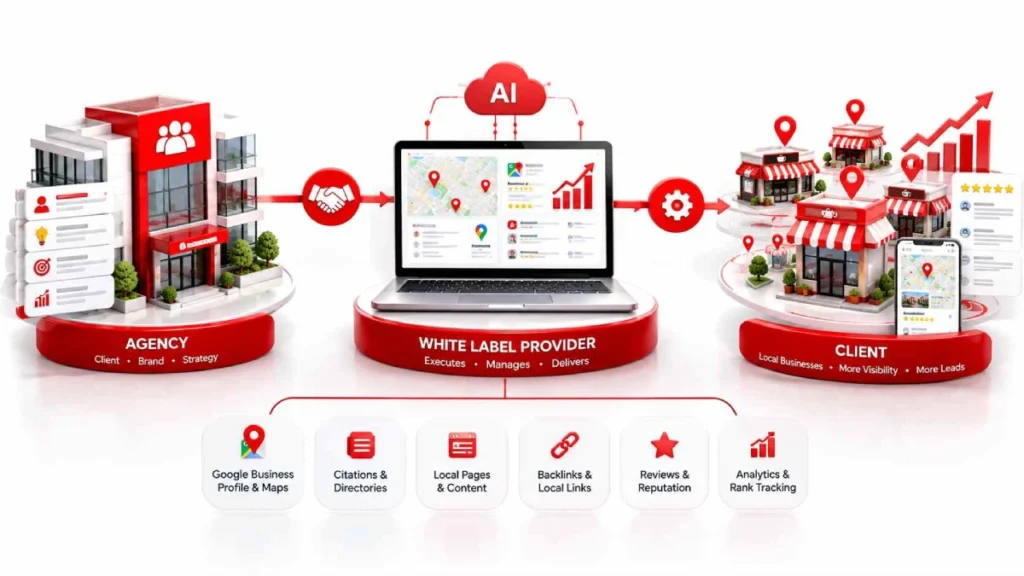
White label local SEO is an arrangement where an outside team runs a local search campaign, and your agency delivers it under its own name. You sell it. Someone else builds it.
The provider works quietly in the background. Nothing they produce carries their branding. Reports, audits, and dashboards all show your logo and your domain. Your client works exclusively with your agency.
Purpose
The point is speed. An agency can start selling local SEO this month instead of spending six months hiring for it.
Most agencies land here for the same reason. A client asks for something the team cannot fulfil. Web designers, ad agencies, and branding studios hit this wall constantly. Rather than lose the work, they buy the delivery and keep the account.
How It Works
There are three parties in this model, not two.
The provider does the work, stays anonymous, and bills you at a wholesale rate. Your agency sells, prices, communicates, and owns the client relationship. The end client pays your retail price and never hears the provider’s name.
Here is the flow, start to finish:
- You sign a partner. Agree on scope, turnaround times, and wholesale pricing.
- You sell the service. Set your own retail price and package it your way.
- You hand off the intake. Send account access, target locations, and priority services.
- They execute. Profile management, citation cleanup, local pages, and links.
- You deliver. Check the work, add your read on it, then present it to the client.
Your agency keeps strategy and the relationship. The provider keeps execution. That line matters more than anything else in this model.
How Local Differs From Regular SEO
This is not standard SEO with a city name dropped into the title tag. Local search rankings rely on a different set of ranking signals. Proximity to the searcher affects rankings. So does the Google Business Profile itself, which sits outside your website entirely. A business can have a strong site and still lose the map pack to a weaker competitor two miles closer.
The core inputs are:
- The profile. Categories, services, hours, photos, posts, and Q&A.
- Listing consistency. Matching Name, Address, and Phone across Yelp, Bing Places, Apple Maps, and industry directories.
- Aggregator data. Data Axle, Foursquare, and TransUnion Localeze feed hundreds of smaller sites downstream.
- Reviews. Volume, recency, and what the text actually says.
Reviews pull heavier weight than most agencies expect. BrightLocal’s 2026 Local Consumer Review Survey of 1,002 US adults found 97% of consumers read reviews before picking a local business, and 47% skip any business with fewer than 20 reviews. Rankings alone don’t win customers.
Example
Picture a small web design studio. They built a site for a roofing company last year. The roofer calls. He is not showing up on Google Maps, and his competitor is. The studio has no SEO staff and no map pack experience. They could refuse the job. They could guess their way through it and risk the relationship.
Instead they send it to a white label partner for $600 a month and charge the roofer $1,500. The partner cleans the listings, fixes the profile, and builds out service-area pages. The studio reviews it, reports on it, and keeps the client.
A one-time website build just turned into recurring revenue. That is the whole appeal of white label local SEO.
What’s Included in a White Label Local SEO Package
A standard package covers three things: one-time setup, monthly execution, and branded reporting. Setup usually runs 7 to 14 days. Everything after that follows a monthly cycle.
Scope changes with price, so no two providers offer the same list. Ask for exact volumes before you sign.
- Google Business Profile management. Categories, services, posts, photos, Q&A.
- Citation building and cleanup. New listings, duplicate removal, NAP fixes.
- On-page local SEO. Title tags, headings, LocalBusiness schema, location pages.
- Local link building. Chambers of commerce, local news, sponsorships.
- Review support. Request workflows, monitoring, response templates.
- Branded reporting. Map pack rankings, calls, direction requests, form fills.
Should You White Label, Hire, or Refer It Out?
White label if you want local SEO revenue now. Hire in-house if local SEO is your core service. Refer it out if you want zero risk. The right call comes down to client volume and cash flow.
White labeling costs almost nothing upfront and keeps the client yours. Hiring runs $55,000 to $75,000 a year and takes 3 to 6 months to pay off. Referrals pay a 5% to 15% commission, but you lose the account.
What It Costs and What You’ll Actually Keep
Wholesale rates run $150 to $1,200 per location per month. Most agencies mark that up 2x to 3x and keep 40% to 55% net. Your real profit depends on how much time your team spends on the account.
Providers price per location, not per hour. Basic packages ($150 to $300) fit solo consultants and rural trades. Standard packages ($450 to $700) fit suburban dentists, plumbers, and law firms. Advanced packages ($800 to $1,200+) suit personal injury attorneys and multi-location healthcare groups.
The Real Margin Math
Take one client at $1,500 retail with a $600 wholesale cost. Gross profit looks like $900, but 4 hours of account manager time at $50 an hour pulls $200 back out. Your actual net is $700, or 46.7%.
Most guides stop at the $900 figure. That is not what you keep, and the gap widens as prices drop. Sell the same client at $900 and your net falls to $100, which is why white label local seo rarely works below an $800 retail floor.
How to Choose a Provider
Judge a provider on process, not on price. Ask for niche case studies, a sample report, and their exact link building method before you commit.
Run one pilot client first. A single account for 60 to 90 days tells you more than any sales call. You will see their turnaround speed, their communication habits, and the real quality of their work.
Questions to Ask Before You Sign
Five questions separate a real partner from a reseller with a nice website.
- “Do you have case studies from my industry?” Ask for map pack rank retention over 6 months, not a single screenshot.
- “How exactly do you build local links?” You want chambers of commerce, local news, and sponsorships. Not private blog networks.
- “What happens if a Google Business Profile gets suspended?” They should have a written reinstatement process.
- “Who is my dedicated point of contact?” A named account manager beats a shared support inbox.
- “Can I see a live sample dashboard on my own domain?” Test the branding before your client sees it.
Ask for deliverable volumes in writing too. “10 citations and 4 profile posts each month” is easy to verify. Ongoing optimization” is not.
Red Flags to Walk Away From
Some signals should end the conversation immediately.
- Guaranteed number one rankings. Google warns against this directly. Local rankings shift with searcher proximity, so nobody can promise a fixed spot.
- Cheap bulk link packages. Offers like “500 local links for $99” often rely on spammy profiles and can risk penalties.
- Hidden methods. If they call it proprietary and refuse to share work logs, walk.
- Ownership requests. A provider should never ask your client for owner access to their Google Business Profile.
- No review workflow. BrightLocal’s 2026 Local Consumer Review Survey of 1,002 US adults found 47% of consumers skip businesses with fewer than 20 reviews. A package ignoring reviews is incomplete.
One last check before signing. Ask how they handle a poor-performing month. A partner who explains a ranking drop honestly is worth more than one who only sends good news.
Protect Your Agency: Contracts and Account Ownership
Two things protect you: a signed agreement with clear terms, and an account structure where your agency holds the keys. Most agencies skip both and find out too late.
This is where agencies lose clients, review history, and years of ranking data. Sort it before your first handoff, not after a problem.
What Your Agreement Must Cover
Six clauses matter most: an NDA, a non-solicitation clause, itemized monthly deliverables, turnaround times, data ownership, and a 30-day exit with clean asset transfer. Add a remedy clause too, so missed deadlines trigger service credits.
One note on non-competes. The FTC struck down the nationwide ban and removed it from federal regulations in February 2026. State laws now determine enforcement.
Who Should Own the Google Business Profile
The client stays the primary owner. Your agency holds owner or manager access. The provider gets manager access through your account only, never their own. Never let a provider create client assets under their master account. If the partnership ends, you can lose the verified profile, the reviews, and years of rank history.
How the Workflow Runs Day to Day
Every message flows through your agency. The client talks to you, you talk to the provider, and the answer returns the same way. The provider never communicates with the client directly.
That single rule keeps the model clean. Break it once and the client starts wondering who actually runs their campaign.
The Monthly Cycle
| Step | Who Handles It | What Happens |
| 1. Onboarding | Your agency | Collect account access, target locations, service priorities, brand guidelines |
| 2. Handoff | Your agency | Pass intake through their portal or a shared board in Asana, ClickUp, or Basecamp |
| 3. Audit and setup | Provider | Technical audit, citation audit, profile optimization, delivered in 7 to 14 days |
| 4. Execution | Provider | Citations, profile posts, on-page updates, local links on schedule |
| 5. Reporting | Both | Provider sends the branded report by the 3rd. You add context and present it |
Keep Your Team in the Middle
Your account manager handles all client contact. Technical questions go to the provider internally, then come back in plain language. Do not forward raw SEO notes to a plumber or a dentist.
Check the Work Before the Client Does
Audit 10% of deliverables monthly. Confirm citations are live, check where new links sit, and watch for keyword stuffing in the business name. That habit keeps a white label local seo setup safe.
When Things Go Wrong
Four problems cause most white label failures: profile suspensions, ranking drops, missed deadlines, and a provider going quiet. Each one has a fix, but only if you planned for it first.
Your client will not care whose fault it was. They hired you, so keep the response calm and keep the communication yours.
The Google Business Profile Gets Suspended
Suspensions usually trace back to keyword stuffing in the business name, an address mismatch, or a sudden category change. Have the provider fix the trigger, then file the reinstatement request with proof of operation like business registration, utility bills, and signage photos.
Tell the client early. Most cases resolve in 7 to 14 days, and framing it as a verification review keeps the conversation calm.
Rankings Drop After an Update
Do not let anyone panic-edit the account. Ask the provider to compare your client’s profile against the businesses now holding the map pack, then rebuild from the basics.
Reviews move fastest here. BrightLocal’s 2026 survey of 1,002 US adults found 41% of consumers always read reviews when browsing, up from 29% a year earlier.
The Provider Misses Deadlines
One late report is normal. A pattern is not, and your contract should already trigger service credits after two misses in a quarter.Keep two backup providers warm at all times. A short call every few months keeps that option open.
The Provider Disappears
Vendors shut down, get acquired, or stop replying. You survive it only if your agency holds owner access to every client profile.Export reports and audits quarterly and store them yourself. With clean access, switching a white label local seo partner takes 2 to 3 weeks.
Proving Value to Your Client
Report on calls, direction requests, and form fills, not rankings. A plumber does not care about position 3. He cares whether his phone rings more this month.
Send a 1-page summary first, with charts behind it. Answer four questions in plain language: what did we do, what changed, why does it matter, and what happens next. Then set the timeline early, since local SEO takes 90 to 180 days to compound.
Is White Label Local SEO Still Worth It in 2026?
Yes, but what you buy has changed. Margins between 40% and 55% still hold, and local businesses still need the work. The difference is where their customers now find them.
AI tools jumped from 6% to 45% as a local discovery channel in a single year, according to BrightLocal’s 2026 survey of 1,002 US adults.Google’s share of reviews dropped from 83% to 71%. So pick a partner who works beyond Google, covering Apple Business Connect, Bing Places, and Yelp.
Mistakes That Cost Agencies Money
Most white label failures come from six avoidable mistakes. None of them involve the provider’s SEO skill.
Fix these before you sign your first partner. Each one costs real money.
- Quoting before auditing. Price the retainer after you see the profile, penalties, and citation mess. Not before.
- Promising fast results. Local SEO takes 90 to 180 days. Clients who expect wins in 30 days cancel early.
- Selling below $800 retail. Account management eats the margin. A $900 client can leave you $100 net.
- Skipping the pilot. Test one client for 60 days before sending a provider five accounts.
- Set and forget. Audit 10% of deliverables monthly. Your brand carries the blame, not theirs.
- Absorbing scope creep. Extra locations, rush content, and site redesigns need their own price. Every time.
One more worth adding. No written contract. Skip the NDA and non-solicitation clause, and you have no protection when a provider approaches your client directly.
FAQs
What is white label local SEO in simple terms?
White label local SEO is outsourced local search work that your agency resells under its own brand. The provider handles Google Business Profile management, citations, and local links while staying invisible to the client.
Do I need to understand local SEO myself to resell it?
Yes, enough to check the work and answer client questions. You should recognize a weak citation report, a spammy backlink, and a business name stuffed with keywords.
How many clients do I need before this makes sense?
Around 10 local clients is where white labeling stops being a side offer. At roughly $700 net each, that produces about $84,000 a year without a single hire.
How long before a client sees results?
Local SEO typically takes 90 to 180 days to compound. Early signals show up sooner through listing accuracy, profile completeness, and review growth.
What happens if I only track rankings?
You lose clients who cannot connect rankings to revenue. Track calls from the Google Business Profile, direction requests, and form submissions instead.
Can I switch providers without disrupting my clients?
Yes, if your agency holds owner access to every client account. With clean access and exported reports, a transition takes 2 to 3 weeks and stays invisible to the client.
Conclusion:
White label local SEO lets your agency sell local search services without hiring a team. A provider handles execution while you keep the client, the strategy, and the brand. The margins hold up at 40% to 55%, as long as you count your own account management time and stay above an $800 retail floor.
The rest comes down to protection and honesty. Sign an NDA and a non-solicitation clause, keep your client as primary owner of their Google Business Profile, and audit 10% of the work each month. Then set a realistic 90 to 180 day timeline and report on calls and leads, not rankings.
Start with one pilot client for 60 days, and scale only once the provider earns it.

30 September 2026
Local SEO Services: What’s Included and What to...

30 September 2026