
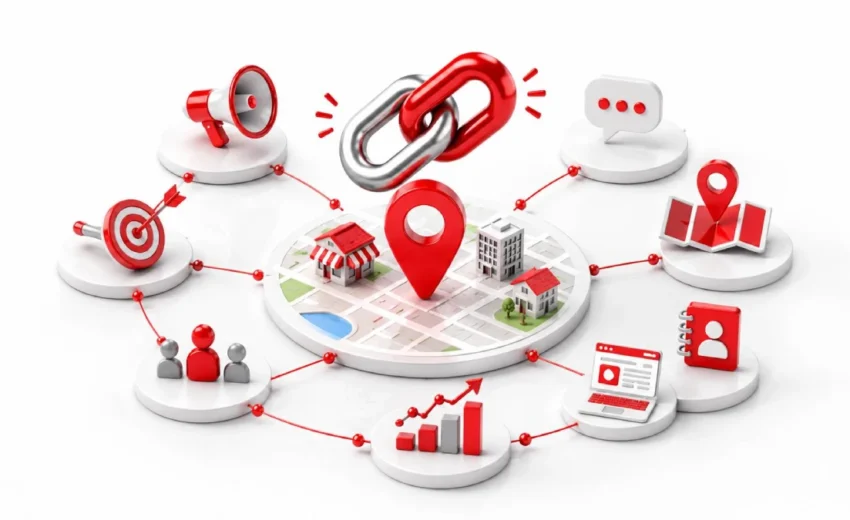
Local backlinks are the missing piece for most businesses struggling to rank in local search. You might have a great website, solid reviews, and an optimized Google Business Profile, but without links from nearby trusted websites, Google has no strong reason to rank you above competitors.
In this guide, you will learn 15 proven strategies to earn local backlinks. From quick wins like directory listings to stronger plays like journalist outreach and government website links.
Key Points:
- Nearby websites link to your business and signal trust to Google.
- Google’s #1 ranked pages carry 3.8 times more backlinks than pages in positions 2 through 10
- Citations and backlinks are different. A citation is just a name and address mention, not a clickable link
- Start free with directory listings, community partnerships, and unlinked mention outreach.
- Links from .edu and .gov websites carry more authority than almost any other source
- Aim for 3 to 5 quality local backlinks per month and track everything in Google Search Console
What Are Backlinks and Why Do They Matter for SEO?
Backlinks are links from other websites pointing to yours. Google uses them as trust signals to decide where your site ranks. Every time a local newspaper or community blog links to you, Google sees it as a vote of confidence. The more quality votes you have, the higher you climb.
Google ranks pages with 3.8 times more backlinks in position #1 than pages sitting in positions 2 through 10. For local businesses, links from nearby sources carry even more weight. They tell Google both that you are trustworthy and exactly where you operate.
15 Link Building Strategies to Boost Your Rankings
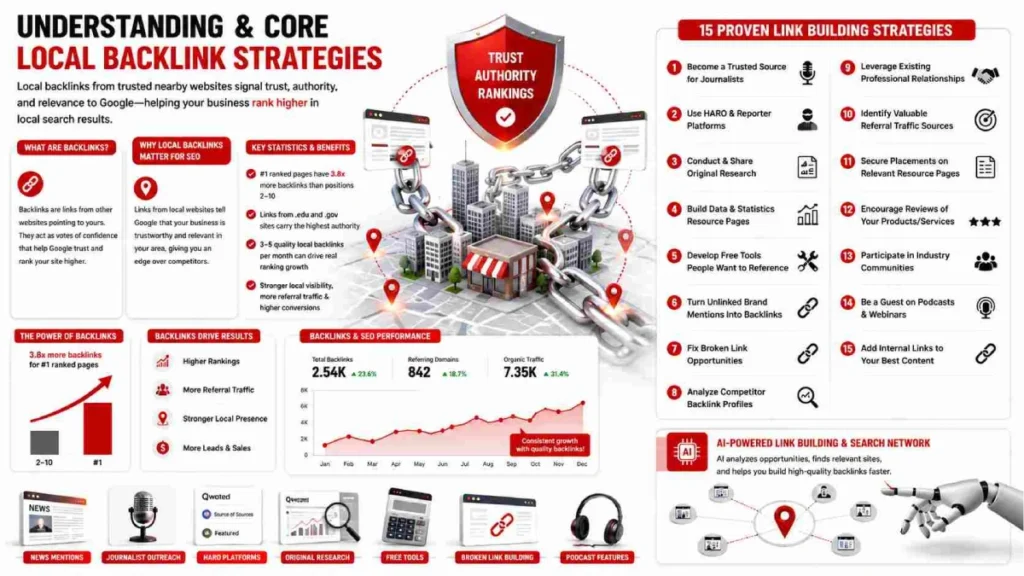
These strategies work for any website. They are useful for local businesses trying to build authority and earn local backlinks. Start with the ones that match your current resources.
1. Become a Trusted Source for Journalists
Journalists need expert quotes. When they use yours, they link back to your website. Reach out to local reporters and introduce yourself as an available source. A single mention in a local newspaper can earn you a high-authority backlink fast.
2. Use HARO Services to Connect With Reporters
HARO connects you with journalists looking for expert sources. Sign up on platforms like Source of Sources, Qwoted, or Featured.com. Respond to queries in your area of expertise. Keep your pitch short and specific. Journalists choose sources who get to the point fast.
3. Conduct and Share Original Research
Publishing original research earns 8 times more backlinks than standard blog content. Run a simple local survey using Google Forms. Compile the results and publish them as a report. Local publications link to original data because it gives their articles a credible source.
4. Build Data and Statistics Resource Pages
A statistics page earns backlinks because writers search for data to support their content. Pick a topic close to your business. A local contractor could build a page of housing statistics for their city. Update the page once a year to keep it relevant.
5. Develop Free Tools People Want to Reference
A free online tool earns backlinks because people keep using it and sharing it. Good examples include a mortgage calculator for a local broker or a cost estimator for a contractor. Once the tool is live, other websites link to it without you asking.
6. Turn Unlinked Brand Mentions Into Backlinks
When someone mentions your business without linking to your site, that is a backlink you have not claimed yet. Set up Google Alerts for your business name and check them daily. When you find an unlinked mention, send a short email asking the author to add a link.
Use the TRACK framework to stay organized:
- T – Target all brand name variations and staff names
- R – Reach mentions across news sites, blogs, and social platforms
- A – Alert and triage your monitoring tools daily
- C – Categorize and send personalized outreach emails
- K – Keep score of conversions and ranking changes
7. Fix Broken Link Opportunities
Broken link building works because you help a website owner fix a real problem. Find broken links on local websites using free tools like Check My Links or Ahrefs. Offer your own content as a replacement. Outreach campaigns using this method achieve conversion rates above 5%.
8. Analyze Competitor Backlink Profiles
Your competitors have mapped out the best link opportunities for you . Use tools like Ahrefs, Semrush, or Moz to pull up a competitor’s backlink profile. Look for local directories and organization listings they have that you do not. If a website is linked to 3 or more competitors, it will likely link to you too.
9. Leverage Existing Professional Relationships
The easiest local backlinks come from people who already know your business. Think about your suppliers, business partners, and long-term clients. Many of them have websites and would add a link if you asked. A simple email to 10 contacts can earn you 3 to 5 backlinks within a week.
10. Identify Valuable Referral Traffic Sources
If a website already sends visitors to your site, their audience matches yours. Open Google Analytics and filter by Referral to see which sites drive real traffic. Use that list to find similar websites and pitch them for a link. The audience fit is already proven.
11. Secure Placements on Relevant Resource Pages
People curate resource pages as lists of helpful links. Getting listed on one earns you a long-term backlink. Search Google using phrases like “best [your service] in [your city] resources” to find pages worth targeting. Send a short pitch explaining what your business does and why it belongs on their list.
12. Encourage Reviews of Your Products or Services
When local bloggers review your business, they almost always include a link to your website. Offer a free product or service to local content creators in exchange for an honest review. Review signals make up 20% of the Local Pack ranking algorithm. This strategy builds both backlinks and local SEO authority.
13. Participate in Industry Communities
Showing up in local online communities builds visibility over time. Join platforms like Nextdoor, local Facebook groups, and local Reddit communities like r/yourcity. When you help others, they visit your website and link to your resources naturally.
14. Appear as a Guest on Podcasts
Podcast hosts publish show notes with a direct link to their guest’s website. Search for local business podcasts on Spotify, Apple Podcasts, or Listen Notes. Send a short pitch explaining what value you bring. One appearance earns you a backlink and introduces you to a new local audience.
15. Strengthen Your Internal Linking Structure
Internal links are not local backlinks from outside sites. But they control how authority from backlinks spreads across your website. Every time you earn a backlink to one page, internal links carry that authority to your other pages. Aim for 3 to 5 internal links per blog post. Use clear anchor text like “local link building guide” instead of “click here.”
Local Link Building Strategies
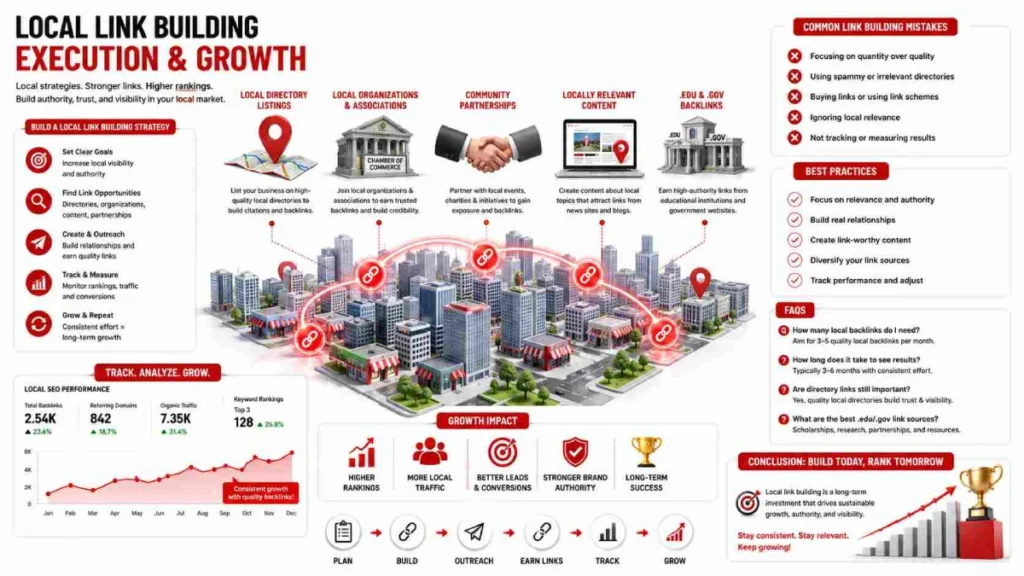
Local link building means getting backlinks from websites in your city or community. These links tell Google your business is a trusted part of the local area. That improves your rankings in local search and Google Maps.
Build a Local Link Building Strategy
Start with a simple plan before reaching out to anyone. Check your existing backlinks in Google Search Console. Then look at what your top local competitors have using tools like Ahrefs or Ubersuggest. Set a goal of 3 to 5 quality local backlinks per month. Track everything in a simple spreadsheet.
List Your Business in Local Directories
Listing your business in local directories is the fastest way to build your first local backlinks. Start with Google Business Profile, Yelp, Better Business Bureau, Apple Maps, and your local chamber of commerce. Keep your business name, address, and phone number identical across every listing. Even small differences can confuse Google and hurt your rankings.
Connect With Local Organizations and Associations
Joining local organizations gives you backlinks from trusted websites in your area. Target your local chamber of commerce, Rotary clubs, trade associations, and nonprofit boards. Their member directories almost always include a link to your site. Do not just join and go quiet. Volunteer, speak at events, and contribute to newsletters.
Build Strategic Community Partnerships
Partnering with local businesses is one of the easiest ways to earn natural backlinks. A local gym can partner with a nutritionist. A wedding photographer can partner with a florist. Each partner adds the other to a recommended local businesses page. Both sites benefit from the link.
Create Locally Relevant Content
Publishing content about your local area attracts links from local news sites and community blogs. Good ideas include neighborhood guides, local market reports, and city-specific event roundups. Original research earns 8 times more backlinks than standard blog content. A data-driven local report is always worth the effort.
Earn Links From Educational and Government Websites
Links from .edu and .gov websites carry more authority than almost any other source. The easiest way to earn .edu links is to launch a small local scholarship. Reach out to nearby colleges and trade schools. They list external scholarships with a link back to your site. For .gov links, register as an approved vendor on your city procurement portal. Approved suppliers get a profile page with a direct link to their website.
Common Link Building Mistakes to Avoid
Avoiding these mistakes saves you time and protects your rankings:
- Confusing citations with backlinks. A citation is just a name and address mention, not a clickable link.
- Chasing quantity over quality. Five links from trusted local sites beat 50 from random directories.
- Submitting to spammy directories. Always check the directory has real traffic before listing your business.
- Sending generic outreach emails. Personalize every message or it gets ignored.
- Ignoring existing relationships. Vendors, partners, and clients are your easiest backlink sources.
- Building links only to your homepage. Spread links across service pages and location pages too.
- Over-optimizing anchor text. Mix branded terms, plain URLs, and neutral phrases to look natural.
- Buying backlinks. Google penalties can tank your rankings overnight and are very hard to recover from.
- Expecting instant results. Most sites see meaningful movement within 4 to 12 weeks.
- Not tracking your backlinks. Use Google Search Console or Ahrefs to monitor what you build and what you lose.
FAQs
What are local backlinks?
Local backlinks are links from websites in your city or community pointing to your business site. They tell Google your business is a trusted, relevant part of the local area.
How many local backlinks do I need to rank in local search?
There is no fixed number, but 3 to 5 quality local backlinks per month is a strong pace for most small businesses. Quality and relevance always matter more than volume.
Are local directory listings considered backlinks?
Yes, but only if the listing includes a clickable link to your website. If it only shows your name, address, and phone number, it is a citation, not a backlink.
What is the difference between a local backlink and a local citation?
A citation records your business name, address, and phone number across the web. A backlink is an actual clickable link pointing to your website.
Do nofollow backlinks from local sites help SEO?
Yes. Nofollow links still drive real referral traffic and build brand visibility. Google also uses them as entity trust signals in AI-powered search.
What happens if I buy backlinks for my local business?
Google can issue a manual penalty that removes your site from search results. Recovery takes months and is never guaranteed.
What happens if I only build links to my homepage?
Your service pages and location pages stay weak in rankings. Always spread backlinks across your most important pages.
Conclusion
Local backlinks are one of the most reliable ways to improve your visibility in local search and Google Maps. Start small, pick 2 to 3 strategies from this guide, and build consistently. Three to five quality local backlinks per month will compound into serious ranking power over time.
The best local backlinks come from real relationships, not shortcuts. Show up in your community, create content worth linking to, and the links will follow naturally.
Ready to rank higher in local search? Start building your first local backlinks today and watch your rankings grow.
10 July 2026