


Most local businesses skip local directory submissions completely. Others submit to hundreds of wrong directories and wonder why nothing improves. Both approaches waste time. Both hurt your rankings.
This guide shows you which directories matter. You will learn how the local search ecosystem works, why NAP consistency controls your rankings, and which mistakes to avoid. Everything you need to build a strong local directory presence is here.
Key Points:
- Quality and consistency beat volume every time in local directory submissions
- Fix Data Axle, TransUnion Localeze, and Foursquare before submitting to any individual directory
- Target 30 to 50 high-quality directories across must-have, niche, and local tiers
- Inconsistent NAP data splits your authority and drops your local rankings
- AI Overviews appear in 68% of local searches, making accurate listings more critical than ever
- Always audit existing listings before adding new ones
What Is a Local Directory Submission and Why Does It Matter?
A local directory submission adds your business details to platforms like Google Business Profile, Yelp, and Apple Maps. Customers and search engines find you there.
Google uses these listings to confirm your business is real, active, and located where you claim. The more trusted platforms list you correctly, the stronger your local search presence grows.
Citation vs. Backlink: What’s the Difference?
In local SEO, a citation refers to a listing of your business name, address, and phone number on another website. A backlink is a clickable link that points directly to your site. Citations confirm your location and build trust. Backlinks pass authority to your website. Many directories, like Yelp and BBB, give you both at once.
Do Local Directory Submissions Still Matter for SEO in 2026?
Yes, local directory submissions still matter in 2026. But the strategy has shifted from quantity to quality.
A listing on Yelp, Apple Maps, or your local chamber of commerce carries more weight than 200 random directory submissions. Google rewards accurate, consistent listings on trusted platforms. It does not reward volume.
AI search platforms like Google AI Overviews, ChatGPT Search, and Perplexity now pull business data directly from trusted directories. AI Overviews appear in 68% of all local search queries. If your listings are missing or incorrect, AI search engines will recommend a competitor instead.
How the Local Search Ecosystem Works
The local search ecosystem is a network of data aggregators. These aggregators distribute your business information to search engines, maps, and apps across the web.
Google, Apple Maps, and Bing do not only rely on what you tell them directly. They pull data from three primary aggregators: Data Axle, TransUnion Localeze, and Foursquare. These aggregators automatically distribute your details to hundreds of directories.
If any aggregator holds wrong data, that data spreads across the web. It can override your Google Business Profile. Fix your aggregator data before you submit to any individual directory.
Which Directories Actually Matter for Local SEO
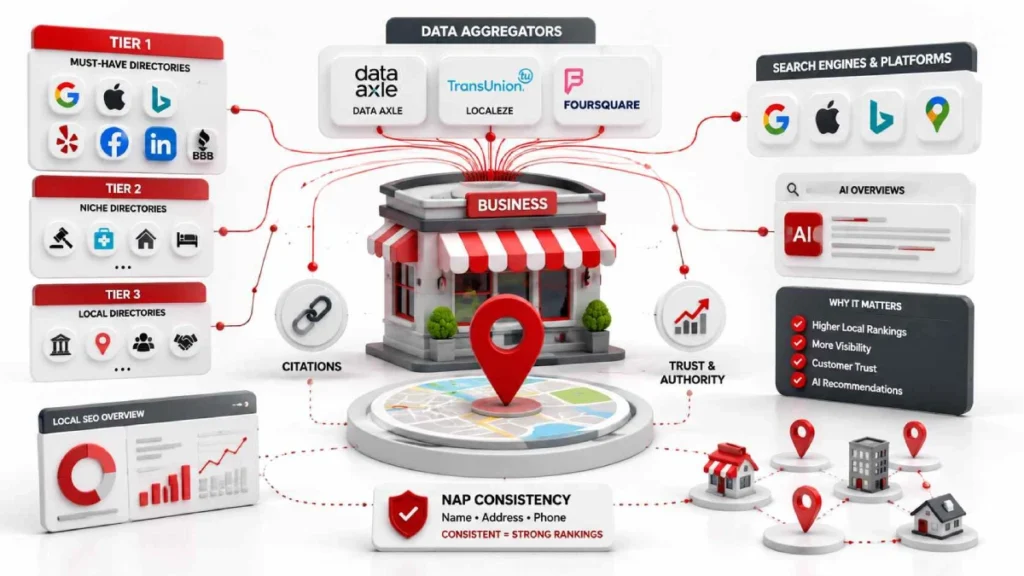
The most valuable directories can be grouped into three tiers based on their authority, relevance, and local reach. Most local businesses benefit from submitting to 30 to 50 high-quality directories across all three tiers. Submitting to hundreds of random ones adds no value. It can also look unnatural to Google.
Tier 1 — Must-Have Directories
Start with these 8 high-authority platforms before you touch anything else. They carry the strongest domain authority. Google, Apple, and Bing trust these sources most when they verify your business.
- Google Business Profile (DA 100) — controls Google Maps and Local Pack visibility
- Apple Business Connect (DA 99) — powers Apple Maps, Siri, and Apple Intelligence
- LinkedIn Company Page (DA 99) — essential for B2B businesses and corporate legitimacy
- Facebook Business Page (DA 96) — drives social trust signals and referral traffic
- Yelp (DA 93) — high consumer trust, feeds Siri and Apple Maps
- Bing Places (DA 93) — covers Microsoft search and Copilot AI recommendations
- Better Business Bureau (DA 91) — validates business legitimacy for search crawlers
- Foursquare (DA 91) — feeds Uber, Snapchat, and Nextdoor automatically
Tier 2 — Niche and Industry-Specific Directories
Niche directories carry topical relevance signals that general directories cannot provide. A plumber listed on Angi sends a stronger industry signal to Google than the same plumber on a generic national directory. Target directories specific to your field:
- Legal: Justia (DA 90), FindLaw (DA 88), Avvo (DA 74)
- Medical: Healthgrades, Zocdoc, WebMD
- Home Services: Houzz (DA 86), Angi, HomeAdvisor
- Hospitality: TripAdvisor (DA 93), OpenTable
Tier 3 — Local and Hyper-Local Directories
Local directories send geographic relevance signals that national platforms cannot replicate. A listing on your city chamber of commerce or a neighborhood platform like Nextdoor tells Google your business sits physically in that community. Target local chamber directories, city government portals, and regional business associations.
How to Spot a Quality Directory vs. a Spammy One
Check these signals before you submit to any directory.
Green flags:
- Manually reviews submissions before approval
- Ranks in Google for relevant local queries
- Has real, active listings with genuine reviews
Red flags:
- Promises instant approval to 500 or more directories
- Has no real traffic or visible user activity
- Forces you to link back to their site from yours
How to Submit Your Business to Local Directories
Prepare all your business information in one document before you submit anywhere. Inconsistencies creep in when you fill out each directory from memory. One master record keeps every listing identical.
Your checklist should include your exact business name, full address, primary phone number, website URL, business hours, categories, a 150 to 250 word description, and photos. Then follow this submission order:
- Fix data on the three primary aggregators: Data Axle, TransUnion Localeze, and Foursquare
- Claim Tier 1 directories: Google Business Profile, Apple Business Connect, Bing Places, and Yelp
- Complete every available field, including photos, services, and holiday hours
- Move to niche and local directories after Tier 1 listings are verified
- Track every listing in a spreadsheet with the profile URL, login, and verification status
Best Tools for Managing Directory Submissions
The right tool depends on your business size, budget, and number of locations.
BrightLocal suits small to medium businesses. It manages citations, tracks rankings, and suppresses duplicates. You own your listings directly with no ongoing fees. Plans start at $39 per month.
Whitespark suits competitor gap analysis. It finds directories your competitors use that you do not. You get direct ownership and no ongoing fees to keep listings live.
Moz Local suits businesses that want simple, automated NAP syncing across major directories. Plans start at $14 per month.
Yext suits larger, multi-location brands. It syncs 200 or more directories in real time, but it uses a rented model. Stop paying, and listings can revert to unmanaged states.
Semrush Local works well for existing Semrush users. It runs on the Yext network, so the same rented model applies.
LocalRank.so is built for AI search visibility on platforms like ChatGPT and Perplexity. Prioritize it if AI search visibility is important to your strategy.
How to Audit Your Existing Directory Listings First
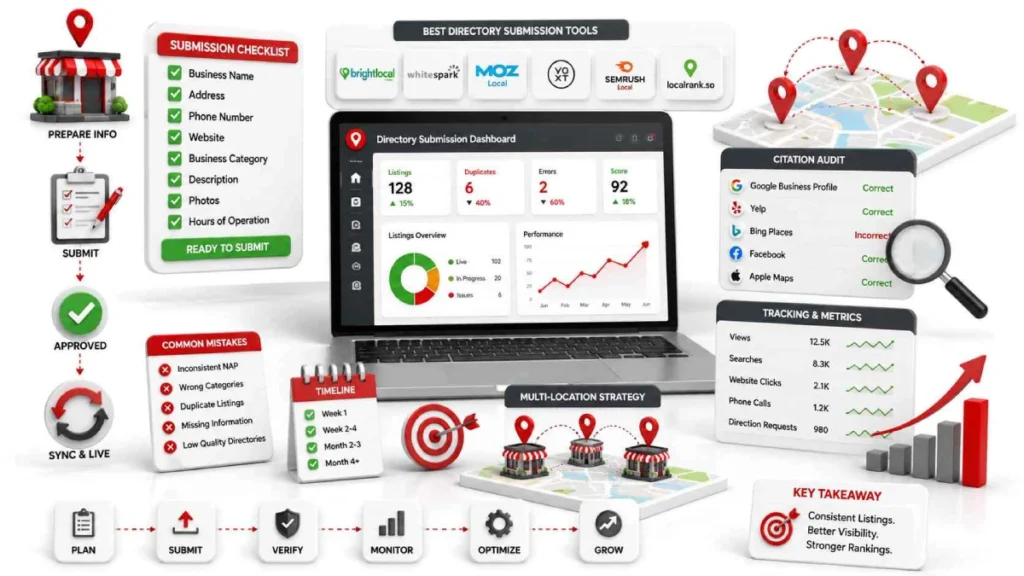
Audit your existing listings before you submit new ones. Adding listings on top of incorrect ones makes the problem worse.
Many businesses already have listings they never created. Data aggregators auto-generate profiles from public records. These profiles are often wrong or outdated. Fix these first. Then build new listings on a clean foundation.
Simple audit process:
- Search Google for your business name and city to find existing listings
- Install the free NAP Hunter Chrome extension to automate directory searches
- Run a citation scan using BrightLocal, Whitespark, or Moz Local
- Search old addresses and previous phone numbers to find ghost listings
- Record every listing in a spreadsheet with the URL, NAP details, and action needed
- Fix Tier 1 directories and aggregators first, then work through Tier 2 and Tier 3
- Re-audit every six months
Do Directory Links Pass SEO Value?
Yes, directory links pass SEO value. But the value depends on whether the link is dofollow or nofollow.
Most major directories, like Yelp, TripAdvisor, and Better Business Bureau, use nofollow links. These still drive referral traffic, build a natural link profile, and strengthen your business entity signals in Google’s knowledge graph. High-authority sources like chamber of commerce websites provide links that pass direct ranking authority. Prioritize those when you can.
Common Directory Submission Mistakes to Avoid
- Submitting to hundreds of low-quality directories. Volume without relevance sends negative signals to Google.
- Inconsistent NAP across listings. Every variation weakens your local search authority.
- Skipping the citation audit. Always fix existing listings before you add new ones.
- Ignoring data aggregators. Wrong data on Data Axle or Foursquare spreads automatically across hundreds of directories.
- Keyword stuffing your business name. Listing as “A1 Phoenix Plumbing | Emergency Plumbers” instead of your legal name violates directory guidelines.
- Using call tracking numbers. These create NAP inconsistencies across your entire directory profile.
- Skipping niche directories. Industry-specific platforms send topical signals that general directories cannot.
- Inconsistent business categories. Different categories across directories confuse Google’s indexing.
- Inconsistent operating hours. Mismatched hours hurt your visibility in “open now” search queries.
- Not verifying listings after submission. Many go live with errors if you skip the check.
- Setting and forgetting. Review and update all listings every six months.
How Long Does It Take to See Results?
Most local businesses see meaningful ranking improvements within 3 to 6 months of completing quality directory submissions.
The timeline follows a predictable pattern. Direct API tools push data to Google Maps, Apple Maps, and Bing Places within the first week. Data aggregators update and distribute to secondary directories between weeks 2 and 4. Downstream directories crawl and index updated listings between weeks 4 and 12. Map Pack and AI search rankings stabilize between months 3 and 6.
Track these metrics while you wait:
- Local keyword rankings using BrightLocal or Semrush
- Google Maps visibility for your main service keywords
- Track referral traffic generated by directory listings in Google Analytics.
- Monitor visits coming from directory listings through Google Analytics.
Directory Submissions for Multi-Location Businesses
Multi-location businesses need separate directory listings for each physical location. One combined listing for the entire brand does not work.
Google treats each location as a distinct entity. Use a unique phone number, address, and dedicated landing page, like brand.com/locations/dallas, for each branch. Tools like Yext or BrightLocal help you manage listings at scale. Kumon managed 650 study centers using BrightLocal. After it cleaned up inconsistent listings, Kumon saw a 63% increase in Position 1 local search rankings.
FAQs
Do local directory submissions still work in 2026?
Yes, they still work when you focus on quality over quantity. Accurate listings on trusted platforms like Google Business Profile, Yelp, and Apple Maps directly influence Google Maps and AI search rankings.
Citation vs. Backlink: What’s the Difference?
A citation is an online reference to your business’s name, address, and phone number, while a backlink is a clickable hyperlink that points to your website.
How many directories should I submit my business to?
Most local businesses benefit from 30 to 50 high-quality directories. Start with Tier 1 platforms, add niche directories, then include local sources.
Are free directory submissions as good as paid ones?
Yes, in most cases. Google Business Profile, Yelp, and Apple Maps are free. They carry more authority than most paid directories.
What Happens When Your NAP Information Is Inconsistent?
Google splits your local authority across ghost listings, and your rankings drop. Fix inconsistencies at the aggregator level first. Then correct individual directories.
Conclusion
Local directory submissions still matter, but only when you do them with precision. Fix your aggregator data first. Claim your Tier 1 directories. Then work through niche and local sources. Thirty to fifty accurate, relevant listings will always outperform hundreds of random ones.
Keep your NAP identical everywhere. Audit every six months. Prioritize quality over volume. That combination builds the local trust signals Google and AI search platforms need to rank and recommend your business.
Start with a free citation audit today. Build your local directory presence the right way.

13 July 2026
How to Get Local Backlinks (15 Proven Strategies)

13 July 2026