


Structured vs Unstructured Citations: What’s the Difference as 46% of all Google searches have local intent, yet most local businesses still get citations wrong. Your rankings stay flat, not because of how many citations you have, but because of the type.
Inconsistent citations confuse Google. When your name appears differently on Yelp, Apple Maps, and Yellow Pages, Google loses trust in your data and pushes competitors above you in local search results.
This article covers both types: structured citations and unstructured citations. You will learn how each one works, why both matter, and how to build them properly.
What Is a Citation in Local SEO?
A local citation is an online mention of your business name, address, and phone number. This is called NAP. Google uses NAP mentions to verify your business is real.
Citations appear on many types of websites. Common sources include Google Business Profile, Yelp, and Yellow Pages. They also appear on local news sites, community blogs, and event pages.
Citations come in 2 forms: structured and unstructured. Structured citations follow a fixed NAP format on directories. Unstructured citations are informal mentions on sites like local newspapers and blogs. Citation signals including NAP consistency and citation volume account for 7% of local pack ranking factors in 2026.
Why Local Citations Matter for SEO
Local citations help Google verify your business and rank you in local search. Google checks your details across Yelp, Apple Maps, and Bing Places. Matching data builds trust. Conflicting data pulls your rankings down.
Citations support Google’s 3 core local ranking factors. Relevance grows when you appear in niche directories. Examples include Avvo for lawyers and Healthgrades for doctors. Distance becomes clear when your address matches across Google Business Profile and Apple Maps. Prominence builds when local newspapers, industry blogs, and community sites mention your business.
In 2026, 3 of the top 5 AI search visibility factors are citation related. Citations support both local pack rankings and AI tools like Google AI Overviews. Businesses with accurate citations rank higher and get found faster.
What Are Structured Citations?

A structured citation is a business listing that appears on an online directory. The platform shows your data in fixed fields. Every listing follows the same format.
Examples of Structured Citations
Structured citations appear on directory platforms. Common ones include Google Business Profile, Yelp, Bing Places, Yellow Pages, and Facebook Business. Niche directories like Healthgrades, Avvo, and Houzz also count. Each platform stores your NAP so search engines can read it.
Benefits of Structured Citations
- Structured citations provide Google with a consistent and clear record of your business information.
- When your NAP matches across Google Business Profile, Yelp, and Apple Maps, Google trusts your data.
- That trust directly boosts your local pack rankings.
- It also makes your business visible on maps, voice tools like Siri and Alexa, and AI search results.
Best Structured Citation Sites
Start with 4 Tier 1 directories. These are Google Business Profile, Bing Places, Apple Maps, and Yelp. Next, list your business with data aggregators like Data Axle, Neustar Localeze, and Foursquare, which spread your details across many websites at once.
What Are Unstructured Citations?
An unstructured citation is any mention of your business outside a directory. These appear in articles, blog posts, and news stories.No specific format is required. Search engines still use them as ranking signals.
Examples of Unstructured Citations
Unstructured citations appear in many places. Common sources are local news articles, blogs, event pages, and press releases. Others include podcast notes, chamber of commerce pages, and social posts. Each one confirms your business exists and where it is.
Benefits of Unstructured Citations
- Unstructured citations send strong trust signals to Google.
- News sites and blogs do not list every business, so your business must earn each mention.
- Google views earned mentions as harder to fake than directory listings.
- Whitespark’s 2026 survey ranks unstructured citation quality among the top 5 AI search visibility factors.
How Unstructured Citations Build Brand Authority
Unstructured citations link your business to trusted sources. When news sites and community pages mention you, Google takes note. These mentions feed into the prominence factor. The more trusted the source, the stronger the signal.
How to Get More Unstructured Citations
The 5 best ways are PR outreach, event sponsorships, guest features, local award entries, and community ties. Pitch your story to city blogs and local papers. Sponsor local events or charity drives. Enter Best of City awards. This earns mentions on high-authority sites.
Structured vs Unstructured Citations: Key Differences
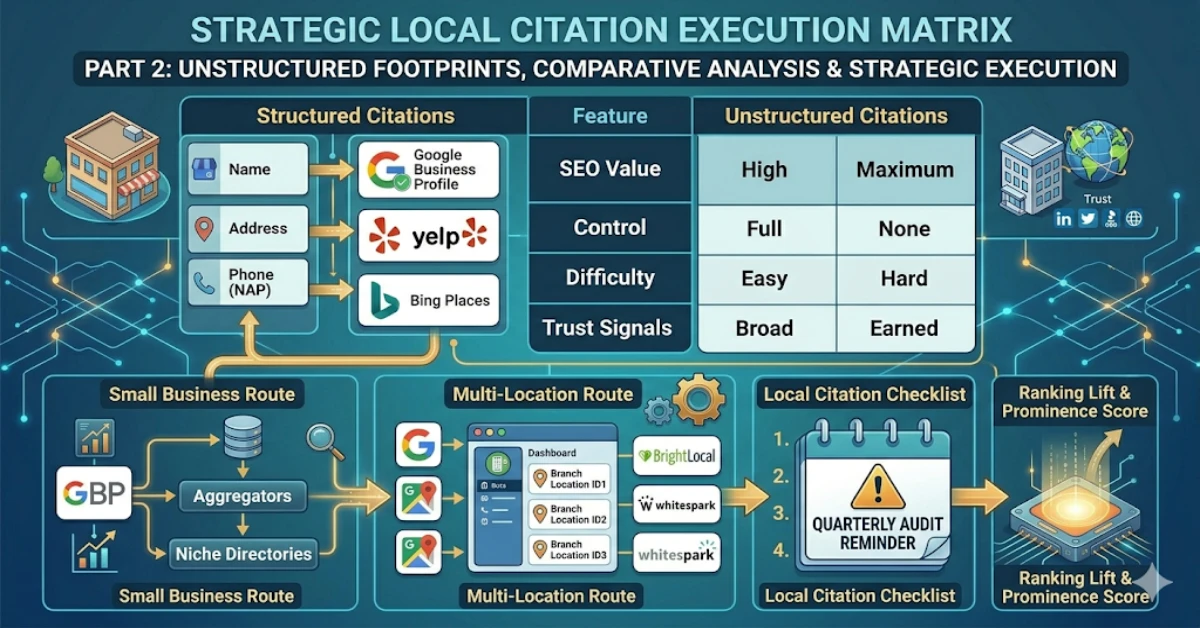
The main difference is format and source type. Structured citations appear in fixed fields on directories like Google Business Profile, Yelp, and Yellow Pages. Unstructured citations appear as editorial mentions on local newspapers, industry blogs, and community pages. Both mention your business but in different ways.
| Feature | Structured Citations | Unstructured Citations |
| Format | Fixed NAP fields | Free form mention |
| Source Type | Directories and listing platforms | News sites, blogs, event pages |
| How You Get Them | Manual submission or paid service | Earned through PR, content, partnerships |
| Control | Full control over details | No direct control |
| SEO Value | Consistency and breadth | Authority and trust |
| Difficulty | Easy to build | Harder to earn |
Structured citations build the foundation. Unstructured citations build the authority on top. A business with 50 consistent directory listings signals trust to Google. A business mentioned in outlets like the Chicago Tribune, Search Engine Land, and Nextdoor signals real world prominence. Citation signals including NAP consistency account for 7% of local pack ranking factors in 2026.
A backlink passes ranking power from one page to another. A citation confirms your business identity and location. Citations matter more for map pack rankings. Backlinks matter more for organic search rankings. A strong local SEO strategy needs both.
How Citations Impact Local SEO Rankings
Citations give Google verified data about your business. Google pulls information from Yelp, Apple Maps, and Data Axle to check your details. The more consistent your data, the more Google trusts you. That trust leads to higher local rankings.
How Citations Support Local Rankings
When your NAP matches across Google Business Profile, Bing Places, and Yellow Pages, Google treats your business as verified.Each consistent citation adds another trust signal. Citation signals including NAP consistency account for 7% of local pack ranking factors in 2026. Inconsistent citations create conflicting signals that suppress rankings.
How Citations Help Google Maps Rankings
Accurate citations confirm your address across multiple sources. Google Maps pulls data from Google Business Profile, Foursquare, and Apple Maps to verify your location. When your address matches across all 3 sources, Google places your pin with confidence. Wrong addresses push your listing down in map results.
How Citations Support Relevance, Distance, and Prominence
Citations feed into all 3 of Google’s core local ranking factors: relevance, distance, and prominence. Relevance improves when you appear in niche directories like Houzz for contractors, Zocdoc for doctors, and Avvo for lawyers. Distance becomes clear when your address matches across Google Business Profile, Bing Places, and Apple Maps. Prominence grows when local newspapers and industry groups mention your business.
How Citations and the Google Map Pack Work Together
The Google Map Pack displays the top three local businesses for a search query. Citations play a direct role in earning one of those 3 spots. Google uses data from Yelp, Facebook Business, and aggregators like Neustar Localeze to rank Map Pack results. In 2026, citations remain part of the trust signals that help determine which businesses appear in the Map Pack and AI search results.
Citation Strategy Based on Your Business Type
Your citation strategy depends on your business size, location count, and current citation status. A new single location business needs a different plan than a chain with 10 locations. Starting with the right sources saves time and builds rankings faster.
Citation Strategy for Small and Local Businesses
Start with 4 Tier 1 directories: Google Business Profile, Yelp, Apple Maps, and Bing Places. Then submit to aggregators like Data Axle, Neustar Localeze, and Foursquare. These reach hundreds of platforms automatically. Finish with niche directories like Angi for home services, Healthgrades for doctors, or FindLaw for lawyers. Research shows 56 to 58% of local businesses have no local SEO program. These steps alone put you ahead of most competitors.
Citation Strategy for Multi-Location Businesses
Each location needs its own citation profile on Google Business Profile, Yelp, and Bing Places. Use a unique local phone number and address for each location. Never combine 2 locations into 1 listing. Use tools like BrightLocal, Whitespark, or Moz Local to manage all locations from one dashboard.
Local Citation Checklist
Complete these 4 core tasks before anything else:
- Claim your Tier 1 listings on Google Business Profile, Bing Places, Apple Maps, and Yelp, and make sure each profile is fully completed.
- Submit to aggregators like Data Axle and Neustar Localeze to push your NAP data to hundreds of platforms automatically.
- Fix any duplicate listings on platforms like Facebook and Yellow Pages before they create conflicting signals.
- Set a quarterly audit reminder to catch new NAP errors early using tools like BrightLocal, Whitespark, or Moz Local.
NAP Consistency: Why It Makes or Breaks Your Local SEO
NAP consistency means your business name, address, and phone number appear in the same format on every platform. Google checks your details across Yelp, Apple Maps, and Yellow Pages. Matching data builds trust. Mismatched data pushes your rankings down.
Small differences cause real damage. “St.” versus “Street” or “Suite 4” versus “Ste 4” can make Google read your listings as 2 different businesses. Duplicate listings on Yelp, Facebook, and Yellow Pages split your citation signals. Outdated details like an old phone number or address mislead both Google and customers.
In 2026, citations form part of the trust layer for local search and AI generated answers. Audit your citations every quarter using tools like BrightLocal, Whitespark, or Moz Local. When your details change, update Google Business Profile and Yelp first. Then update aggregators like Data Axle and Neustar Localeze. Errors there spread to hundreds of directories automatically.
FAQs
How do structured and unstructured citations differ?
Directories like Google Business Profile, Yelp, and Yellow Pages create structured citations through fixed NAP listings. Unstructured citations are casual mentions on news sites, blogs, and event pages.
Do unstructured citations help local SEO?
Yes, They build trust that directories cannot.Google often treats mentions in news articles and blogs as more credible and harder to fake than directory listings.
How do I find inconsistent citations?
Run a citation audit using tools like BrightLocal, Whitespark, or Moz Local to flag NAP errors. Manual checks on Google Business Profile, Yelp, and Apple Maps reveal the most damaging issues first.
What is NAP consistency?
NAP consistency means your business name, address, and phone number appear in the same format on every platform. Even small changes like “St.” versus “Street” reduce Google’s confidence in your listing.
Can citations help my business appear in AI search results?
Yes, The 2026 Local Search Ranking Factors data shows 3 of the top 5 AI search factors are citation related.
Conclusion
Structured and unstructured citations both matter for local SEO. Structured citations build consistency on Google, Yelp, and Apple Maps. Unstructured citations from news sites and blogs build authority and prominence. Keep your NAP correct on every platform. Google will rank you higher.
Start today. Claim your listings on Google Business Profile, Yelp, Apple Maps, and Bing Places. Fix any NAP errors on directories like Yellow Pages and Bing Places. Then earn mentions from local news sites and blogs. That is how you rank above your rivals.

16 June 2026
Fix NAP Inconsistency: Audit & Fix Guide step...

16 June 2026