


Your competitors are getting calls. You are not. The only difference is where they show up online. Most business owners blame their website. But the real problem is citations. A citation is any website that lists your business name, address, and phone number. Google uses these listings to decide which businesses to trust and rank.
Without enough citations, your business stays invisible. Every day without them is a day your competitors get the call instead of you. This article fixes that. You will get a complete list of the best local citation sources by industry, a 6-tier building framework, and a step-by-step workflow to build, audit, and maintain citations the right way.
What Are Local Citation Sources?
A local citation source is any website that shows your business Name, Address, and Phone Number online. Search engines like Google and Bing use these sources to confirm your business is real and in the right location.
The industry term for these three details is NAP ; Name, Address, Phone Number. Every time your NAP shows up on an external website, that counts as a citation. Some people also add the website URL, making it NAPW or UNAP. But the basic three-part NAP is the standard.
Citations do not need a link to count. Even a plain text mention of your business name and address sends a trust signal to search engines.
Why Local Citations Still Matter in 2026
Local citations help Google confirm that your business is real, located at a specific address, and serves a local area. They support local rankings and help your business appear in Google Maps and Local Pack results.
Voice assistants and AI tools also use citation data. Siri pulls information from Yelp and Apple Business Connect. Alexa uses Bing Places. AI search tools read data from platforms like Foursquare, niche directories, and Google Business Profile listings.
Directory sites like Yelp, Angi, and HomeAdvisor also rank in search results. Accurate and consistent citations matter more than quantity. A few trusted listings help more than hundreds of incorrect ones.
Structured vs. Unstructured Citations
Local citations come in two forms: structured and unstructured. Both send trust signals to search engines. The difference is where they appear.
Structured citations
It appears on business directories with set fields for your Name, Address, and Phone Number. You fill in a standard form and your details appear in a fixed format. Examples include Google Business Profile, Yelp, Yellow Pages, and Bing Places.
Unstructured citations
It appear inside regular web content. A local food blogger mentions your restaurant’s address. A newspaper article names your law firm’s phone number. A community events page lists your business as a sponsor. No form needed. The mention itself is the citation.
Both types have value. Structured citations confirm your details to search engine databases. Unstructured citations show that real people and real publications know your business. A strong local SEO plan builds both.
The 6-Tier Framework for Citation Building
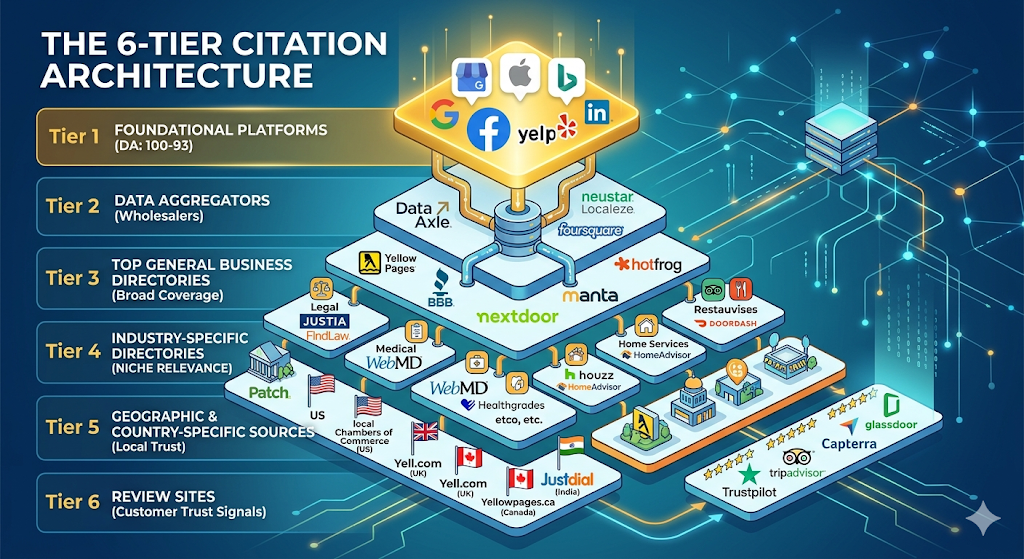
Most businesses make a common mistake. They submit to a few directories and stop, then wonder why rankings do not improve. The issue is not effort but lack of structure.
The 6 Tier Framework organizes citation sources in a clear order. Start with high authority platforms and move down to niche and local ones. Each tier builds on the previous one. Complete Tier 1 before moving to Tier 2 and continue in order.
Here is how the six tiers work:
- Tier 1 Foundational Platforms are the main systems every business should claim first. These include Google Business Profile Bing Places Apple Business Connect Facebook and Yelp.
- Tier 2 Data Aggregators are large databases that share your business info with many smaller sites and apps. Examples include Data Axle Neustar Localeze and Foursquare.
- Tier 3 General Business Directories are high authority sites that list all types of businesses. These include Better Business Bureau Yellow Pages, Manta Hotfrog and MapQuest.
- Tier 4 Industry Specific Directories focus on one industry. Lawyers use Avvo and Justia, dentists use Healthgrades and Zocdoc and contractors use Houzz and HomeAdvisor.
- Tier 5 Geographic and Country Specific Sources include local directories, chambers of commerce and city websites. They confirm your local presence.
- Tier 6 Review Sites are platforms where customer reviews act as trust signals. Examples include Trustpilot G2 TripAdvisor Capterra and Glassdoor.
Tier 1 : Foundational Citation Sources
Tier 1 is non-negotiable. These are the platforms search engines, voice assistants, and AI tools check first. Every local business should claim and complete all six profiles before moving to other tiers.
A half-completed Tier 1 profile does more damage than no profile at all. Anyone can edit an unclaimed listing. Claim every profile, verify ownership, and fill every available field.
Google Business Profile
Domain Authority: 100 | Free
Google Business Profile is the most important citation a local business can have. It controls how your business appears in Google Search, Google Maps, and the Local Pack. Every other citation you build must match the NAP details entered here.
Complete every section business name, address, phone, website, hours, categories, photos, and description. Google uses this profile as the main template to verify your listings across the we
Apple Business Connect
Domain Authority: 99 | Free
Apple Business Connect manages your listing across Apple Maps Siri iOS Spotlight Search Apple Wallet and Apple AI tools. Over 1 billion iPhone users use these platforms for local searches.
Many businesses skip Apple Business Connect and focus only on Google. That is a loss of visibility on every iPhone and Mac running a local search.
Bing Places
Domain Authority: 93 | Free
Bing Places powers local results across the Microsoft ecosystem Bing Search, Bing Maps, and Bing Copilot. It is a key data source for Microsoft AI search tools and has strong desktop search traffic. Claiming your Bing Places profile adds your data to Bing Copilot’s local result
Facebook Business Page
Domain Authority: 96 | Free
A Facebook Business Page works as both a social profile and a structured citation. Search engines index Facebook pages and use the NAP data there as a verification point.
Keep the name, address, and phone number on Facebook identical to your Google Business Profile. Even if you do not use Facebook for marketing, the page must exist with accurate NAP data.
Yelp
Domain Authority: 93 | Free
Yelp is the strongest review-based citation source for local businesses. It ranks on its own for thousands of local queries, feeds data to Apple Maps, and shows up in about one-third of all local AI search queries.
A complete Yelp profile includes your business category, hours, photos, and a keyword-rich description. Complete profiles with active reviews rank higher in Yelp search and Google results.
LinkedIn Company Page
Domain Authority: 99 | Free
LinkedIn confirms your business as a real corporate entity. Search engines use LinkedIn to verify business details especially for B2B companies agencies and professional firms. A complete LinkedIn page with an accurate address improves branded search visibility.
Tier 2 : Data Aggregators
Most business owners are unfamiliar with data aggregators. These companies distribute your business information across directories apps and platforms. Manual updates cannot match their reach. One verified submission spreads your NAP across hundreds of networks.
Aggregators act as wholesalers of business data. Directories navigation systems voice assistants and apps rely on them. Incorrect data spreads everywhere if not fixed. Accurate data also spreads everywhere when correct. There are three main aggregators in North America. Submit to all three. Each feeds different platforms.
Data Axle
Cost: ~$30 per location per year
Data Axle, formerly Infogroup, is one of the oldest business data providers in North America. It sends verified profiles to Yahoo Local, Bing, MapQuest, Citysearch, and public library databases. It also feeds in-car navigation systems used by major car brands.
Neustar Localeze
Cost: ~$30 per location per year
Neustar Localeze, now under TransUnion, manages business identities for search engines and voice platforms. It feeds verified data to Google Maps, Bing Places, Yahoo, Apple Maps, Amazon Alexa, and Siri.
This makes Localeze the most important aggregator for voice search. If your data is wrong in the Localeze database, that wrong data reaches Alexa and Siri. Fix it at the source and it fixes across all connected platforms.
Foursquare
Cost: ~$30 per location per year
Foursquare merged with Factual in 2020 and became the top location data provider for mobile apps and AI platforms. It powers geospatial data for Apple Maps, Uber, Facebook Places, Snapchat Maps, TomTom, and Twitter.
Foursquare also has a direct data deal with ChatGPT. When a user asks ChatGPT for a local business, the answer pulls from Foursquare’s database. A business not listed there is invisible to those AI results.
Important: Data aggregators do not update partner directories right away. After submitting, allow 4 to 8 weeks for the data to spread across partner networks. Do not submit and then check for results the next day.
Tier 3 : Top General Business Directories
Once you complete Tier 1 profiles and Tier 2 submissions, move to general business directories. These platforms accept all business types and have high domain authority. They also rank well in organic search results.
General directories will not replace industry-specific citations, but they build broad national coverage. Most offer a free basic listing that is enough for citation purposes.
Yellow Pages (YP.com)
Domain Authority: 80+ | Free Basic and Paid Advertising
Yellow Pages is one of the most indexed local directories on the web. It ranks well for commercial searches and feeds secondary directories. A free basic listing covers all citation needs.
Better Business Bureau (BBB)
Domain Authority: 91 | Free Basic and Paid Accreditation
The BBB is one of the highest-trust directories for local businesses. A free basic profile lists your business and confirms its existence. Paid BBB accreditation adds a trust badge, which carries weight for service businesses. The free listing alone is a strong citation.
Nextdoor
Domain Authority: 83 | Free
Nextdoor connects businesses with hyper-local neighborhood audiences. It is one of the few directories where proximity is the main filter. A verified Nextdoor profile reaches residents in a defined local area and sends a strong geographic signal to search engines.
Manta
Domain Authority: 50+ | Free Basic and Paid Premium
Manta focuses on small and midsize businesses. Search engines index it and it provides citation coverage for SMBs.. The free basic profile is enough for citation building.
Hotfrog
Domain Authority: 58 | Free Basic and Paid Upgrades
Hotfrog is an active international directory with strong localization features across many countries. It is useful for businesses targeting audiences outside the United States. The free listing covers core citation needs.
MapQuest
Domain Authority: 50+ | Free
MapQuest handles mapping utility searches and works as a secondary navigation citation. It is free to list and feed mapping data to users who use MapQuest instead of Google Maps or Apple Maps.
Superpages
Domain Authority: 50+ | Free
Superpages is a classic local directory powered by the Yellow Pages network. It provides extra citation coverage in the same directory ecosystem. Listing on both Yellow Pages and Superpages covers the full reach of that network.
Free vs. Paid: For citation building, free listings on all seven directories are enough. Search engines index your NAP data, not paid features. Paid upgrades are advertising tools. They improve visibility to users on the platform but do not add citation value. Use your budget for Tier 4 industry directories instead.
Tier 4 : Best Local Citation Sources by Industry
General citations build your foundation. Industry-specific citations build your relevance. Search engines use niche directories to understand what your business does and who it serves. Work through every industry section that fits your business.
Legal
Legal directories are among the most competitive citation sources. Legal services carry high value and need strong consumer trust. Key platforms include Justia (DA 90), FindLaw (DA 88), Avvo (DA 74), HG.org (DA 66), and LawTally (DA 63). Justia and Avvo offer free profiles. FindLaw and LawTally require paid fees.
Medical and Dental
Google classifies healthcare searches as Your Money or Your Life (YMYL) queries. This means Google applies stricter verification to medical results. Verified citations on healthcare directories are a direct trust signal for rankings and patient acquisition. Core platforms include WebMD (DA 94), Psychology Today (DA 93), Healthgrades (DA 70), Zocdoc (DA 75), and RateMDs (DA 63). Most offer free basic profiles with optional paid upgrades.
Home Services and Contractors
Consumers searching for contractors, plumbers, electricians, and HVAC providers have an immediate need. A verified profile on these platforms puts your business in front of high-intent buyers ready to hire. Top platforms include Houzz (DA 89), HomeAdvisor (DA 78), Porch (DA 76), BuildZoom (DA 60), and The Blue Book (DA 53). Houzz and BuildZoom offer free submissions. Networx runs on a paid lead generation model.
Restaurants and Food
The food sector uses structured citations and supports online ordering and delivery. A restaurant listed on TripAdvisor, DoorDash, and Uber Eats works as both a citation source and a revenue channel at the same time. TripAdvisor (DA 93) offers a free profile with optional paid promotion. DoorDash, Uber Eats, and Grubhub run on a revenue commission model. HappyCow (DA 86) is a strong free listing for vegan and vegetarian restaurants.
Real Estate
Real estate platforms connect agent locations with regional MLS databases. They help buyers and sellers find local agents. Core platforms include Zillow Trulia Realtor.com and Redfin. All have domain authority above 90. Free profiles are available on all four, with paid upgrades for promoted listings.
Automotive
Consumers researching dealerships, repair shops, and car rental agencies check specialized directories before making contact. An incomplete profile is a direct loss of leads. Yelp Automotive (DA 93) is the strongest free option globally. CarFax Directory (DA 80+) is free for partnered dealers. Expertise’s automotive category covers the United States market with free and paid placement options.
Hotels and Hospitality
Booking engines and mapping systems crawl hospitality directories to verify room capacity, coordinates, and amenities. Hotels and B&Bs lose booking traffic when they miss these platforms. Competitors take those bookings when they list. Hostelworld (DA 83) is the highest authority free option for global hospitality. HotelPlanner, AllStays, and BNBFinder offer free basic submissions. BBOnline requires a paid entry.
Beauty, Wellness, and Fitness
Directories in this category combine structured citations with direct booking features. Each profile works as both a citation and a revenue tool. Booksy and ClassPass are the two strongest platforms globally, both on a commission-based scheduling model. MyLocalSalon covers the United States market. The Guild of Beauty Therapists serves UK-based professionals.
Financial and Professional Services
Accounting firms, tax advisors, and insurance brokers rely on directories that show professional licensing and compliance. A verified financial directory profile builds credibility and reduces friction. TaxBuzz (DA 41) is the main free option for US-based professionals. AccountantsBook, Insurance Level, and BanksDAILY cover broader global markets.
B2B and SaaS
B2B buyers research software providers and agencies on review platforms before making contact. A verified profile is a critical part of the sales process. GoodFirms (DA 54) and Digital Agency Network (DA 54) are strong global options. They offer free and paid listings. UpCity and Best SEO Companies focus on the United States market. They also offer free basic submissions.
Retail and Ecommerce
Retail directories support inventory discovery, neighborhood promotions, and local reviews. Yelp Retail (DA 93) is the strongest free citation for retail businesses globally. Nextdoor (DA 83) connects businesses with the surrounding residential community. Apsense (DA 75) provides broader global coverage.
Education and Childcare
Academic directories cross-reference state licensing and regional accreditations. Verified listings build trust with parents and guardians. Care.com Childcare Pro (DA 79) is the strongest option here, with free and paid tiers. Private School Review (DA 59) serves US-based private schools with a free basic profile.
Tier 5 : Geographic and Country-Specific Sources
General and industry directories confirm what your business does. Geographic citations confirm where your business operates. Search engines use region-specific directory signals to confirm a business is part of its local economy.
Work through the section that matches your primary market. If your business operates in multiple countries, build citations in each market.
United States
US businesses should target the Better Business Bureau (DA 91), Patch (DA 90) for neighborhood-level listings, and their local Chamber of Commerce directory. Chamber listings confirm a business is an active local member and build geographic trust.
United Kingdom
UK businesses should target Yell.com, Thomson Local, Scoot.co.uk, 118Information.co.uk, and ThePhoneBook.BT.com. Yell.com is the strongest option with free and paid listing tiers.
Canada
Canadian businesses should build citations on Yellowpages.ca, Yelp.ca, n49, Websites.ca, and GoldBook.ca. Yellowpages.ca and Yelp.ca are the two highest priority submissions.
Australia
Australian businesses should target Yellowpages.com.au, TrueLocal.com.au, StartLocal.com.au, WhitePages.com.au, and Aussieweb.com.au. Yellowpages.com.au carries the highest domain authority in this group.
India
The main citation sources in India are Justdial.com, Sulekha.com, IndiaMART.com, TradeIndia.com, Yellowpages.in, and Grotal.com. Justdial is the top local search platform in India. IndiaMART and TradeIndia are strong for B2B and wholesale businesses.
Chambers of Commerce and Hyper-Local Directories
Every business should claim a listing in its local Chamber of Commerce directory. Chamber listings confirm neighborhood-level presence to search engine crawlers. They carry geographic trust that national directories cannot match.
Beyond Chambers, hyper-local citations include city-specific business directories, local newspaper sites, community event pages, and city government portals. A mention on a local news site or a city-approved vendor list works as a strong unstructured geographic citation.
Tier 6 : Review Sites That Double as Citations
Review platforms are the most underused tier in citation building. Most businesses treat these sites as reputation tools only. They are also structured citation sources that search engines index and use as trust signals. A complete, verified profile on a high-authority review platform counts as a citation even with zero reviews on it.
A citation on Yellow Pages does one job. A citation on Trustpilot or G2 does three. It verifies your NAP data, feeds review signals into Google’s local algorithm, and ranks on its own in organic search results.
- Trustpilot (DA 93) is one of the most indexed review platforms in the world. A verified Trustpilot profile confirms your business name, address, and website URL to search engine crawlers. The free basic plan is enough for citation purposes.
- TripAdvisor (DA 93) is both a structured citation and a high-traffic directory that influences mapping engines and navigation systems globally. It is the top platform for restaurants, hotels, and travel businesses. The free profile covers all citation needs.
- G2 (DA 90+) is the main peer-to-peer review platform for B2B software, SaaS products, and tech agencies. A verified G2 profile confirms corporate address, business category, and legitimacy. B2B buyers check G2 before making decisions.
- Capterra (DA 80+) is a software comparison directory for tech businesses, agencies, and professional service providers. A free basic listing covers core citation needs and reaches buyers comparing software options.
- Glassdoor (DA 90+) acts as an employment review platform and a verified citation. It confirms corporate office locations and addresses. Search engines index Glassdoor company pages as entity verification sources.
Citations for service area multi location and online only businesses
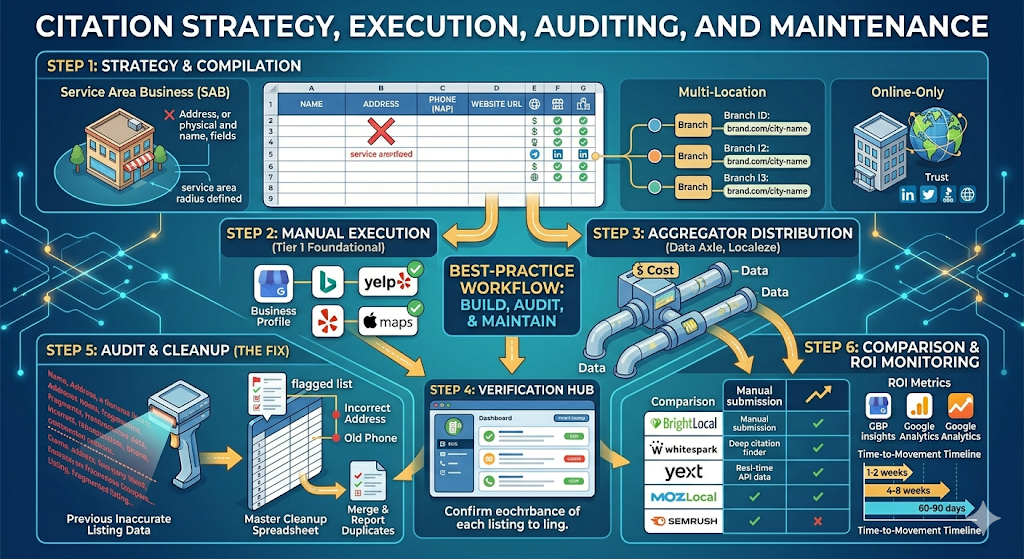
Standard citation advice assumes your business has one physical storefront. Most businesses do not fit that model. A mobile plumber, a nationwide franchise, and a software company all need citations but each needs a different approach.
Service-Area Businesses
Service area businesses include plumbers, electricians, carpet cleaners and mobile service providers that travel to customers. Google requires these businesses to hide their physical address if customers are not served there. You must still submit the real address to major data aggregators for verification. Keep service areas consistent across Google Business Profile Yelp and your website. Use the same cities or ZIP codes everywhere.
Multi-Location Businesses
Each business location needs a separate citation profile with its own address, phone number, and landing page. Use location subfolders like brand.com/locations/city-name to build authority and improve rankings. Assign a unique local phone number to every branch to keep NAP consistency accurate. Businesses with many branches should use bulk verification to manage profiles efficiently.
Online-Only Businesses
Online-only businesses do not need local rankings, but citations still confirm legitimacy and trust. Submit your business to trusted directories like the Better Business Bureau, LinkedIn, and Dun and Bradstreet. Focus on earning mentions from blogs, news sites, and industry publications to build authority and improve search visibility.
How to Build Local Citations the Right Way
Building citations without a system creates duplicate listings, inconsistent NAP data, and wasted hours fixing mistakes. Follow this workflow in the same tier order covered in this article. Finish each step before moving to the next.
Step 1: Compile Your Master NAP Document Create a spreadsheet with your exact business name, address, phone number, and website URL. Standardize every detail — decide whether you use “Street” or “St.” and stick to that format across every submission. This document is your single source of truth. Every profile you create must match it.
Step 2: Claim and Complete Your Tier 1 Profiles Register and verify your business on Google Business Profile, Apple Business Connect, Bing Places, Facebook, Yelp, and LinkedIn. Use Google Business Profile as the master template. Complete every available field on each platform including description, categories, hours, and photos.
Step 3: Submit to Data Aggregators Submit your verified NAP profile to Data Axle, Neustar Localeze, and Foursquare. Do not skip this step. Aggregators push your data to hundreds of partner directories, navigation systems, and voice assistant databases. Allow 4 to 8 weeks for full syndication before checking results.
Step 4: Build Industry and Geographic Citations Use the Tier 4 and Tier 5 sections to find the directories that fit your industry and location. Submit to each one and complete every available profile field. Prioritize platforms by domain authority first.
Step 5: Verify Every Listing Most high-quality directories need verification via SMS, phone call, postcard, or a business-domain email. Complete every verification step for every listing. Log every listing URL and login credential in your master spreadsheet.
Step 6: Add Review Site Profiles Once your core citation tiers are done, claim profiles on Trustpilot, G2, Capterra, TripAdvisor, and Glassdoor based on your industry. A verified profile with zero reviews still counts as a structured citation.
How to Audit and Clean Up Existing Citations
Most local businesses have citations online before they ever build one intentionally. Data aggregators, scrapers, and auto-population tools create listings using public business data. Many of these listings contain wrong addresses, old phone numbers, or name variations that conflict with your current NAP. Building new citations on top of inconsistent old ones hurts rankings. Audit first, build second.
Step 1: Run an Automated Citation Scan Use a citation audit tool to find every existing mention of your business name, phone number, and address. BrightLocal Citation Tracker Whitespark Local Citation Finder and Semrush Local scan hundreds of directories. They show where your business appears and what data each listing contains.
Step 2: Build a Cleanup Spreadsheet Export the audit results and flag every listing with a wrong phone number, old address, outdated name, or missing information. Add a status column with three values correct, needs update and needs removal.
Step 3: Find and Remove Duplicate Listings Search each major directory for duplicate entries. Duplicate listings split citation authority and confuse search engine crawlers. Most directories let you report or merge duplicates through their support system. Remove every duplicate before updating any other listing.
Step 4: Claim and Fix Inaccurate Profiles Log into each directory with wrong information, verify ownership, and update every field to match your master NAP document. For directories where you cannot claim ownership, use the platform’s correction request or support system.
Step 5: Update the Aggregator Databases If wrong business data exists across many third-party sites, the problem starts at the aggregator level. Update your profile with Data Axle, Neustar Localeze, and Foursquare. Fixing the data at the source pushes correct information across all connected partner networks.
Step 6: Schedule Quarterly Audits A citation audit is not a one-time task. Businesses move, change phone numbers, and rebrand. Directories revert listings to older cached versions without warning. Run a full citation audit every three months.
Best Citation Tools and Services Compared
No single tool does everything. Each platform uses a different technical model, targets a different type of user, and solves a different problem. Match the tool to your situation before spending anything.
Citation Management Tools
- Yext — around 499+ per location per month Yext sends business data to over 200 publisher networks in real time and bypasses aggregators. Updates appear within hours. It suits large enterprises with 50+ locations. If you cancel listings can revert to unverified states.
- BrightLocal — from 2 per site and 29 per month+ BrightLocal uses manual submissions. You own each listing with no recurring control fees. It includes citation audits rank tracking reviews and reporting. It suits SMBs and agencies.
- Whitespark — from 1 to 2 per site and 33 per month+ Whitespark focuses on manual citation building and competitor research. Its Citation Finder shows missing listing opportunities. It suits SEO professionals.
- Moz Local — from 16 per month annual billing Moz Local automates listing distribution through data aggregators. It suits small businesses that want simple NAP syncing.
- Semrush Local — from 20 per location per month Semrush Local adds citation tracking inside the Semrush SEO suite. It suits users already using Semrush.
- Synup — from 79 per month up to 25 locations Synup combines listing management with review tracking. It suits agencies and multi location brands.
Best use by need Yext suits large enterprises. BrightLocal or Whitespark suit users who want ownership and control. Moz Local suits simple setup needs. Semrush Local suits existing Semrush users. Synup suits agencies managing multiple locations.
Cost, ROI, and Free vs. Paid Citations
Citation buildings do not need a large budget. Most high-value citation sources in this article are free.
Free vs. Paid Citations
Free listings on Google Business Profile Yelp and the Better Business Bureau have the same citation weight as paid listings on those platforms. Paid upgrades on general directories act as advertising. They increase visibility for users but do not improve citation value for search engines. Industry specific directories are different. Platforms like FindLaw Psychology Today and BBB accreditation use paid membership to confirm verified professional status that free listings do not provide.
Direct Costs
Manual citation building through BrightLocal or Whitespark costs $2 to $4 per listing. A complete 50-listing build is a one-time cost of $100 to $200 with no recurring fees. Data Axle Neustar Localeze and Foursquare charge about $30 each per year. The total cost is around $90 for all three. Yext charges $499 or more per location per month. If you cancel the subscription listings revert to unverified states.
Measuring ROI
Citation building builds results over time. It does not produce immediate conversions like paid ads. Track four metrics. Monitor Google Local Pack rankings for target keywords. Track actions inside your Google Business Profile. Measure referral traffic from directories in Google Analytics. Track brand mentions in ChatGPT Google AI Overviews and Bing Copilot.
Realistic Timelines
Manual directory submissions index within 1 to 2 weeks. Aggregator syndication takes 4 to 8 weeks to spread across partner networks. You see meaningful Local Pack movement after 60 to 90 days of a full citation build. This timeline assumes you optimize your Google Business Profile. It also assumes you collect reviews at the same time.
Common Citation Mistakes to Avoid
Most citation problems are self-inflicted. They happen through rushed submissions, poor organization, and one-time thinking. Each one is preventable.
- Inconsistent NAP Formatting “Joe’s Plumbing LLC” on Google and “Joes Plumbing” on Yelp register as two separate businesses to a search algorithm. Standardize every element in your master NAP document before submitting anywhere and never deviate from it.
- Using Call Tracking Numbers Call tracking numbers on directory listings create NAP mismatches that weaken citation trust. Use your primary local business number on every listing and apply call tracking at the website level instead.
- Submitting to Low-Quality Directories More citations do not mean better rankings. Fifty citations on high-authority platforms beat five hundred on low-quality directories. Ignore any service promising hundreds of submissions for a flat fee.
- One-and-Done Thinking Citations need maintenance. Directories revert listings to older cached versions without warning. Run a full citation audit every three months and update anything that no longer matches your master NAP document.
- Skipping Verification An unverified listing is an uncontrolled listing. Anyone can suggest edits to an unclaimed profile and those changes can apply without your knowledge. Verify every listing you build.
- Ignoring Duplicate Listings Duplicate listings split citation authority and confuse search engine crawlers. Find and remove all duplicates during your initial audit before building new citations.
FAQs
What are local citation sources?
Local citation sources are websites that show your business Name, Address, and Phone Number online. Google Business Profile, Yelp, Yellow Pages, and Healthgrades are common examples.
Is Google Business Profile a local citation?
Yes, it is the most important local citation your business can have. Every other listing you build must match the details entered there exactly.
How long do citations take to work?
Manual submissions index within 1 to 2 weeks and aggregator syndication takes 4 to 8 weeks. Local Pack movement becomes visible around 60 to 90 days after a complete citation build.
What happens if my business details are inconsistent across directories?
Search engines treat different NAP versions as different businesses, which lowers your rankings. Fix inconsistencies in a master NAP document before building any new citations.
Do citations help with ChatGPT and Google AI search?
Yes, AI tools recommend businesses from structured directory databases they index. Businesses not listed on Foursquare are invisible to ChatGPT local recommendations.
Conclusion
Local citations help search engines voice assistants and AI tools trust your business and show it in local results. Businesses that rank higher are often better listed not always better.
Follow the 6-tier framework step by step. Start with core platforms, distribute consistent business information, and build industry-specific and local citations. Fix errors, verify listings, and audit them on a regular basis. Citations take time, but every accurate listing strengthens your local visibility for the long term.
Ready to start? Run a free citation audit with BrightLocal or Whitespark to see exactly where your business stands today. Find the gaps, fix the inconsistencies, and work through the tiers one by one. Your next customer is already searching. Make sure they can find you.
15 June 2026
How to Build Local Citations (Step-by-Step Guide)

15 June 2026