


46% of all Google searches look for local information. Yet most small business websites never show up in those results. You picked keywords. You wrote pages. You waited weeks. Nothing ranked. Those keywords belong to Yelp, Angi, and HomeAdvisor. They have held page one for years. A new local site cannot beat them on those terms.
Low competition local keywords solve this problem. They are location-based search terms that big directories ignore. This article shows you how to find them, check if they are winnable, and build pages that rank.
Why Small Businesses Struggle to Rank with the Wrong Keywords
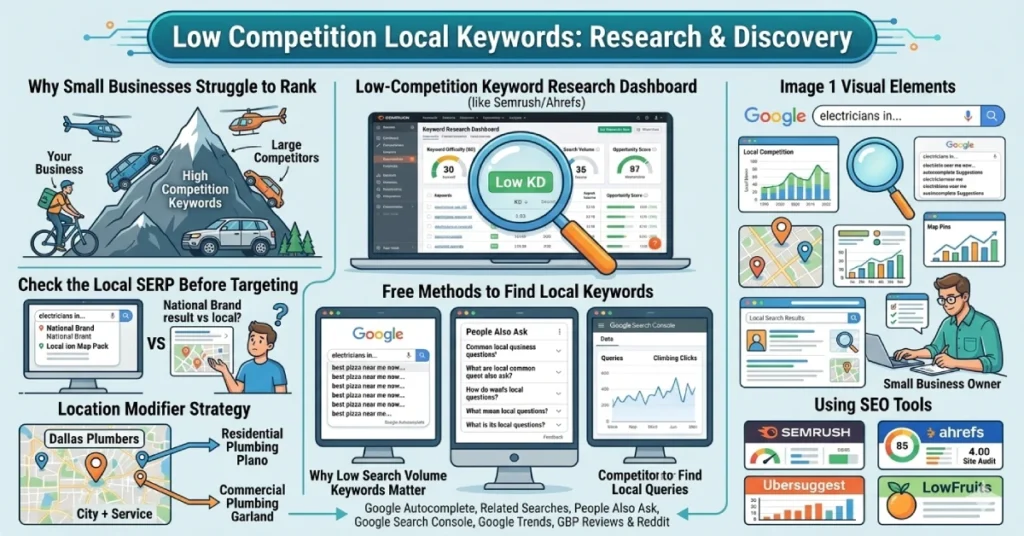
Most small businesses fail to rank because they target keywords that national brands already own.Searches for “plumber,” “dentist,” or “HVAC repair” often return a first page dominated by Yelp, Angi, and HomeAdvisor. These platforms have domain authority scores above 70. Their backlink profiles took decades to build.
Large directories target broad terms. They rarely build content for specific neighborhoods like Wrigleyville in Chicago, Montrose in Houston, or Dilworth in Charlotte. Those gaps belong to you.
A small business with a complete Google Business Profile, 50 genuine local reviews, and a page for “emergency plumber Midtown Memphis” can outrank a national directory. That directory has no locally optimized content for that area. That is where low competition local keywords create a real opening.
What “Low Competition” Actually Means for Local Keywords
A keyword is low competition when the pages ranking for it are weak enough to beat. SEO tools like Semrush and Ahrefs measure this with a Keyword Difficulty score from 0 to 100. The problem is these scores use national data. They do not measure competition in your specific city.
A keyword with a national KD of 60 can have a local difficulty of 10. Take “boiler repair.” It ranks nationally because Wikipedia and large directories dominate it. But when someone searches “boiler repair South Austin,” Google shows local service providers. If those businesses have a domain authority under 25 and thin pages, the keyword is easy to rank for.
At the local level, look for these signals. Local business sites with a domain authority under 25 rank on page one. Community platforms like Reddit or Nextdoor appear in the top 3 results. National directories like Yelp rank with generic unoptimized pages. The Map Pack shows profiles with under 15 reviews or missing business details. Spot these signals and the keyword is winnable.
Why Low Search Volume Local Keywords Are Worth Targeting
A local keyword with 20 monthly searches can bring more revenue than a national keyword with 5,000. “Emergency commercial boiler repair Plano TX” gets 20 searches a month. Every searcher has a broken boiler. They need to hire someone today. “Boiler maintenance tips” gets 5,000 searches a month. Those searchers want free advice, not a service provider. Target low volume local keywords first. They bring buyers, not browsers.
Check the Local SERP Before You Target Any Keyword
Always search your keyword in an incognito window before targeting it. A KD score shows national competition. It does not show who ranks in your city. Look at the first 5 results before you commit to any keyword.
What a Winnable Local SERP Looks Like
A SERP is winnable when weak pages hold the top spots. Look for Reddit or Quora in the top 3 positions. This tells you Google cannot find strong local business pages for that query. Check the Google Map Pack too. Profiles with under 15 reviews or incomplete descriptions confirm a weak local market.
When Yelp or Yellow Pages rank with generic category pages, that is a green light. Those pages rank by default. No local business has built a dedicated page for that query yet. Create one and you have a strong chance of ranking within 60 to 90 days.
Use Location Modifiers to Find Keywords Big Brands Skip
Adding a location to a service keyword turns a competitive term into a winnable one. Large directories like Yelp, Angi, and HomeAdvisor build broad category pages for major cities. They rarely build content for neighborhoods like Wrigleyville in Chicago, Montrose in Houston, or Dilworth in Charlotte.
The formula is simple. Core Service + Geographic Modifier = Low Competition Local Keyword. Use modifiers at 3 levels. City-level modifiers like “Austin plumber” carry the most search volume but also the most competition. Neighborhood-level modifiers like “plumber Wrigleyville” or “emergency plumbing Lincoln Park” bypass city-wide competition. Proximity-based modifiers like “plumber near Millennium Park” or “AC repair 60614” target searchers near specific landmarks or ZIP codes.
How to Find “Near Me” and Voice Search Local Keywords
Voice searches are full sentences. Typed searches are short phrases. Someone typing writes “boiler repair Nottingham.” Someone speaking says, “Where can I find an emergency plumber near me right now?”Add a well-structured FAQ section to each service page. Format questions the way people speak them. Including questions such as “Who fixes AC units in South Austin?” helps match natural speech patterns used in voice searches.
Location Modifier Strategy for Service-Area Businesses
Service-area businesses like mobile pet groomers, HVAC contractors, and independent electricians need a different strategy. These businesses have no storefront. Google cannot anchor their location with a map pin. Build a dedicated Service Area Page for each target city or neighborhood. Each page needs unique content, geo-tagged photos from local jobs, and reviews from clients in those areas. A generic page copied across multiple locations triggers duplicate content issues and ranks for none of them.
Free Methods to Find Low Competition Local Keywords
You can build a complete local keyword list using free Google tools. No paid software needed. Google’s own features show you exactly what local searchers type every day.
Google Autocomplete and Related Searches
Google Autocomplete shows real searches from real people in real time. Open an incognito window and type your core service plus a location like “plumber Austin.” Read the dropdown suggestions. Go further with the Alphabet Soup method. Type “plumber Austin a,” then “plumber Austin b,” and work through the alphabet. This surfaces hidden long-tail variations. Scroll to the bottom of the page and check Related Searches for more local keyword ideas.
People Also Ask
The People Also Ask section reveals low-competition local questions that often signal purchase intent. Search “drain cleaning Chicago,” and PAA shows questions like “How much does drain cleaning cost in Chicago?” Add these questions as H3 headings on your service pages. Answer each question in 2–3 concise sentences. These targets featured snippets and voice search results at the same time.
Google Search Console
Google Search Console shows keywords your site ranks for, but has not fully optimized. Open the Performance report and click the Queries tab. Look for keywords where your site ranks between positions 5 and 15 with high impressions but low click-through rates. A page at position 8 for “emergency electrician Midtown Atlanta” needs only minor fixes. Add the keyword to the title tag and H1. These quick wins need no new backlinks and produce results fast.
Google Trends
Google Trends shows when local search demand peaks for your service. Filter by state or metro area. Compare terms like “AC repair Dallas” and “heating repair Dallas” to see when each spikes. Publish your optimized local pages 60 to 90 days before the seasonal peak. This gives Google time to crawl, index, and rank the page before demand hits its highest point.
Google Business Profile Reviews and Reddit
Customer reviews contain the exact phrases local buyers use when they search. Read your own Google Business Profile reviews and your competitors’ reviews. When a customer writes “Best same day oil change in Polk County,” use that phrase as a local keyword. Reddit city subreddits like r/Austin, r/Chicago, and r/Atlanta work the same way. Locals describe their problems in natural buyer language like “affordable burst pipe repair” or “late night locksmith near downtown.”
How to Use SEO Tools to Find Local Keywords Faster
Paid SEO tools filter thousands of keywords by difficulty, volume, and intent in minutes. When using any paid tool, apply 3 filters. Set KD under 15 for new sites. Set monthly search volume between 20 and 500. Set intent to transactional or commercial. This keeps your focus on keywords that drive direct leads.
How to Find Low Competition Local Keywords in Semrush
In the Keyword Magic Tool, enter a broad service term like “plumber.” Set KD under 15 and intent to Transactional. Use the Include filter to add your city or neighborhood name. In the Keyword Gap tool, enter your domain alongside 3 to 5 local competitor domains. Set the filter to Missing or Untapped. This shows keywords competitors rank for but your site does not.
How to Find Low Competition Local Keywords in Ahrefs
In Site Explorer, enter a local competitor’s URL and open the Organic Keywords report. Find low competition terms they rank for on page 2. In Keywords Explorer, set KD to a maximum of 15 and Word Count to a minimum of 3 words. This isolates local long-tail variations. Use the Link Intersect tool to find local directories and neighborhood blogs that link to competitors but not to your site.
Free and Budget-Friendly Alternatives
Ubersuggest gives SEO Difficulty scores. Target terms with a score under 30 for established sites and under 20 for new domains. LowFruits flags Weak Spots where low authority domains under DA 20 or community forums rank in the top 10. Google Keyword Planner is the most reliable free option. A high Top of Page Bid signals strong commercial intent worth targeting first.
Find Low Competition Keywords Your Local Competitors Missed
Competitor keyword research finds proven local keywords fast. Your competitors have tested what works in your market. Analyzing their rankings shows the gaps they left open.
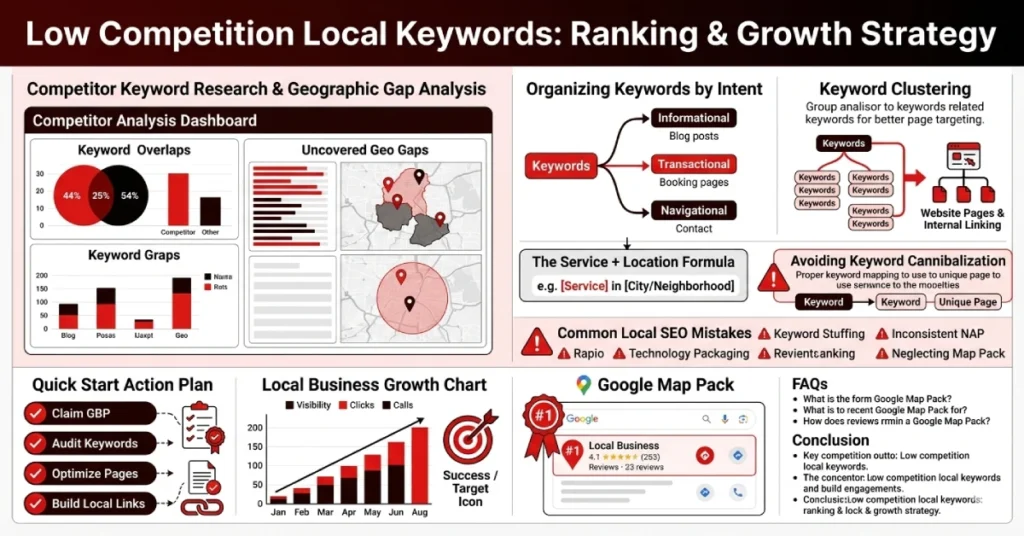
Collect the URLs of 3 to 5 local competitors. Ignore large national directories like Yelp or Angi. Enter each URL into Site Explorer in Ahrefs or Domain Overview in Semrush. Look for keywords where competitors rank on page 2 or lower. These terms have market demand but no strong page targeting them yet.
The real opportunity is in geographic gaps. If local competitors offer drain cleaning but none have a page for “drain cleaning West End” or “drain cleaning Buckhead,” that page is open.Create a dedicated, optimized page for that location. You face zero locally optimized competition.
Cross-reference 3 to 5 competitors together. Keywords that appear in multiple profiles but rank weakly signal high value. One strong local page beats 5 weak competitor pages every time.
Organize Your Keywords Before You Start Writing
Group your keywords by search intent before assigning them to pages. Transactional keywords like “emergency AC repair Plano” or “same day plumber Lincoln Park” go on core service pages. Informational keywords like “how to prevent pipe bursts in winter” go on blog posts. Target transactional keywords first because they drive direct leads.
Once sorted, cluster related keywords onto single pages. Terms like “AC repair Dallas,” “air conditioner repair Dallas,” and “emergency AC technician Dallas” share the same intent. One strong page targeting all 3 beats 3 thin separate pages every time.
This prevents keyword cannibalization. Cannibalization happens when multiple pages compete for the same term and Google ranks neither page well. Each page must target one distinct service and location. Use internal links to connect blog posts back to core service pages.
Common Mistakes to Avoid with Local Keyword Research
Most local businesses fail to rank because of 5 repeated mistakes, not because of a lack of content or budget.
- Chasing high-volume keywords like “plumber,” “dentist,” or “electrician” puts your site against Yelp, Angi, and HomeAdvisor. These platforms have a domain authority above 70.
- Trusting national KD scores causes businesses to skip keywords that are easy to rank for locally. A keyword with a national KD of 55 can have a local difficulty of 8 if current ranking sites are weak.
- Ignoring neighborhood keywords leaves the most accessible traffic untouched. Neighborhoods like River North in Chicago, The Heights in Houston, and Virginia Highland in Atlanta have no dedicated optimized pages from any competitor.
- Creating thin duplicate pages for variations like “plumber Dallas,” “plumber Dallas TX,” and “Dallas plumber” splits authority. Cluster these onto one strong page.
- Skipping live SERP analysis causes businesses to target keywords already dominated by Local Service Ads or strong local competitors. A 2 minute incognito search prevents this mistake.
Quick-Start Action Plan for Beginners
Follow these 6 steps to find and target low competition local keywords today. No budget required.
Step 1: Start with Google Autocomplete and PAA. Open an incognito window and type your core service plus your city. Write down every relevant suggestion. Scroll to the People Also Ask box and collect every question Google shows.
Step 2: Build your seed list using the Service + Location formula. Combine services like plumbing, AC repair, or electrical work with city, neighborhood, and ZIP code modifiers. Aim for 20 to 30 keyword variations before moving on.
Step 3: Check the SERP manually before committing to a keyword. Search each keyword in incognito and look at the first 5 results. If Reddit, Quora, or weak local sites with domain authority under 25 rank on page one, the keyword is winnable.
Step 4: Verify with a free or paid tool. Run your list through Google Keyword Planner, Ubersuggest, or LowFruits. Filter for KD under 15 and monthly search volume between 20 and 500. Remove any keyword that fails both filters.
Step 5: Group keywords by intent and assign one theme per page. Map transactional keywords like “emergency plumber Midtown Memphis” to service pages. Map informational keywords like “why does my pipe burst in winter” to blog posts. Never assign 2 different intent types to the same page.
Step 6: Start with the lowest competition keywords first. Publish your easiest keywords first to build early ranking momentum.Monitor keyword rankings monthly using Google Search Console. Optimize pages sitting between positions 5 and 15 for quick wins.
FAQs
What is a low competition local keyword?
It is a service plus location keyword like “emergency plumber Wicker Park” where the pages currently ranking are weak enough for a small local site to outrank.
How do I know if a local keyword is actually low competition?
Search it incognito and check the top 5 results. Reddit threads, sites with a domain authority under 25, or generic directory pages confirm the keyword is winnable.
Can I do local keyword research without paid tools?
Yes, Google Autocomplete, People Also Ask, Search Console, and Google Trends are enough to build a solid local keyword list for free.
How many local keywords should I optimize for on a single page?
One primary keyword plus 3 to 5 close variations. Terms like “AC repair Dallas” and “emergency AC technician Dallas” share the same intent and belong on one page.
What happens if I rely only on free tools?
Free tools cover the basics but miss competitor gap analysis. Add Ubersuggest or LowFruits to fill those gaps without a large budget.
Conclusion
Low competition local keywords exist in every market and every service category. Large directories like Yelp, Angi, and HomeAdvisor ignore specific neighborhoods, suburbs, and ZIP codes. They chase broad audiences at scale. That gap belongs to small local businesses willing to do the research.
Start with free methods. Check every keyword in an incognito window. Apply the Service + Location formula before writing a single page. Group keywords by intent, cluster related variations together, and publish your easiest keywords first.
The businesses that rank locally are not the ones with the biggest budgets. They are the ones targeting the right keywords with dedicated pages that national directories never bothered to build. Start with one keyword, one page, and build from there.

18 June 2026
What are Near Me Keywords and How to...

18 June 2026