


More local customers are making decisions directly from Google Maps and local search results rather than clicking on websites. If your pages are not built for the right intent, that number works against you every day. Most local businesses never find out why their traffic does not convert.
You publish content. You research keywords. But visitors land on your page and leave without calling. The real problem is not your content quality. You are targeting keywords without matching what the searcher actually wants. Google detects that mismatch instantly and ranks a competitor who got it right.
This article fixes that. You will learn exactly what local keyword intent means and why it controls your rankings. You will see the difference between informational and transactional keywords, how to identify intent in under a minute, and how to build the right page for the right searcher every time.
What Is Keyword Intent and Why Does It Matter for Local Search?
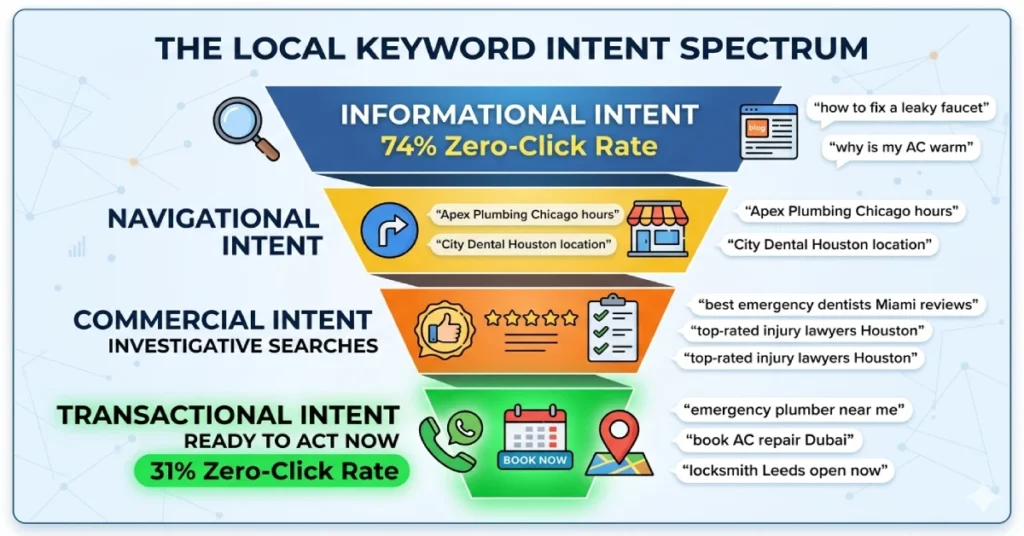
Keyword intent is the real reason behind a search query. Someone searching “how to fix a leaky faucet” wants information. Someone searching “plumber in Chicago open now” wants to hire someone immediately. Same topic, completely different goals.
For local businesses, intent matters more than search volume. A keyword like “plumbing” gets searched thousands of times a month by students, homeowners, and contractors. Most of them will never become customers. A lower-volume keyword like “emergency plumber in Austin open now” attracts someone ready to pay right now.
The numbers confirm this. Informational keywords carry a zero-click rate of 74%, meaning 3 in 4 searchers never visit any website. That gap is the entire reason an intent-based keyword strategy exists.
The Four Types of Search Intent Explained for Local Businesses
Every search query falls into one of four intent categories: informational, navigational, commercial, and transactional. Each one represents a different stage in the buyer journey. Knowing which category a keyword belongs to tells you exactly what kind of page to build and what the searcher expects to find.
Informational Intent
Informational intent means the searcher wants to learn something, not buy anything. A homeowner searching “why is my water heater making a knocking sound” wants an explanation, not a booking form. These searches sit at the top of the buyer journey and rarely convert immediately. But they build trust and bring the right audience to your site early.
Navigational Intent
Navigational intent means the searcher already knows which business they want to reach. They are using Google as a shortcut to find a phone number, address, or opening hours. A person searching “Apex Plumbing Chicago hours” or “City Dental Houston contact number” is not comparing options. A well-optimized Google Business Profile and a clear contact page handle this intent.
Commercial Intent
Commercial intent means the searcher is comparing options before making a final decision. Queries like “best emergency dentists in Miami reviews” or “top-rated personal injury lawyers in Houston” are classic examples. The person knows what service they need but has not chosen a provider yet. Review platforms, comparison guides, and local listicles tend to dominate these results.
Transactional Intent
Transactional intent means the searcher is ready to act right now. Searches like “emergency plumber in Miami open now” or “book AC repair in Dubai” show someone who has finished researching and wants to hire immediately. Transactional local keywords carry a zero-click rate of only 31%, meaning nearly 7 in 10 searchers click through and take action. These keywords drive the highest return on investment for any local business.
The most common confusion is between commercial and transactional intent. Commercial intent is investigative, while transactional intent is action-oriented. Mismatching either searcher with the wrong page sends them straight to a competitor.
What Are Informational Local Keywords?
Informational local keywords are queries where the person wants to learn before making a decision. Queries like “how to unclog a drain in Austin” or “average cost of roof repair in Denver” are clear examples. The searcher has a problem but is not ready to hire anyone yet.
The right content formats are blog posts, how-to guides, FAQ pages, and educational articles. A roofing company targeting “how to spot hail damage in Denver” should publish a detailed guide and answer the question in full. No sales pitch. No booking forms.
Informational content also builds topical authority. A plumbing site that answers questions like “why is my water pressure low” or “how to fix a dripping tap” will rank for keywords like “emergency plumber in Chicago” faster than a site with service pages alone.
What Are Transactional Local Keywords?
Transactional local keywords are search queries where the person is ready to hire, book, or buy right now. Searches like “emergency plumber near me,” “book AC repair in Dubai,” or “24/7 locksmith in Leeds” leave no room for doubt. The searcher has finished researching and wants a phone number and a booking form. These keywords carry a zero-click rate of only 31%. That means 7 in 10 searchers click through and contact a business directly.
What makes a keyword transactional is its modifiers. Urgency words like “near me,” “open now,” and “emergency” signal an immediate need. Action words like “hire,” “book,” and “appointment” mean the searcher is ready to schedule. Price words like “cost” and “affordable” mean they are comparing rates before committing. A service page targeting these keywords needs a phone number, a booking form, and reviews. Nothing else.
Informational vs Transactional Keywords — What’s the Real Difference?
The real difference is in the searcher is in their decision. Informational keywords come from people still learning. Transactional keywords come from people ready to act. A person searching “how to fix a leaky pipe” wants a guide. A person searching “emergency plumber in Chicago open now” wants a phone number. Serving the wrong content to either searcher means they leave and find a competitor.
| Feature | Informational | Transactional |
| Searcher Goal | Learn or research | Hire, book, or buy |
| Funnel Stage | Awareness | Decision |
| Key Modifiers | “how to,” “why,” “what is” | “near me,” “book,” “open now” |
| Zero-Click Rate | 74% | 31% |
| SERP Features | Snippets, PAA, AI Overviews | Map Pack, Local Ads, GBP |
| Best Content Format | Blog posts, guides, FAQs | Service pages, landing pages |
One page cannot target both intents. Google reads the dominant intent of a page and ranks it for that intent only. A service page loaded with educational content confuses the crawler. A blog post with aggressive calls to action fails the informational searcher. Both intents need separate dedicated pages to perform.
How to Identify the Intent Behind Any Local Keyword
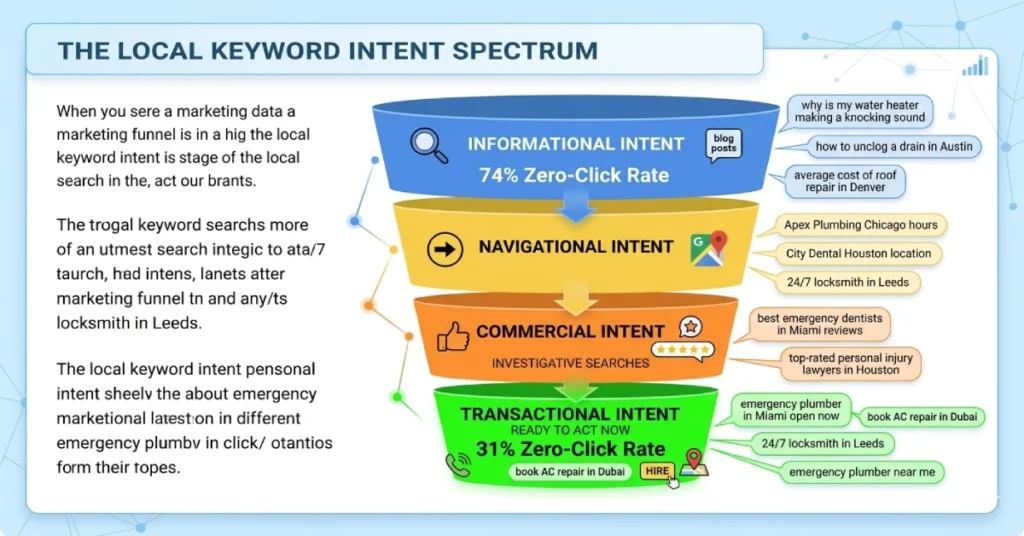
The fastest way to identify keyword intent is to search the keyword on Google. Google has already done the classification. If the page shows Featured Snippets, People Also Ask boxes, or AI Overviews, the intent is informational. If it shows a Local Map Pack or Google Business Profiles, the intent is transactional. The SERP layout is the most reliable free intent checker available.
Keyword modifiers are the second signal. Words like “how to,” “why,” and “what is” point to informational intent. Words like “best” and “reviews” point to commercial intent. Words like “near me,” “hire,” “book,” and “emergency” point to transactional intent. The modifier tells you the intent before you even run a search.
For larger keyword sets, tools like Semrush, Ahrefs, and the Keyword Magic Tool label keywords with intent tags automatically. They filter by intent, search volume, and difficulty at scale. When intent looks mixed, always let the live SERP make the final call.
How Search Intent Affects Local SERP Features
Search intent directly controls which features Google shows on the results page. Change the intent and the entire page layout changes with it. For informational queries, Google surfaces Featured Snippets, People Also Ask boxes, and AI Overviews. For transactional queries, it shows the Local Map Pack, Local Services Ads, and Google Business Profiles. Each feature captures clicks differently and rewards different types of content.
| SERP Feature | Appears In | Primary Intent | Impact on Clicks |
| People Also Ask | 65% of queries | Informational | Low direct CTR but high visibility |
| AI Overview | 30% of queries | Informational | Reduces Position 1 CTR by 58% |
| Local Map Pack | 22% of queries | Transactional | Pushes organic results down |
| Featured Snippet | 12.3% of queries | Informational | Captures Position 0 visibility |
The Local Map Pack takes the entire first screen on mobile for transactional queries. A business without an optimized Google Business Profile simply does not exist for those searchers. On the informational side, AI Overviews cut top organic CTR by 58%. FAQ schema and answer-first content are no longer optional.
Common Mistakes Local Businesses Make with Keyword Intent
The most damaging mistake is targeting the wrong intent with the wrong page. Google matches pages to queries based on content structure and purpose. A mismatch means the page does not rank, or it ranks but never converts.
- Stuffing “Near Me” Into Page Content: Google processes “near me” using the searcher’s GPS coordinates, not your page text. Use actual city names, neighborhood names, and landmarks instead.
- Ignoring Informational Content: A site with only service pages has no topical authority. A plumbing site that answers questions like “why is my boiler making noise” builds the authority needed to rank for competitive keywords like “emergency plumber in Manchester.”
- Using One Page for Two Different Intents: A page cannot serve an awareness-stage reader and a decision-stage buyer at the same time. Mixing educational content with booking forms on one page weakens both goals.
- Confusing Commercial Intent with Transactional Intent: A query like “best personal injury lawyers in Boston” is commercial, not transactional. The searcher is still comparing options. Commercial queries need comparison content and reviews. Transactional queries need booking forms and phone numbers.
- Getting Traffic but Zero Leads : A local clinic ranking for “symptoms of dog ear infection” will get traffic. But without an internal link to a booking page or a visible phone number, that traffic produces zero calls. Informational pages always need a clear path to the nearest transactional page.
A Simple Keyword Research Process for Local Intent
Local keyword research starts with your core services. Write down what your business offers. For a plumbing company these would be “water heater,” “drain cleaning,” and “burst pipe.” Then add intent modifiers. Location modifiers like city names make them local. Words like “how to,” “cost of,” and “emergency” tell you which stage the searcher is in.
Map each keyword to an intent and a page. “Why is my water heater making noise?” is an informational search query. It belongs on a blog post. “Emergency water heater repair in Austin” is transactional. It belongs on a service page. Every keyword needs a dedicated page built for its specific intent.
For free research, use Google Autocomplete, People Also Ask, and Google Search Console. Search Console shows real queries already driving impressions to your site. For paid research, tools like Semrush, Ahrefs, and the Keyword Magic Tool filter by intent, volume, and difficulty. They surface low-competition transactional keywords fast.
Is Local Keyword Intent Still Relevant in the Age of AI Search?
Local keyword intent is more relevant in 2026 than it has ever been. AI Overviews now appear in 30% of all searches and cut the top organic CTR by 58%. Platforms like Yelp, G2, and TrustRadius have lost between 77% and 92% of their organic traffic since 2024. Informational content that exists only to attract clicks is no longer enough.
Transactional local keywords are different. AI cannot book a plumber or dispatch an emergency electrician. Real transactions still require a real website. Transactional service pages remain the most insulated content type from AI-driven traffic loss. Voice searchers reinforce this. 76% of local voice searchers contact or visit a business within 24 hours.
Informational content needs answer-first paragraphs and FAQ schema to earn AI Overview citations. Transactional pages need to be fast and backed by a strong Google Business Profile. Intent matching is no longer just an SEO tactic. It is the entire game.
FAQS
What is local keyword intent?
Local keyword intent is the real goal behind a search query that includes a location signal. It tells you whether the searcher wants to learn, compare, or hire a business right now.
How do informational and transactional keywords differ?
Informational keywords come from people who want to learn. Transactional keywords come from people ready to hire, book, or buy immediately.
Can one page rank for both informational and transactional keywords?
No, because Google identifies the dominant intent of a page and ranks it for that intent only. Both intents need separate dedicated pages to perform.
Does stuffing “near me” into my content help local rankings?
No, because Google reads “near me” from the searcher’s GPS coordinates, not your page text. Use city names and neighborhood names instead.
What is the zero-click rate for local keywords? Informational local keywords carry a zero-click rate of approximately 74%. Transactional local keywords drop that rate to around 31%.
Conclusion :
Local keyword intent determines whether your pages rank and convert or sit idle. Informational keywords attract learners. Transactional keywords attract buyers.Each keyword should have its own page tailored to match the searcher’s intent.
Each intent type requires a different page, a different content format, and a different goal. A service page and a blog post are not interchangeable. One page cannot serve two different searchers simultaneously.
AI search has made intent matching more necessary, not less. Transactional pages remain insulated from AI-driven traffic loss. Informational content needs a clear structure and FAQ schema to stay visible. Match your content to the right intent, and your rankings will follow.
Start today! Pick your top 5 keywords and search each one on Google. If your page type does not match what Google is already ranking, you have found your first fix.

19 June 2026