

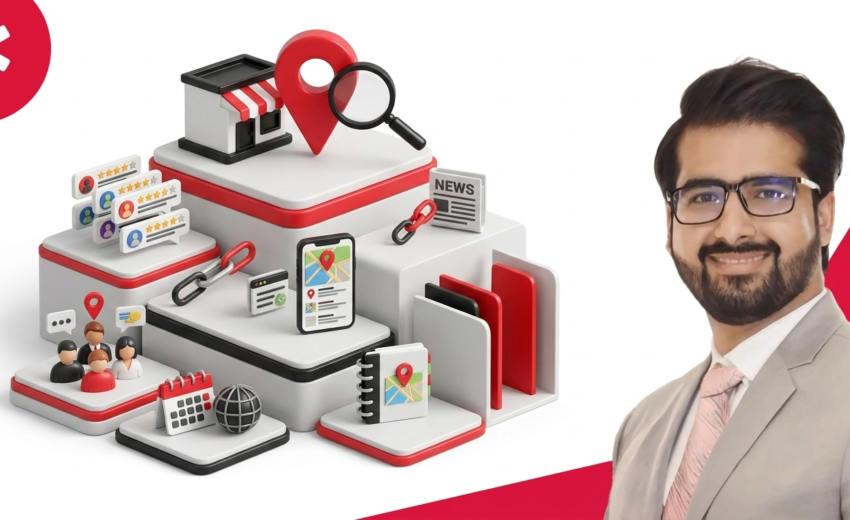
46% of Google searches include local intent. Yet most local businesses are invisible in those results. They have an active profile, reviews, and a working website. The issue is not effort. It is optimizing the wrong signals.
Google scores local businesses across six signal groups.Most businesses get the priority order wrong. Google Business Profile signals account for 32% of your Local Pack ranking. Reviews account for 20%, while citations account for just 6%. Your competitor is not outranking you because they have a better business. They outrank you because they work the right signals in the right order.
This guide covers every local SEO ranking factor that matters in 2026. The Whitespark survey includes 47 expert SEOs who score 187 individual factors. You will learn which signal groups to prioritize, what tactics to stop wasting time on, and how to appear in AI recommendations from ChatGPT, Perplexity, and Gemini.
What Is Local SEO and Why Does It Work Differently From Regular SEO?
When someone searches “emergency plumber London,” they are not looking for a blog post. They want a real business they can call within the next few hours. Google knows this. It delivers results from a dedicated local ranking system. This system is separate from its standard organic algorithm. A small local business with a modest website can outrank a large national brand in local results. Local SEO does not reward the biggest domain. It rewards the most relevant and trusted option nearby.
What Local SEO Actually Means
Local SEO is the process of optimizing your online presence so search engines match your business to nearby searchers. In 2015, this meant keeping your Name, Address, and Phone number consistent across directories like Yelp and Facebook. That approach no longer works.
Google now treats your business as an entity. It builds a picture of who you are, what you offer, where you operate, and whether real customers trust you. A Google Business Profile set up once and never updated is not a local SEO strategy. The 2026 algorithm rewards liveness. Active profiles outperform static ones.
Google uses Large Language Models to extract keywords from customer reviews. If 30 customers mention “same-day roof repair” in their reviews, that business ranks higher for that query. This happens even without targeting it on their website. Local SEO in 2026 is about making your business easy for Google, ChatGPT, Gemini, and Apple Maps to understand, verify, and recommend.
What Is the Google Local Pack?
The Google Local P
ack is the block of three business listings at the top of Google search results for local queries. It includes a map, three business names, star ratings, addresses, phone numbers, and hours. It appears above all organic results for most local queries.
57% of local searches happen on mobile. The 3-Pack occupies the entire screen before a user scrolls. The click-through rate drop from position one to position three inside the Local Pack is only 2.5 percentage points. In regular organic search, that drop exceeds 29 percentage points. Any position inside the Local Pack beats ranking fourth or fifth in organic results.
In 2026, the Local Pack includes AI-generated snapshots, curated Top Lists, and dynamic layouts. Layouts change based on query type and device. The Local Pack and organic results use separate ranking systems. They rely on different signals.
Who Needs Local SEO?
Any business that serves a geographic area needs local SEO. Storefront businesses like dental clinics and gyms use it to appear in nearby searches. Multi-location businesses like franchise chains maintain separate local presence for each location. Professional service providers like accountants and therapists use local SEO even when they work remotely.
76% of people who search for something nearby visit a business within 24 hours. About 84% of local searches are discovery searches. The searcher has not yet decided which business to contact. That 84% is where local SEO determines whether a customer finds your business or a competitor’s.
How Google Ranks Local Businesses: Relevance, Distance, and Prominence
Google uses three core pillars to decide which businesses appear in the Local Pack. These are Relevance, Distance, and Prominence. They do not work independently. Google weighs them together and the strongest combination wins.
Relevance — Does Your Business Match What the Searcher Needs?
Relevance measures how well your business profile matches what the searcher needs. Google reads your primary category, services list, business description, and review keywords. An “Emergency Plumber” profile ranks higher for emergency plumbing searches than a “Plumbing Company” profile. Specific categories improve query matching.
Google uses large language models to extract keywords from reviews. Repeated mentions like “mold inspection” connect that service to your business. Customer language influences your rankings.
Google also compares your GBP data with your website. A mismatch weakens the signal. If your GBP lists “teeth whitening” and your website does not, Google reduces relevance.
Distance — How Close Are You to the Searcher?
Distance drives about 55 percent of Local Pack ranking decisions. Google calculates distance using device GPS, IP address, or the location in the search query. A search like “coffee shop open now” uses the user’s exact location. A search like “best accountant in Manchester” uses Manchester as the anchor location.
You cannot control distance. Strong relevance and prominence can outrank closer competitors. A business 0.8 miles farther away can still rank higher with stronger reviews and GBP signals.
For service area businesses like electricians and cleaners, Google checks if the user falls within the service area. If the user qualifies, the business becomes eligible. Relevance and prominence then determine rankings.
Prominence — How Well-Known and Trusted Is Your Business?
Prominence measures how well-known and trusted your business is online and offline. Google calculates prominence using review volume, ratings on Google and Yelp, local backlinks, citations on Bing Places and Apple Maps, and brand mentions on authoritative sites.
In 2026, prominence connects to entity recognition. Google’s Knowledge Graph verifies your business before assigning full prominence. Local press and “best of” lists strengthen entity recognition more than basic directory listings.
Branded searches also signal trust.Google treats searches for your business name as a ranking signal. Relevance shows what you do. Distance shows where you are. Prominence shows whether your business ranks above nearby competitors.
The 6 Local SEO Signal Groups and How Much Each One Matters
Not all local SEO efforts carry equal weight. Google scores your business across six signal groups. Each group contributes a different percentage to your Local Pack ranking.
Whitespark 2026 Local Search Ranking Factors Survey
The Whitespark 2026 survey is a key benchmark for local ranking factors. Forty-seven SEO experts scored 187 factors, including a new AI search visibility category. The survey has tracked changes in ranking signals for over a decade.
The 2026 report shows local search as an ongoing engagement model. Liveness and trust drive visibility.
The 6 Signal Groups With Their Percentage Weights
Google distributes its local ranking weight across six core signal groups. Google Business Profile signals carry 32%. This includes your primary category, profile completeness, business name, proximity, and listing management activity.. Review signals follow at 20%. This measures quantity, velocity, recency, star rating, keywords in reviews, and response rate. On-page signals account for 15%. This covers local landing pages, LocalBusiness schema, NAP consistency, and mobile performance.
Behavioral signals sit at 9%. This tracks click-through rate, mobile calls, direction requests, dwell time, and in-store visits. Link signals account for 8%. This measures quality and local relevance of backlinks and brand mentions. Citation signals account for 6%. This covers NAP accuracy across Google, Apple Maps, Bing Places, and Facebook.
What This Breakdown Means for How You Spend Your Time
The signal weights establish a clear hierarchy of importance. These two areas have more impact than on-page SEO, backlinks, and citations combined, so they should be addressed first before anything else.
On-page signals at 15% carry even more weight in local organic results, where they account for 33% of ranking decisions. Link signals dropped to 8%. Three editorial links from local news or chambers of commerce deliver more value than 50 links from generic directories.
Citation signals at 6% still matter because inconsistent NAP pulls rankings down. Mass directory submission delivers no return in 2026. Put 50% of your effort into GBP and reviews. Put 20% into your website. Split the rest between links and citations.
Google Business Profile Signals
Your Google Business Profile carries 32% of your total Local Pack ranking weight. Google reads every field, every photo, every review, and every update. A complete, active, and accurate profile is the foundation of your entire local SEO strategy.
How to Choose Your Primary and Secondary Categories
Your primary category is the most impactful field in your entire GBP. It determines which search queries your business is eligible for. A business listed as “Personal Injury Attorney” enters different search auctions than one listed as “Law Firm.” Choose the most specific category that reflects your core service.
If you run a bakery that also serves coffee, list “Bakery” as primary and “Coffee Shop” as secondary.Google allows up to nine secondary categories. Use them only for services your business offers. Adding unrelated categories risks suspension. Google now cross-references your categories against your website content to verify your claimed services.
How to Complete Your Profile the Right Way
Profile completeness became a direct ranking requirement after the March 2026 Core Update. Incomplete profiles face an active ranking penalty. Missing service details or inaccurate hours can reduce visibility and hurt search performance. Every empty field is a missed signal.
Your business description should be 700 characters or more. Write it as clear prose covering your core services and geographic areas. Fill in every relevant attribute. Options like “Wheelchair accessible” and “Woman-led” are semantic signals Google uses to match your profile to filtered searches. The “Business is Open” status is the 5th most important GBP ranking factor. If your profile shows “Closed” at 8 PM, Google demotes your listing at that moment regardless of your other signals.
How to Use Photos to Signal Trust and Activity
Updating your profile with new photos can increase engagement, leading to more actions such as calls and direction requests. Google’s Vision AI reads your images to categorize services. A before-and-after renovation photo is a direct relevance signal for niche searches. Profiles that go more than 30 days without a new photo see measurable visibility declines. Local SEO practitioners call this the 30-day danger zone.
Upload two to three photos per week in competitive markets. Build a gallery with at least three exterior shots, three interior views, team photos, and project images. Stock photos carry zero ranking value and damage customer trust.
How to Use GBP Posts and Q&A Effectively
GBP Posts are a direct signal of activity. They show Google that your business is actively serving customers. Offer posts expire after seven days. In competitive markets, post at least twice per week. Link posts to specific services and locations. A focused post like “Same-Day Boiler Repair Available in Leeds” sends a stronger signal than a general update.
The Q&A feature changed in late 2025. Google’s Gemini AI now generates answers from your business profile, website FAQ, and reviews. Seeding your own questions is no longer effective. Keep your Services tab and website content clear and direct. This helps Google pull accurate answers to common customer questions.
Which GBP Fields Actually Move the Needle for Rankings?
Certain GBP fields carry more ranking weight than others. The primary category is the most important GBP ranking factor. Your business name ranks third. Adding keywords beyond your legal name violates Google’s guidelines. The “Business is Open” status ranks fifth. Your physical address ranks seventh for storefronts. Service keywords from your Services tab rank 75th but are rising as AI crawlers rely more on structured data.
The One Mistake That Can Get Your Profile Suspended
The leading cause of GBP suspension in 2026 is misrepresenting your business type or location. This happens when a service area business claims a storefront using a virtual office or unhidden home address. Google’s AI detects device clustering and IP patterns that signal false location data. Businesses caught using fake addresses face permanent suppression.
The second most common trigger is keyword stuffing your business name. List your business name exactly as it appears on your signage and legal documents. Hide your address in GBP settings if you operate as a service area business.
Review Signals: The Most Controllable High-Impact Factor
Reviews carry 20% of your total Local Pack ranking weight. Unlike proximity, which you cannot change, reviews are something you can generate starting today. That makes them the most actionable signal group available.
What Google Actually Measures in Your Reviews
Google measures five dimensions: quantity, quality, velocity, recency, and owner engagement. The 4.0 star mark is where Google begins treating a business as credible. A perfect 5.0 with zero negative feedback is often flagged as inauthentic. The most effective rating range is 4.5 to 4.8. A business receiving five reviews every month signals consistent activity. A business collecting 50 reviews in one week then going silent sends a weaker signal.
Google uses Natural Language Processing to extract keywords from review text. If customers mention “emergency drain cleaning,” Google maps that term to your business and ranks you higher for that query.
How to Build a Consistent Review Strategy
Ask every customer for a review within 24 hours of service completion. SMS outperforms email for response rate. Send a short message with a direct link to your Google review page. Ten new reviews every month for twelve months builds a stronger profile than 120 reviews collected in one campaign. Sudden spikes followed by silence raise flags in the review algorithm.
Google recognizes Story reviews in 2026. These are short vertical videos uploaded directly to the GBP. They generate stronger engagement signals in the mobile Maps environment. Encourage customers to share their experience on camera.
Why Buying Reviews Is a Serious Risk in 2026
Google’s AI detection for review fraud reached a new level of accuracy in 2026. The algorithm identifies reviews from identical IP addresses, accounts with no prior activity, and clusters appearing within short timeframes. Google now applies visibility suppression to businesses caught buying reviews. One documented case saw a business lose 140 reviews overnight, dropping from position two in the Local Pack to outside the top results within 72 hours.
Why Responding to Reviews Is a Ranking Signal
Owner response rate is now a formal ranking signal in 2026. A 90% or higher response rate improves ranking stability during algorithm updates.Respond to all reviews within 24 hours. Mention the exact service in each reply. For example, include “your roof replacement in Bristol.” This strengthens relevance signals. Generic replies provide little value.
Review Recency as a Ranking Signal
Review recency received a 2.3 times increase in ranking weight in the 2026 update. Reviews from the past 90 days carry far more weight than older ones. A business with 20 reviews posted in the last three months outranks a competitor with 200 reviews from two years ago. Your review strategy needs to generate fresh reviews every month, not just hit a number and stop.
The AI Recommendation Threshold
A business needs about 150 reviews per location to show up in recommendations across ChatGPT, Perplexity, and Gemini.
Below that level, LLMs often skip the business due to weak entity signals. A low response rate under 5% also reduces visibility in AI-driven recommendation systems. With around 150 reviews, a 90% response rate, and a 4.5–4.8 rating, a business can strengthen its presence in Google Local Pack, AI Overviews, ChatGPT, Perplexity, and Gemini at the same time.
On-Page SEO Signals — Why Your Website Still Matters
Your website accounts for 15% of your Local Pack ranking weight and 33% of your local organic ranking weight. Google cross-references your website against your GBP data to verify your claimed services. A strong GBP with a weak website leaves a third of your local visibility unused.
How to Build Local Landing Pages That Actually Rank
City-swap pages do not work. These pages repeat the same content across different locations and only change the city name. Google treats this as thin content. Each location page must have unique content. A roofing company in coastal areas should include details about storm damage and salt corrosion for that region.
Each page should contain specific service information, a Google Map, local NAP details, and photos from real projects in that area. Multi-location businesses should create separate pages for each city with unique URLs. Each Google Business Profile should link to its matching city page instead of the homepage.
The On-Page Elements That Carry the Most Weight
Five on-page elements contribute the most to local ranking performance. Title tags should include your primary local keyword and city. A title like “Emergency Plumber in Leeds” targets both clearly. NAP data on your website must match your GBP exactly, character for character. “St” versus “Street” creates entity confusion that reduces Google’s confidence. Place your NAP in the footer of every page.
Each core service needs its own dedicated page with a unique URL. Google cross-references your service pages against your GBP Services tab. When both match, your relevance score strengthens. Internal linking between your location pages and service pages tells Google where you operate and what you offer in each area.
Technical SEO Basics Every Local Site Needs
Technical issues reduce rankings that other signals could earn. The March 2026 Core Update made Interaction to Next Paint the main Core Web Vital. Pages that rank for voice search load 52% faster than average local sites. Keep INP under 200 milliseconds on mobile. Mobile-first indexing means Google evaluates the mobile version before the desktop version.
Most local businesses ignore robots.txt. AI crawlers from Google, Bing, and Perplexity index content for AI-generated results. Blocking these crawlers removes visibility from AI Overviews, even when traditional rankings are strong.
What Structured Data Helps Local Rankings?
Structured data sends business information to search engines in a readable format. LocalBusiness schema in JSON-LD defines name, address, phone number, hours, and service categories, and it must match Google Business Profile exactly. Service Schema defines offerings with price ranges. Review Schema enables star ratings in organic search results. GeographicCoordinates schema sets latitude and longitude for Google Maps accuracy. Most local businesses lack structured data. Implementation creates a competitive advantage in 2026.
Link Signals: Local Relevance Beats Volume
Link signals account for 8% of your Local Pack ranking weight. Volume without local relevance no longer moves rankings. Three strong local links outperform fifty generic directory links.
What Types of Local Links Actually Move Rankings
Geographic relevance outweighs raw domain authority. Local news outlets provide strong link value, especially when they cover regional stories. A feature in a publication like the Manchester Evening News signals authority to Google’s Knowledge Graph. Chamber of commerce links confirm community legitimacy and support entity recognition. Community organizations, local sponsorships, and event partnerships create strong location-based signals that reinforce geographic authority.
What No Longer Works for Local Link Building
Three tactics now trigger penalties. Private Blog Networks and paid link networks cause suppression instead of ranking gains. Google’s AI detects these clusters through hosting patterns and link structures. Mass directory submissions reduce trust signals. Links from many low-quality directories signal manipulation. Over-optimized anchor text like “Best Dentist Manchester” across inbound links triggers spam detection. Natural link profiles use varied anchor text.
How Brand Mentions Work as an Authority Signal
Unlinked brand mentions are an authority signal in Google’s local ranking algorithm. ChatGPT, Perplexity, and Gemini use unlinked mentions to validate businesses for AI recommendations. A mention in a local newspaper builds entity authority without a link. Features in local press strengthen authority. Expert commentary and community references build entity recognition. In 2026, digital PR and community presence form the foundation of local link building.
Behavioral Signals: What Happens After Users Find You
Behavioral signals account for 9% of your Local Pack ranking weight. Google uses these signals to confirm your rankings reflect actual customer activity.
What Google Tracks as a Behavioral Signal
Google tracks six signals: click-through rate, mobile clicks-to-call, direction requests, website visits, dwell time, and in-store visits. Higher CTR confirms search intent match. Mobile calls and direction requests show high intent. They indicate action after discovery. In 2026, Google tracks in-store visits using Android location data. Foot traffic feeds directly into Local Pack rankings. It measures whether search results satisfy users.
Why Rankings Often Lag Behind Your Efforts
Behavioral signals take weeks or months of consistent data before Google adjusts rankings. Google builds a baseline of user interactions and compares your listing with competitors. Rankings change after the new pattern stays consistent. Typical movement in the Local Pack appears within three to six months after optimization.
Users searching your business by name create a trust signal. Brand search volume increases first. Rankings follow after.
How to Improve Your Behavioral Signals
Behavioral signals improve when your listing gives users clear reasons to click, call, and stay. Upload high-quality photos that show your business and work. Keep your hours accurate. Write a specific business description. Place your phone number at the top of every website page in tap-to-call format. Use clear headings so users find answers quickly. Set your Google Maps pin at the exact location. A wrong pin sends users to the wrong address and reduces user satisfaction signals.
Citation Signals: Fix Them and Move On
Citation signals account for 6% of your Local Pack ranking weight. Citations still matter enough to get right. They do not matter enough to prioritize over GBP, reviews, and content.
What Citations Are and Why They Matter Less Now
A citation is any online mention of your business name, address, and phone number on a third-party platform. Citations appear on directories like Yelp and Facebook, and on data aggregators like Neustar and Foursquare. Google now relies more on its own entity data than third-party listings. Citations dropped to 6 percent because Google uses stronger systems to verify business legitimacy. Citations do not increase rankings. Inconsistent citations reduce rankings.
What Still Matters With Citations Today
Accuracy across core platforms is the main citation priority. The key platforms are Google Business Profile, Bing Places, Apple Maps, and Facebook. Every detail must match exactly. “St” and “Street” create inconsistencies in entity data. Data aggregators like Neustar, Foursquare, and Data Axle distribute NAP data to secondary directories. Fixing aggregators updates downstream listings over time.
Should You Claim Bing Places and Apple Maps?
Bing Places and Apple Maps are worth claiming. Both platforms reach audiences outside Google Maps. Apple Maps is the default map app for 55 percent of US smartphone users. It powers Siri queries and Spotlight searches. About 20 percent of local searches start in map applications. A missing Apple Maps listing removes potential customers. Bing Places feeds into ChatGPT’s “Search with Bing” feature. A complete Bing Places listing supports AI search visibility.
When to Do Citation Cleanup and When to Skip It
Citation cleanup is necessary in two situations. The first is when your business name, address, or phone number changes. Conflicting data creates entity confusion. The second is when incorrect NAP data appears on the first page of branded search results. In other cases, fixing minor variations on obscure directories produces no measurable benefit. Clean your core platforms, fix major aggregators, and move on.
Service Area Businesses Operate Under A Different Set Of Rules
Service area businesses operate under different local ranking rules than storefront businesses. If you travel to customers instead of receiving them at a fixed location, the standard local SEO playbook does not apply.
What Makes a Service Area Business Different
A service area business travels to customers instead of serving them at a physical storefront. Plumbers, electricians, roofers, and house cleaners all qualify as SABs. SABs operate from a hidden anchor point instead of a public address. Google uses this verified address during GBP setup and keeps it private while calculating proximity. SABs rely on reviews, website authority, and service area configuration more than storefront businesses.
How to Set Up Your Service Area in GBP
Google allows SABs to define up to 20 service areas. List individual cities or zip codes instead of broad counties. A plumber listing “Greater London” sends a weaker signal than one listing Hackney, Islington, Camden, and Southwark separately.
You hide your address in GBP settings before your listing goes live. Video verification serves as the default method for SABs in 2026. Google no longer uses postcard verification for most SABs. Your service areas must match your website city landing pages.
How Proximity Works for SABs
For SABs, proximity works as a filter rather than a ranking factor. Google checks if the searcher falls within your defined service area. If they do, your business becomes eligible to appear. Relevance and prominence then determine your position, not distance. The March 2026 proximity update affected SABs most. Businesses with broad service areas experienced ranking drops.
The Most Common SAB Mistakes That Kill Local Visibility
The most common SAB mistakes reduce local visibility. Publishing a home address instead of hiding it can lead to profile suspension. An overly broad service area weakens relevance signals. Skipping city-specific landing pages reduces competitiveness against SABs with dedicated pages per city. Mismatched GBP service areas and website locations block Google from verifying your coverage.
Local SEO and AI Search in 2026
AI search is not separate from local SEO. It is an extension of it. Businesses with strong GBP signals, consistent reviews, and clear website content appear in AI-generated results. That gap between optimized and neglected businesses is widening in 2026.
How AI Overviews Work for Local Queries
AI Overviews appear for 43 to 64 percent of search queries in 2026. A search like “best dentist in Austin” triggers an AI-generated answer before traditional listings appear. Google pulls that answer from GBP data, website content, review signals, and structured data. The March 2026 Core Update expanded AI Overviews in local search. Businesses that rely on position one organic rankings saw lower traffic because AI answers removed the need for clicks.
How ChatGPT, Perplexity, and Gemini display local business
Three major AI platforms surface local business recommendations. Gemini recommends 11 percent of local businesses using Google Maps data. Perplexity recommends 7.4 percent of businesses using “best of” lists and structured data. ChatGPT recommends 1.2 percent of business locations and favors strong cross-surface authority.
A 150-review threshold applies across all platforms. Bing Places supports ChatGPT through “Search with Bing.” Apple Maps supports Siri results.Both systems play a role in AI search visibility
How to Write Website Content That AI Can Extract and Recommend
AI systems extract answers, not paragraphs. Use question-based headers with direct answers.A page titled “How much does a roof replacement cost in Dallas?” with a clear price range is more likely to be cited than a vague “Our Services” page. Focus on replacing general claims with specific, concrete information. “We provide same-day emergency plumbing in Leeds with a 60-minute response time” gives AI clear data to quote. A focused FAQ answer performs better than a long page that hides the answer.
What AI Search Means for Zero-Click Visibility
Zero-click searches make up 65 to 70 percent of informational queries in 2026. Users may ask ChatGPT for a service and contact a business directly without visiting a website. Share of Model measures how often AI platforms mention a business by name. AI-referred users reach websites later in the decision process. They arrive after receiving a recommendation. AI-driven traffic converts at higher rates because the decision starts before the visit.
Local SEO Myths and Tactics That No Longer Work
Many sources still teach outdated tactics as best practices in 2026. Following them produces no ranking benefit and in several cases triggers active penalties.
Debunked Google Business Profile Tactics
Three GBP tactics are now ineffective or carry suspension risk: Geotagging photos strengthens location signals by embedding GPS data into images.. Google’s Vision AI now extracts its own context from image content. Manual EXIF data has no effect on rankings. Keyword stuffing in your business name triggers automated detection and suspension instead of improving rankings. Seeding the Q&A section lost its value after Gemini took over answer generation in late 2025. Ensure your Services tab and website contain clear answers to common customer questions instead.
Debunked Off-Page and Link Tactics
Four off-page tactics now trigger active penalties: Private Blog Networks and paid link networks trigger suppression. Google’s AI detects these clusters through hosting patterns and content style. Parasite SEO on platforms like Medium and LinkedIn lost effectiveness after the March 2026 Core Update. Mass directory submissions reduce trust signals. Over-optimized anchor text with exact-match local keywords across links signals spam.
Common Signals People Misunderstand
Three signals are misunderstood and result in wasted time and budget. Social media likes and follower counts are not direct local ranking signals. A business with 50,000 Instagram followers and a neglected GBP will not outrank a competitor with 500 followers and a complete profile.
Content length is not a ranking factor. A 200-word FAQ that answers a specific question outranks a 3,000-word post that buries the answer.Domain Authority is a third-party metric developed by Moz and is not used by Google as a ranking factor. A local business with low DA but strong local relevance outranks high-DA national sites in local results.
Where Small Businesses Should Start First
Local SEO has a clear priority order based on the signal weights in this guide. Follow it in sequence.Each step builds on the previous one.
Step 1 : Fully Optimize Your Google Business Profile
GBP carries 32% of your Local Pack ranking weight. Audit every field before doing anything else. Select the most specific primary category. Fill in every service, attribute, and your business description up to 700 characters. Upload at least ten real photos. Set your hours and update them for holidays. Once complete, keep it active. Upload photos two to three times a week. Post a GBP update at least once per week tied to a specific service or location.
Step 2 : Build a Consistent Review Strategy
Ask every customer for a review within 24 hours of service completion via SMS. Do not run review campaigns. Consistent monthly acquisition outperforms burst activity.Reply to all reviews within 24 hours and keep your response rate at 90% or above
. Maintain a 90% or higher response rate. Set a target of 150 or more reviews per location for AI platform visibility.
Step 3 : Fix Your Website’s Local Signals
On-page signals account for 15% of Local Pack weight and 33% of local organic weight. Implement LocalBusiness schema via JSON-LD on every page. Fix your title tags to include your primary service and city. Place your NAP in the footer matching your GBP exactly. Build a dedicated landing page for each city you serve with unique content. Test your site on a real mobile device and confirm your INP score is under 200 milliseconds.
Step 4 : Earn Quality Local Backlinks
Link signals account for 8% of Local Pack weight. Start with your local chamber of commerce. Contact local news outlets and offer expert commentary. Look for community sponsorship opportunities and local event partnerships. Aim for three to five strong local links before expanding further.
Step 5 : Clean Up Citations and Move On
Citation signals account for 6% of Local Pack weight. Check your NAP on Google Business Profile, Bing Places, Apple Maps, and Facebook. Every character must match across all four. Fix your data on Neustar, Foursquare, and Data Axle. If your NAP has been consistent since launch, a light audit of your four core platforms is enough. Do not spend weeks chasing minor variations on obscure directories.
What Results Timeline Should You Expect?
Local SEO produces results in three phases. In the first two months, technical work takes effect. GBP completeness improves. Schema gets indexed. First reviews arrive. No ranking movement happens yet. Between months three and six, rankings become visible for long-tail local queries.
AI Overviews begin citing your content if your review count and website meet the input thresholds. Between months six and twelve, primary industry terms reach the top three Local Pack positions. Ranking gains become stable. By month twelve, a business that followed this priority order will have a local presence that is hard for competitors to displace.
Final Local SEO Checklist
The Final Local SEO Checklist summarizes the key actions for ranking in local search. It brings together on-page, off-page, and Google Business Profile factors in one structure. You use it to confirm your setup meets all core local SEO requirements.
Google Business Profile
- Primary category is the most specific option available
- You select up to nine secondary categories where relevant.
- Business description is 700 characters or more
- You list every service in the GBP Services tab.
- You fill in all relevant attributes.
- Business hours are accurate and updated for holidays
- You upload photos two to three times per week.
- Photo gallery includes exterior shots, interior shots, team photos, and project images
- GBP Posts go out at least once per week
- You hide your address if you operate as a service area business.
- Service areas list specific cities or zip codes
Review Signals
- Review acquisition process runs every month
- You request reviews within 24 hours via SMS.
- Average star rating sits between 4.3 and 4.8
- Owner response rate is 90% or higher
- Total review count per location is at or above 150
- You do not purchase or incentivize reviews.
On-Page SEO
- Each core service has its own dedicated page
- Each city you serve has its own landing page with unique content
- Title tags include the primary service keyword and city
- NAP in the footer matches GBP character for character
- LocalBusiness schema is active via JSON-LD on every page
- Mobile INP score is under 200 milliseconds
- HTTPS is active
- Robots.txt allows AI crawlers access
Link Signals
- At least one verified link from a local chamber or community organization is in place
- At least one editorial mention in a local news outlet exists
- Link profile contains no PBN links, paid links, or mass directory submissions
- You vary anchor text across inbound links and keep it natural.
Citation Signals
- NAP is accurate on Google Business Profile, Bing Places, Apple Maps, and Facebook
- You claim and activate your Apple Maps listing through Apple Business Connect.
- Data is correct on Neustar, Foursquare, and Data Axle
- You claim your Bing Places listing and match it exactly with your GBP.
AI Search Visibility
- Total review count per location is above 150
- Review response rate is above 90%
- Website content uses question-based headers followed by direct answers
- Service pages contain specific, verifiable facts
- Robots.txt does not block AI crawlers
- LocalBusiness schema is active and accurate
- You claim and complete your Bing Places and Apple Maps listings.
Service Area Businesses Only
- You hide your address in GBP settings.
- You list specific cities or zip codes as service areas.
- You complete video verification.
- You create a landing page for each city in your service area.
- Your GBP service areas match your website landing pages.
FAQs
Do I Need a Physical Location for Local SEO?
No, Service area businesses can rank without a public address by setting service areas in GBP and building strong review and website signals.
How Do I Compete With Larger Businesses in Local Search?
Large businesses rarely maintain their local presence at a granular level. Businesses that optimize GBP, reviews, and local pages outrank neglected competitors.
How Important Are Reviews for Local SEO Rankings?
Reviews carry 20% of your Local Pack ranking weight, making them the second most important signal group. Recency, velocity, and a 90% response rate matter more than total review count alone.
How Long Does Local SEO Take to Show Results?
Ranking movement becomes visible between months three and six for long-tail local queries. Primary industry terms reach competitive Local Pack rankings within 6–12 months of consistent effort.
How does local SEO differ from traditional SEO?
Local SEO targets the Google Local Pack using GBP signals, reviews, and proximity. Traditional SEO targets national organic results using backlinks, content depth, and domain authority.
Conclusion
Local SEO in 2026 comes down to six signal groups and a clear priority order. GBP and review signals are two of the most important factors in Local Pack rankings. Your website, local backlinks, and citations reinforce those signals. The same fundamentals that rank you in the Local Pack determine whether ChatGPT, Perplexity, and Gemini recommend your business by name.
Start with your GBP. Build your review strategy. Fix your website signals. Earn strong local links. Clean your citations. Visible movement comes between months three and six. Competitive positions solidify between months six and twelve.
Ready to find out where your rankings are losing ground? Audit your GBP, check your review velocity, and implement LocalBusiness schema today. Start with the highest-weight signal and work down the list.

3 June 2026
Why is Local SEO Important for Businesses in...

3 June 2026