


46% of all Google searches look for something local. Yet most small businesses never show up in those results. The reason is almost always the same: broken, missing, or inconsistent local citations.
Every time your business name, address, or phone number appears differently across directories like Yelp, Apple Maps, and Google, it sends a red flag to search engines. Google loses confidence in your business data. That pushes you out of the Local Pack and hands customers to your competitors.
This guide fixes that from the ground up. You will learn how to audit your citations, lock in your NAP, build listings on the right directories, and keep everything accurate over time. By the end, Google will have what it needs to trust and rank your business in local search.
What Is a Local Citation?
A local citation is any online mention of your business name, address, and phone number (NAP). It appears on directories like Yelp, Yellow Pages, and Apple Maps. It also shows up on platforms like Facebook and LinkedIn, in local news articles, and in blog posts. You do not need a link for it to count. The mention itself is what matters.
Google collects these mentions from across the web. It uses them to confirm your business is real, that it operates at the address you claim, and that your contact details are correct. The more accurate your citations are, the more Google trusts your business in local search results.
This matters more than most business owners know. Around 62% of consumers avoid a business if they find wrong information online. A bad phone number or old address does not just frustrate customers. Inconsistent information tells Google it cannot trust your business data.
What Is NAP and NAPW?
NAP means Name, Address, and Phone number. These three pieces of information form the foundation of every local citation. NAPW adds a fourth element, your Website URL, which ties all your citations together and prevents “entity drifting” where search engines confuse two similar businesses. Decide on one fixed URL format, either https://www.yourbusiness.com or https://yourbusiness.com, and use that exact version everywhere.
Structured vs. Unstructured Citations
Structured citations appear on platforms with set fields like Google Business Profile, Yelp, Apple Maps, and Bing Places. Unstructured citations are natural mentions of your business in content such as local blog posts, news articles, and community event pages. Both matter for local SEO. Structured citations give Google clean, verifiable data. Unstructured citations act as community endorsements that search engines see as harder to fake.
Why Local Citations Matter for Local SEO
Local citations directly influence how and where your business appears in local search results. They are one of the top 6 ranking factors for the Google Local Pack. Without them, Google has no third-party evidence to confirm your business is real, active, and located where you say it is.
The stakes are significant. Around 46% of all Google searches have local intent. Half of Google searches involve people looking for nearby businesses, services, or products. If your citations are missing or inconsistent, you are invisible to that audience.
How Google Uses Citations to Verify Your Business
Google does not rely on your claims alone. It cross-references your business information across hundreds of external sources to confirm your business is real and located where you claim. Google calls this process “entity reconciliation” and assigns a Confidence Score to your business data. Every consistent citation raises that score and every inconsistency lowers it.
How Local Citations Impact Search Rankings
Citations are a major local SEO ranking factor. Accurate citations improve local rankings, traffic, and customer actions. Businesses with consistent citation profiles perform better in local search results.
Are Local Citations Still Worth Building in 2025?
Citations remain a key local SEO strategy and are becoming more important with AI search. AI tools like Google Gemini, ChatGPT, and Siri use citation data to answer local queries. Many users still see incorrect business data online, creating opportunities to gain an advantage.
Step 1: Claim and optimize your Google Business Profile
Your Google Business Profile is the most important citation you will ever build. It powers your appearance in Google Search, Google Maps, and the Local 3-Pack. Go to google.com/business, claim your listing, and complete verification before anything else. An unverified profile has almost no visibility in local search.
Once verified, fill out every field. Add your exact business name, local phone number, and fixed website URL. Write a 150 to 200 word business description. Pick the most specific primary category. “Dentist” beats “Health Professional.” “Italian Restaurant” beats “Restaurant.” Add up to 9 secondary categories and complete all attributes covering parking, accessibility, and payment methods. Upload at least 5 high quality photos. Listings with photos get 35% more clicks than those without.
Do not let the profile sit idle. Post updates 2 to 3 times per week. Respond to every review. Check weekly for edits you did not make. Competitors and bots sometimes submit wrong information through Google’s public edit feature. GBP signals make up about 32% of local pack ranking factors. Get this right before touching any other directory.
Step 2: Submit to Data Aggregators
Data aggregators are large databases that collect your business details and push them to hundreds of directories, apps, and platforms. One accurate submission spreads your information across the web without extra work.
An aggregator like Data Axle or Neustar Localeze collects your NAP data, checks it, and pushes it to partner sites, GPS apps, car navigation systems, and local search engines. There are three main aggregators worth submitting to in the US market.
- Data Axle feeds your details to navigation apps, car assistants, and a wide network of local search engines.
- Neustar Localeze sends your data to over 80 platforms and is one of the higher authority sources in the aggregator space.
- Foursquare controls point of interest data used by mobile apps and social platforms like Snapchat and Apple Maps.
Submit to all three using your exact Master NAP details. Do not change a single character. Aggregators sometimes pull in old records and overwrite the correct data you submitted. Check your aggregator listings every few months for accuracy.
Submit to aggregators before building citations on individual directories. The data they push out forms the base of your entire citation profile.
Step 3: Build Core Directory Citations
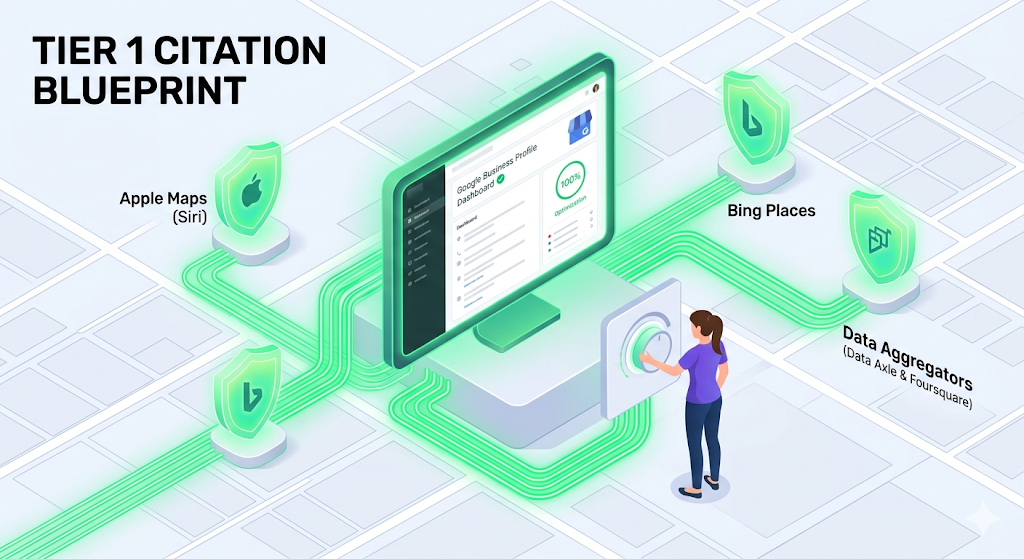
After the aggregators, get your business listed on the most important individual directories. These are high authority platforms with large user bases. A listing on any one of them carries real weight with search engines.
Start with universal directories. These are platforms that accept businesses from every industry and location. They are the most influential citations you can build outside of your Google Business Profile.
- Apple Maps has a domain authority of 100 and powers every search made through Siri and iPhone Maps. Any customer using an iPhone to find a local business is relying on Apple Maps data.
- Bing Places is critical for visibility in the Microsoft ecosystem including Bing Search, Cortana, and Microsoft Maps. It has a domain authority of 94 and covers a significant share of desktop search traffic.
- Yelp has a domain authority of 93 and is one of the most visited review platforms in the world. It carries particular weight in food, home services, and professional service industries.
- Facebook is a high authority social citation. A complete and accurate business page with your NAP information counts as a strong structured citation in Google’s eyes.
- Better Business Bureau has a domain authority of 86 and carries high trust signals. Many consumers search for BBB listings before making a purchase decision.
- Yellow Pages and Foursquare round out the core list and are widely syndicated across
Get listed and verified on all of these before moving to niche directories. When filling out each listing, copy your business name, address, phone number, URL, and description from your Master NAP document. Do not retype from memory. Pick the most specific category the platform offers. Add hours, photos, and every available field. Complete profiles rank better in directory internal search results. Save your login details for every directory in one secure place.
Step 4: Build Niche and Local Citations
General directories give you authority. Niche directories give you relevance. Once your core listings are live, move into directories built for your industry. Healthcare professionals should be on Healthgrades, Zocdoc, and WebMD. Law firms should be on Avvo, Justia, and FindLaw. Plumbers and contractors should be on Angi, Houzz, and Thumbtack. Restaurants should be on OpenTable, Zomato, and TripAdvisor. Real estate agents should be on Zillow and Realtor.com.
Local citations come from sources connected to your city or neighborhood. Your local Chamber of Commerce directory is one of the most valuable local citations you can get. Also look for city-specific directories, neighborhood portals, and local event pages. A sponsor listing on a community event page counts as a local citation. So does a mention in a local news article or city blog post.
To find citation gaps, search your top competitor’s business name in Google and look at every directory result. List every platform they are on that you are not. Then get listed on those same platforms. Tools like Semrush and Ahrefs speed this up by showing every source that mentions your competitors in one place.
Step 5: Competitor and Advanced Citation Building
The fastest way to find new citation opportunities is to check where your top competitors list their businesses. Search your competitor’s business name in Google and look at every directory result. List every platform they are on that you are not. Then list your business on those same platforms. This alone can uncover 10 to 20 opportunities you would not find on your own. For a deeper look, use Semrush or Ahrefs to pull your competitor’s backlink profile and filter for directory and listing sites.
Google search operators give you another layer of discovery. Search your competitor’s name in quotes followed by their own website. Example: “Competitor Name” -site:competitorwebsite.com. Every result is an outside source that mentions them. Check each one for citation opportunities.
You can also find gaps from your own unlinked mentions. Search your business name in quotes on Google and find results that mention your business but do not list it.. Reach out to those sites and ask them to add your full NAP details. Focus on platforms where all three of your top competitors have a listing. If every strong competitor in your area is on a platform, Google is paying attention to it.
Step 6: Build Unstructured Citations
Unstructured citations are business mentions in regular content instead of directory listings. A local food blogger writing about your restaurant, a news article quoting your owner, or a community website listing you as an event sponsor all count. Google treats them as genuine community endorsements. They are harder to earn than a directory listing but stronger as a trust signal.
Building unstructured citations is closer to public relations than SEO. Find local bloggers, journalists, and community websites in your area. Reach out and offer to be a resource. Sponsor local events and community fundraisers. Event organizers list their sponsors on their website and that listing is a citation tied directly to your area.
Create a Google Alert for your business name. Every time someone mentions you online, you get a notification. Check each mention for your full NAP details and ask the site owner to add them if they are missing.
Step 7: Manual vs. Automated Citation Building
There are two ways to build citations: do it yourself or use a tool. Each has its place depending on your budget, time, and business size.
Manual citation building means visiting each directory, creating an account, and filling out every field by hand. It takes more time but gives you full control over every detail. Nothing gets auto-filled wrong. Nothing goes to a directory you did not pick. For small businesses building their first 20 to 30 citations, manual is the right place to start.
Automated tools push your NAP data to dozens or hundreds of directories at once. You enter your details once and the tool handles the rest. This saves time and works well once your base citations are in place. The tradeoff is less control. Some directories these tools submit to are low quality or off-topic for your business.
Here are the top tools and what each one does best:
- BrightLocal is the standard for citation audits, rank tracking, and review monitoring. It also offers a manual building service where real people submit your listings.
- Whitespark is best for high quality manual discovery and building. It finds niche and local citation opportunities that automated tools miss.
- Moz Local is a budget option for automated listing management and duplicate removal across a network of directories.
- Yext syncs your data in real time across 100 or more directories. It is the most complete option but also the most expensive.
- Semrush Local spots listing errors and automates distribution to over 70 platforms. It works well for businesses already using Semrush for SEO.
Most professionals use a mix of both. Build your Tier 1 citations like Google Business Profile, Apple Maps, Bing Places, and Yelp by hand. Then use an automated tool for Tier 2 and Tier 3 directories. This gives you accuracy where it matters and speed everywhere else.
Step 8: Multi-Location and Service-Area Businesses
Most citation guides assume every business has one physical location. Many do not. Service-area businesses and multi-location companies face different challenges. Here is how to handle both.
Service-Area Businesses
Google lets service-area businesses like plumbers, electricians, and mobile detailers hide their physical address while still appearing in local search results. During setup, hide your address and define your service area by listing the cities or zip codes you cover. Focus on directories that allow city-based listings without a visible street address.
Multi-Location Businesses
Each location needs its own unique phone number, verified Google Business Profile, and listings on core directories like Yelp, Apple Maps, and Bing Places. Each location needs its own website page with unique content, local reviews, and an embedded Google Map. Never use virtual offices or co-working spaces as a listed address. Google removes listings when businesses are not physically staffed at the listed address during business hours.
Step 9: Add LocalBusiness Schema Markup to Your Website
Schema markup is code added to your website that helps search engines read your business details. Directory listings provide business information from external sources. Schema markup provides the same details directly from your website in a machine-readable format. Search engines and AI tools like Google Gemini and ChatGPT use this data to verify your business identity.
The best format is JSON-LD. It sits apart from your visible page content, so you can update it without touching your website design. Most SEO plugins for WordPress let you add schema without writing any code. Your schema should include your business type, name, address, phone number, website URL, opening hours, and geo coordinates. Use the most specific business type. “Plumber” beats “LocalBusiness.” “Dentist” beats “HealthcareProfessional.” Every detail should match your Master NAP document exactly.
For service-area businesses, add the areaServed field and list every city or region you cover. For multi-location businesses, add a unique schema block to every location page with that branch’s specific NAP details. Good schema creates a direct line of trust between your website and search engines. It backs up your citations and makes your business easier for AI tools to find and recommend.
Step 10: Monitor and Maintain Your Citations
Building citations is not a one-time task. Citation data breaks down over time. Directories get updated by the public, aggregators pull in old records, and competitors sometimes submit wrong edits to your listings. Google and Yelp let anyone suggest changes to a business listing. Check your Google Business Profile at least once a week. Check core listings like Yelp, Apple Maps, and Bing Places once a month.
Any time your business moves, changes its phone number, or updates its hours, update your citations right away. Start with your Google Business Profile and data aggregators. Changes at the aggregator level push out to dozens of partner directories on their own. Then work through your top 20 listings by hand.
Run a full citation audit every quarter using tools like BrightLocal, Moz Local, or Whitespark. These flag errors, new duplicates, and listings where your data has changed. Once a year, run a full scan across all directories to catch errors that have built up. Keep a spreadsheet of every directory where you have a listing along with your login details so updates do not waste time.
Step 11: Check Whether your Citations are Working
Citations take time to show results. Google must crawl and index directories before they affect rankings. This takes 4 to 12 weeks depending on the platform’s authority and how often Google crawls it.
Track your local pack position using a geo-grid tool like Local Falcon. This shows where your business ranks across different parts of your city, not only one average position. Scan your citations before you start building new ones. Run another scan 60 to 90 days later and compare the two.
Monitor direction requests, phone calls, and website clicks inside your Google Business Profile dashboard. These reflect real customer action. A steady rise in these numbers after a citation campaign means your visibility is growing. For tracking directory traffic, add UTM parameters to your website URL on each listing. This lets Google Analytics 4 show you how much traffic each citation source sends to your site.
Common Mistakes That Kill Local Rankings
Most citation problems do not come from doing too little. They come from doing things wrong. Here are the mistakes that hurt local rankings most.
- Inconsistent NAP across platforms is the most damaging error. “Mike’s Plumbing,” “Mikes Plumbing,” and “Mike’s Plumbing Co.” look like three different businesses to a search engine. Every variation lowers your Confidence Score.
- Building citations before auditing adds new listings on top of broken ones. This makes existing problems worse. Always audit first.
- Keyword stuffing the business name breaks Google’s rules. “Mike’s Plumbing Best Plumber in Chicago” can get your listing removed entirely.
- Using call tracking numbers on directory listings breaks NAP. Use your real local number on every citation. Apply call tracking only on your website through dynamic number insertion.
- Choosing quantity over quality wastes time and weakens your citation profile. Thirty accurate listings on Yelp, Apple Maps, and the Better Business Bureau beat three hundred listings on spam directories.
- Ignoring duplicate listings splits your authority across multiple profiles on the same platform. Two Yelp listings for the same business confuse both users and search engines.
- Using a P.O. Box or virtual office as your listed address sends the wrong signal to Google and can result in a listing removal.
- Dropping your citations after the first build is how data decay starts. Citations need regular checks and updates to stay accurate.
Advanced Strategies and Growth
Once your citation base is solid, there are more ways to grow your local presence beyond standard directory submissions.
Use Google Ads to Reinforce Local Visibility
Location extensions in Google Ads reinforce your physical address and increase direction requests from search results. Branded search campaigns increase the number of people searching for your business by name. Google uses branded search volume as a prominence signal for local organic rankings.
Build Citations Through Local Networking

Strong local citations come from real-world relationships instead of directory submissions. Business networking groups like BNI create referral connections that lead to high-authority website mentions. Your local Chamber of Commerce provides an authoritative directory listing and local business support. Alignable is a free platform built for small businesses that creates referral-based mentions.
Optimize for AI and Voice Search
AI tools like Google Gemini, ChatGPT, and Siri use citation data to answer local queries such as “best plumber near me open now.” Consistent NAPW across all platforms helps your business appear in these answers. LocalBusiness schema on your website supports AI recognition. Content that answers customer questions helps AI tools find and recommend your business.
FAQs
How many local citations do I need?
Focus on 30 to 50 high-quality citations. Ten accurate listings on platforms like Yelp, Apple Maps, and the Better Business Bureau beat a hundred listings on low-authority directories.
How long does it take to see results from citations?
Most businesses see ranking movement within 4 to 12 weeks. Citation cleanup often shows faster results than building new listings.
Can incorrect citations hurt my SEO?
Yes, Wrong information lowers your Confidence Score and can push you out of the Local Pack entirely.
What is the difference between a citation and a backlink?
A citation is any online mention of your business NAP. A backlink is a clickable link pointing to your website.
Do citations still matter if I have strong reviews?
Yes, Reviews affect trust and click rates but citations tell Google your business is real. Google will not rank a business with great reviews if it cannot verify its physical location.
Conclusion
Local citations are one of the most direct ways to improve your visibility in local search. They tell Google your business is real, active, and located where you claim. Without them, a well designed website and strong reviews are not enough to compete in local search results.
The process is clear. Audit what exists. Lock in your NAP. Build listings on core directories, niche platforms, and local sources. Add schema markup. Then check everything on a regular schedule. Businesses that rank in the Local Pack have accurate, consistent citations across the right platforms. They keep them that way over time.
Start today. Pick your top three missing directories and get listed. Fix one wrong listing. Run one Google search to see where your business appears right now. Each accurate citation sends Google a signal that your business deserves visibility.

15 June 2026