


68% of consumers stop trusting a business after finding wrong information online. That is, most of your customers walk away before they ever call. You may have updated Google and Yelp. But hundreds of directories still show your old address or the wrong number.
Every conflict tells Google it cannot verify your business. Google ranks you lower or stops showing you at all. This article covers what NAP consistency is and why it controls your local rankings. You will learn where your business data lives, how wrong data spreads, and how to fix it step by step.
What Is NAP Consistency?
NAP consistency means your business name, address, and phone number are identical across every platform online. Every detail must match. Not close. Not similar. Identical.
Google checks your data across hundreds of sources. These include your website, Google Business Profile, Yelp, and Apple Maps. When all sources agree, Google trusts your business is real. When they conflict, that trust drops and your rankings fall.
What Does NAP Stand For?
NAP stands for Name, Address, and Phone Number. The N is your legal business name. The A is your full address including suite number, city, state, and zip. The P is your main local phone number for that location.
In local SEO this extends to NAP+W. The W adds your website URL. These four data points form your digital fingerprint. Search engines use it to tell your business apart from thousands of others in the same area.
A correct NAP listing for a Chicago dental practice looks like this. Name: Miller Dental Associates. Address: 500 Oak Avenue Suite 10, Chicago IL 60601. Phone: (312) 555-0199. Every platform must show this exact format. Same punctuation. Same abbreviations. Every time.
Why Exact Formatting Matters
A person can tell “500 Oak Ave #10” and “500 Oak Avenue Suite 10” are the same place. A search engine cannot. It reads these as two different pieces of text. Each variation reduces your confidence score with Google. Lower confidence means lower Local Pack rankings.
Small variations cause real damage. Using “&” instead of “and.” Writing “St.” on one site and “Street” on another. Across dozens of listings these gaps break your local visibility. We call this slow buildup data drift. It is the root cause of most local ranking problems.
The fix starts with a NAP Master Record. This is one document that defines the exact format of your name, address, and phone number. Every listing must match it. Also show your NAP as plain HTML text on your site. Text inside images is invisible to search engines.
What Is NAP in SEO and Why Does Formatting Matter?
What is NAP in SEO? It is the core data set search engines use to verify your business identity and place you in local results. Understanding NAP meaning in SEO goes beyond just knowing what the letters stand for. It means understanding that search engines read your business data like a machine, not like a human.
A person can tell “500 Oak Ave #10” and “500 Oak Avenue Suite 10” are the same place. A search engine cannot. It reads these as two different pieces of text. Each variation reduces your confidence score with Google. Lower confidence means lower Local Pack rankings.
Small variations cause real damage. Using “&” instead of “and.” Writing “St.” on one site and “Street” on another. Across dozens of NAP listings these gaps break your local visibility. We call this slow buildup data drift. It is the root cause of most local ranking problems.
The fix starts with a NAP Master Record. This is one document that defines the exact format of your name, address, and phone number. Every NAP listing must match it. Also show your NAP as plain HTML text on your site. Text inside images is invisible to search engines.
Why NAP Consistency Matters for Local SEO
NAP consistency local SEO is the main signal search engines use to verify your business is real and worth showing to local searchers. Local rankings depend on three things: Proximity, Relevance, and Prominence. NAP local SEO drives prominence and supports relevance. The NAP consistency significance for local search is that without it, even strong reviews and a complete Google Business Profile cannot fully compensate.
It Tells Search Engines Your Business Is Legitimate
Search engines confirm your business exists through data. Google checks your NAP information across your website, Google Business Profile, Yelp, and Yellow Pages. When every source matches, Google gets consensus signals that confirm your business is real.
When signals conflict, confidence drops. If your site shows “Oak Avenue” but Yelp shows “Oak Ave,” Google cannot confirm they are the same business. It reduces your NAP score in SEO and may stop showing your listing entirely. This is the difference between ranking locally and being invisible.
It Directly Affects Your Local Pack Rankings
The Local Pack is the block of three results at the top of Google for searches like “dentist near me” or “plumber in Chicago.” This is the most valuable spot in local search.
Google Business Profile NAP consistency guidelines make clear that your profile details must match what appears across the web . A well-optimized profile can strongly improve local search visibility. NAP consistency makes those signals work. A great GBP with bad directory data still loses ranking power. Businesses in the 3-Pack get 126% more traffic and 93% more user actions than those below it.
A 2024 study found that businesses with consistent NAP across at least 15 platforms were 23% more likely to appear in the 3-Pack. When your NAP matches on Yelp, Facebook, and TripAdvisor, all review signals point to one entity. When it does not match, that authority splits and no listing ranks as well.
It Affects Whether Customers Can Actually Reach You
Wrong NAP information stops customers from reaching your business. A customer calls the number or drives to the address. If the number is wrong or the address is old, they cannot reach you. That is a lost sale. Another study found that 73% of consumers lose trust when they see inconsistent details across Google, Yelp, and Facebook.
The harm is worst in urgent situations. A wrong number for an emergency plumber or a 24-hour clinic sends the customer to a competitor and often produces a one-star review. Good NAP also protects returning customers who saved your old number and try to call again.
Where Your NAP Information Needs to Match
Your NAP must match on every platform where your business appears. Every NAP directory citation, social profile, and webpage that mentions your name, address, or phone number is a potential source of bad data.
Your Website (Contact Page, Footer, and Location Pages)
Your website is the most trusted NAP source you control. Your NAP should appear in three places. The footer puts contact details on every page. The contact page shows your full NAP with a clickable number and an embedded Google Map. Each branch needs its own location page with unique NAP details and schema markup.
Without separate pages search engines cannot tell branches apart. We call this location cannibalization, and it splits your ranking power. Always show your website NAP as plain HTML text. Text inside an image is invisible to crawlers.
Google Business Profile
Google Business Profile is the most important NAP listing for any local business. It feeds into Google Maps, the Local Pack, and the Knowledge Panel. If your NAP is wrong here it is wrong everywhere Google shows your business.
Treat your GBP as the reference for every other listing. If your GBP shows “500 Oak Avenue, Suite 10” every other platform must show exactly that. Fill in every field including categories, service area, hours, and website URL.
Online Directories and Citation Sites
Citations come in two forms. Structured citations appear on sites like Yelp, Yellow Pages, and the Better Business Bureau. They are easy for search engines to read. Unstructured citations appear in news articles, blog posts, and forums. They carry strong authority because they are genuine third-party mentions.
The top platforms to focus on are Google Business Profile, Yelp, Apple Maps, Bing Places, Yellow Pages, and the Better Business Bureau. Industry directories like Healthgrades for doctors, Avvo for lawyers, and TripAdvisor for hotels also carry real authority in their fields.
Social Media Profiles
Platforms like Facebook, Instagram, LinkedIn, and YouTube now act as secondary search engines. AI tools scan social media to check business credibility. An old phone number on your Facebook page weakens your entity trust.
The About section of your Facebook page, your LinkedIn profile, and every social platform that lists your contact details must match your NAP Master Record. Same format. Same punctuation. Every time.
What Are Data Aggregators and Why Do They Matter?
Data aggregators collect and send your business data to hundreds of directories, maps, and search engines.Most business owners do not know about them. Even if you never submitted your business to a single directory, aggregators may have done it for you. Sometimes with wrong information.
How NAP Syndication Spreads Your Data Across the Web
NAP syndication in SEO works through three main aggregators in the US: Data Axle, Neustar Localeze, and Foursquare. Data Axle sends data to search engines, in-car navigation, and 85% of large public libraries. Neustar Localeze sends to over 80 platforms including Apple Maps, Bing, Alexa, and Siri. Foursquare powers location data across mobile apps and navigation tools.
Google, Bing, and Apple license data from these aggregators. Facebook, Yelp, and Yellow Pages pull from them too. Fixing your NAP information at the aggregator level is more important than fixing individual directories. It fixes the source, not the symptoms.
Why Old or Wrong Data Keeps Coming Back
You fix your Google Business Profile. You fix Yelp. Six weeks later a directory shows your old address again. The reason is aggregators. They refresh their databases from public records, utility bills, and government files. If your old address still exists there the aggregator picks it up and sends it out again. This overwrites your manual fixes.
Local SEO professionals call this a Zombie Listing. It keeps coming back no matter how many times you fix it. The only fix is correcting your NAP at the aggregator level. Fixing directories before aggregators is like mopping the floor while the tap is still running. Turn off the tap first.
How to Check Your NAP Consistency
The first step is finding exactly where your NAP listings are broken. A NAP consistency checker approach whether manual or tool-based starts with a spreadsheet that has five columns: platform name, listing URL, name shown, address shown, and phone shown. Every listing you find goes into this sheet.
The Manual Method
Search your exact business name in quotes on Google. Check all results on the first two pages. Then search your current NAP number in quotes. Search your old phone number if you ever changed it this finds old NAP listings still sending customers to a dead line. Finally search your name with your old address if you ever moved.
Record every listing in your spreadsheet. Mark each one as correct, wrong, or duplicate. Do not start fixing yet. Finish the full audit first. The manual method works for small businesses with one location. Its limit is coverage. Google does not index every directory.
Using a Tool to Audit at Scale
For businesses with many locations, a long history, or a recent rebrand, use a NAP consistency tool. BrightLocal, Moz Local, and Whitespark scan hundreds of directories in minutes. They find wrong numbers, old addresses, and duplicate NAP listings in one report. Most tools also give you a NAP score in SEO to show which platforms need fixing first.
Tool audits also find listings the manual method misses. Auto-generated profiles. Old agency listings never removed. Duplicate profiles splitting your authority. Always run a full tool audit before you touch any listing.
How to fix NAP inconsistencies step by step
Fixing NAP problems requires a set order. Going straight to individual directories without fixing the source first wastes time and the wrong data keeps coming back.
Step 1 — Start by fixing your Google Business Profile first
Your GBP is your most trusted local listing. Log in and check every field. Confirm your name matches your legal name. Check your address, phone, and website URL. If your profile is not verified, request it now. Once correct your GBP becomes the Gold Standard every other listing must match.
Step 2 — Update Your Website
Update your footer, contact page, and all location pages to match your GBP. Same name. Same address. Same phone. No variation. Also add LocalBusiness schema markup. Schema gives crawlers a clear version of your NAP and acts as a final check when directory data conflicts.
Step 3 — Correct the Data Aggregators
Send your correct NAP to Data Axle, Neustar Localeze, and Foursquare. These aggregators push your data to hundreds of directories. Fixing them stops zombie listings from coming back. When aggregators carry wrong data they overwrite your manual fixes at the next sync.
Step 4 — Update Major Directories and Citation Sites
Claim and update listings on Yelp, Apple Maps, Bing Places, Yellow Pages, and the Better Business Bureau. For directories that do not allow direct edits contact the operator. Remove or merge duplicate listings. Update vertical directories like Healthgrades, Avvo, and TripAdvisor too.
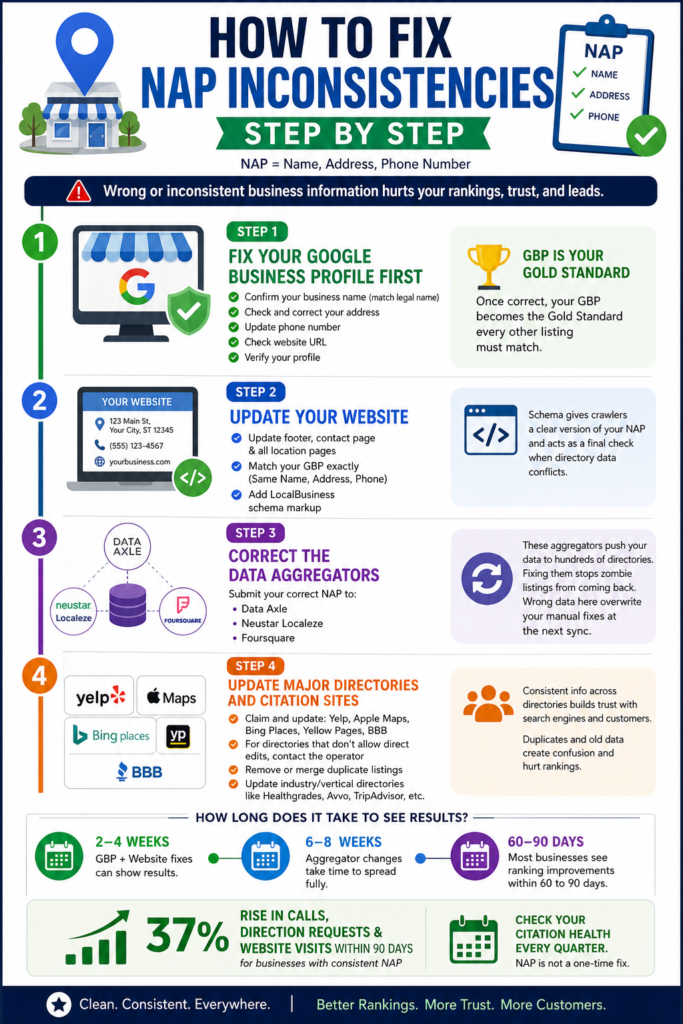
How long does it take to see results?
Most businesses see ranking gains within 60 to 90 days. GBP and website fixes can show results in 2 to 4 weeks. Aggregator changes take 6 to 8 weeks to spread fully. Research shows businesses with consistent NAP see a 37% rise in calls, direction requests, and website visits within 90 days. Check your citation health every quarter. NAP is not a one-time fix.
Tools That Help You Manage NAP Consistency
The right tool saves hours of work and stops problems from coming back. The best choice depends on your budget and how many locations you manage.
BrightLocal
BrightLocal combines citation audits, rank tracking, and review monitoring in one platform. It scans hundreds of directories and flags every problem. Pricing starts at $39 per month. Best for small and medium businesses.
Moz Local
Moz Local sends your NAP to major aggregators and key directories on its own. It watches for conflicts and sends alerts. Pricing starts at $16 per month on an annual plan. The most affordable option.
Whitespark
Whitespark focuses on citation building and cleanup by hand. It finds local citation chances that automated tools miss. One-time services start at $20. Best when you want full control.
Yext
Yext syncs your data across 200 plus directories in real time. Any update pushes to the full network at once. Listings go dark when your subscription ends.Pricing begins at $199 per year for each location. Best for multi-location brands.
Birdeye
Birdeye uses AI to manage NAP data across many locations. It stops local managers from breaking brand-level formatting. It pairs listing management with review and customer experience tools.
One important note that applies to every tool on this list. No tool replaces a proper audit. Use these platforms to monitor and maintain consistency after you complete the initial cleanup. They are management tools not substitutes for understanding where your NAP stands today.
Special Situations That Need Extra Attention
Standard NAP advice works for one location with a fixed address. Not every business fits that. Getting these situations wrong causes ranking drops and profile suspensions.
Service-Area Businesses With No Public Address
Service-area businesses like plumbers and electricians serve customers at their location. On GBP verify with your real address then set it to hidden. Define your service area by city or radius instead. For directories that need an address use your home address consistently. Never use a P.O. Box. It risks profile suspension.
Keep your business name and phone number the same everywhere. These two fields are what search engines use most to match your listings.
Businesses With Multiple Locations
Multi-location businesses face data drift from edits that are not coordinated. The fix is central control. Create one master NAP document with approved details for every location. Each location needs its own page on your site and its own Google Business Profile. Without separate pages search engines cannot tell branches apart. This is location cannibalization and it splits your ranking power.
After a Move, Rebrand, or Phone Number Change
A move, rebrand, or phone change is the most risky moment for your local SEO. Build your new NAP Master Record before the change. On the day of the switch update your GBP and website at the same time. Then fix Data Axle, Neustar Localeze, and Foursquare. Follow with Yelp, Apple Maps, Bing Places, and Yellow Pages.
Post the change on Facebook, Instagram, and LinkedIn and email your customer list. These steps create unstructured citations that help search engines link your old identity to the new one.
How to Use Schema Markup to Reinforce Your NAP
Schema markup is code that you add to your website. It gives search engines a clear machine-readable version of your business data. It acts as a solid reference when other sources conflict.
For local businesses the right type is LocalBusiness schema. It is part of Schema.org and works with Google, Bing, and Apple. Use JSON-LD format.Google says this is the recommended approach. Only 12.4% of domains use structured data. Adding schema puts you ahead of most local competitors.
Your name, address, and phone in the schema must match your NAP Master Record exactly. Use the most specific business type. A dental practice uses a Dentist. A law firm uses LegalService. A hotel uses a hotel. For multiple locations each branch needs its own schema on its own page. Validate your code with Google’s Rich Results Test before going live.
NAP Consistency in AI Search and Voice Search
NAP consistency matters more in AI and voice search than in old-style search. Traditional search shows a list and lets the user pick. AI search and voice search pick one answer and give it directly. If your data is wrong you do not rank lower. You get left out completely.
Google Assistant pulls from Google Business Profile. Siri pulls from Apple Maps and Yelp. Alexa relies on Bing Places and Yelp. If your NAP differs across these sources, voice assistants give wrong information about your business. You become invisible to an entire segment of the market.
The businesses that win in AI and voice search have the most consistent data on the most trusted platforms. Accurate data is no longer just good practice. It is the entry requirement.
Common NAP Mistakes to Avoid
Most NAP problems are not caused by neglect. Small decisions that seem harmless cause them and create lasting damage to local search visibility.
- Most NAP problems come from small decisions that seem fine at the time but cause lasting damage to local rankings.
- Using call tracking numbers as your main listed number. Different numbers on different directories break NAP consistency. Use tracking as the primary on GBP and add your real number as the extra phone field.
- Keyword stuffing your business name. Adding text like “Best Plumber in Chicago” breaks Google’s rules and creates entity confusion. Use only your legal business name.
- Using a P.O. Box or virtual office address. Google needs a real physical address. A P.O. Box risks profile suspension and reduces trust.
- Ignoring duplicate listings. Two listings for the same business on the same platform split your review signals. Find duplicates and merge or remove them.
- Fixing directories before fixing aggregators. Manual fixes get overwritten at the next aggregator sync. Always fix Data Axle, Neustar Localeze, and Foursquare first.
- Leaving old listings live after a move or rebrand. Old listings become zombie data that aggregators keep spreading. Claim, fix, or remove every old listing.
- Inconsistent formatting. Using “St.” on one listing and “Street” on another creates the same confusion as wrong data.Choose one format and use it everywhere..
- Treating NAP as a one-time fix. Directories change without notice. Aggregators resync from public records. Check your NAP health every quarter.
- Putting NAP inside images on your website. Text inside a banner or logo image is invisible to search engines. Always use plain HTML text.
- Ignoring social media profiles. Facebook, LinkedIn, and Instagram are active NAP sources. A wrong number on your Facebook About page weakens your entity trust.
FAQs
What is NAP consistency in local SEO?
NAP consistency means your business Name, Address, and Phone number are the same on every platform. Search engines use this to verify your business and decide where to rank it locally.
What does NAP stand for?
NAP stands for name, address, and phone number. In local SEO this extends to NAP+W, which adds your Website URL as a fourth element.
Does NAP consistency still matter in 2025?
Yes, Search engines expect more accurate data not less. AI tools and voice assistants need consistent NAP to verify and suggest local businesses.
What happens if my NAP is inconsistent?
Google loses trust in your business and your local rankings fall. Customers get wrong contact details which leads to lost calls, missed visits, and bad reviews.
Do small formatting differences actually matter?
Yes, Search engines read “123 Main St” and “123 Main Street” as different text. Across dozens of listings these small gaps reduce Google’s trust in your business.
Is a NAP tool worth it for small businesses?
Yes, Losing customers from wrong contact details costs more than the tool. Moz Local starts at $16 per month. BrightLocal starts at $39 per month.
Can I use a P.O. Box as my business address?
No, Google needs a real physical address. A P.O. Box risks GBP suspension and weakens trust signals across directories and aggregators.
Conclusion
NAP consistency forms the base of every local SEO strategy. Your business name, address, and phone number must be the same across your website NAP, Google Business Profile, directories, aggregators, and social profiles. One inconsistency reduces Google’s trust and costs you rankings, customers, and sales.
The businesses that lead in local search are not always the biggest. They are the ones with the most accurate and consistent NAP citations on the most trusted platforms. In a world where AI tools and voice assistants give one answer with full confidence, accurate NAP information is not optional. It is the entry requirement.
Ready to fix your NAP? Search your business name in quotes on Google and start your NAP consistency cleanup today.

12 June 2026