


Google Reviews are important as 93% of consumers read reviews before choosing a local business. One unanswered negative review can cost you dozens of customers. Most businesses never realize it is happening.
Ignoring reviews doesn’t make them disappear. It makes them the final word. Generic copy-paste replies hurt just as much. Customers know when you didn’t read their feedback. Future customers notice even faster.
This guide shows you exactly how to respond to Google reviews the right way. You will get a proven response formula, ready-to-use templates for every situation, and real examples. It also shows the difference between a reply that builds trust and one that destroys it.
What Is a Google Review Response and Why It Matters
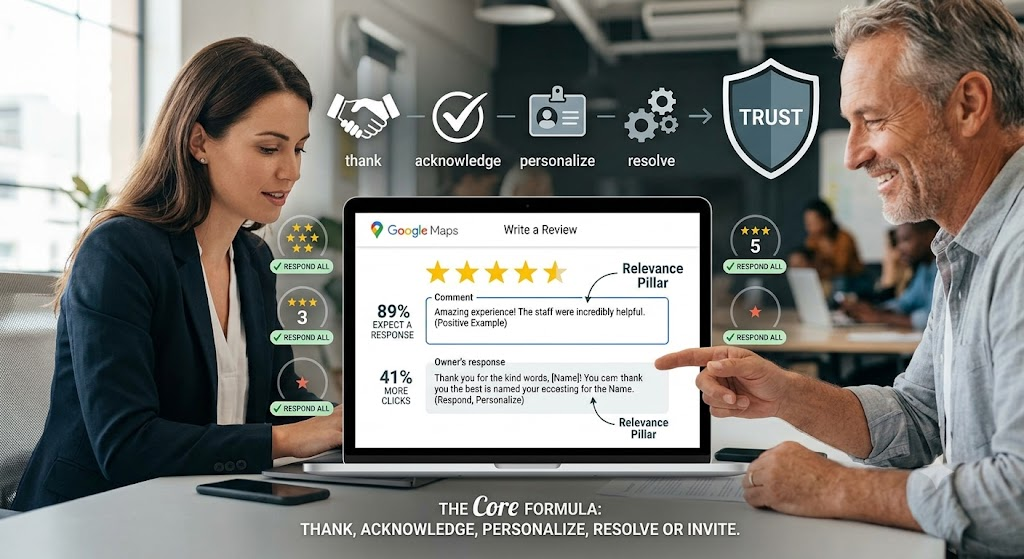
A Google review response is a public reply from a verified business owner or manager. It appears under a customer’s feedback on Google Search or Google Maps. Anyone who finds your business can see it. Most owners treat it like a private message to one customer. It isn’t. Every response you write shapes how future customers see your business.
The impact on reputation and conversions is direct. Businesses that respond to every review are more likely to be used by 80% of consumers. Unanswered negative reviews drive away 77% of customers. Resolving customer complaints helps bring unhappy customers back. Businesses that respond to reviews are significantly more likely to be chosen and trusted by consumers
Evidence builds trust, not claims. Any business writes “excellent customer service” on its website. A business that replies to reviews on Google resolves a billing complaint at an accounting firm, fixes a wait-time issue at a medical clinic, and thanks a repeat customer at a local restaurant. It demonstrates the claim instead of only stating it. 89% of consumers now expect a response to their review. Silence reads as indifference.
Why Responding to Google Reviews Is Worth Your Time
Every reply shapes future decisions, not only the reviewer’s. People read reviews before visiting. They notice how you handle pressure. They see how you treat problems and people. They also notice if you respond at all. Your reply becomes a trust signal for future customers.
Consistent responses increase buying decisions. Customers choose businesses that respond to reviews 41% more often than businesses that do not respond. About 80% of consumers say they would use a business that responds to all reviews.
A significant share of consumers avoid businesses that fail to acknowledge feedback or respond to reviews. About 57% who left a negative review and received no response say they will not return. Ignoring a review does not make it disappear. It makes it the last word.
About 89% of consumers expect a response. 34% expect it within two to three days. A missing response is not a neutral outcome. It is a visible gap that potential customers notice and factor into their decision.
How to Set Up Access to Your Google Reviews
Before you can respond to a Google review, you need verified access to your Google Business Profile. Without it, the reply button does not appear. You set up everything in a few minutes and only once.
On Desktop (Step-by-Step)
- Sign into your Google account and search for your business name.
- Click “Read reviews” in your Business Profile panel.
- Find the review you want to reply to and click “Reply.”
- Type your response and click “Post reply” to publish.
On Mobile (Step-by-Step)
- Open Google Maps and sign into the correct account.
- Tap your profile photo and select “Your Business Profile.”
- Tap “Reviews,” select a review, and tap “Reply.”
- Write your response, then tap “Post” to publish it.
For team access, the Manager role is the right choice for anyone handling reviews. It allows full response access without the ability to change sensitive account settings. New managers must wait seven days before performing any sensitive profile actions.
When you reply to a review, the original reviewer receives an email notification. A prompt response gives an unhappy customer a reason to reconsider. Some customers update their rating when they feel heard.
What Makes a Good Google Review Response
The core formula that works across every review type is: Thank, Acknowledge, Personalize, Resolve or Invite. Thank the customer for their time. Acknowledge what they specifically mentioned. Personalize by using their name and referencing their exact experience. Close by resolving the issue or inviting them back. This structure keeps every response focused, human, and purposeful.
Tone matters as much as content. The moment a response turns defensive, it stops being about the customer and starts being about the business. Generic copy-paste replies put off 50% of consumers. Use the reviewer’s name, mention a detail from their review, and refer to the service or staff member they highlighted. Keep google review responses between 50 and 150 words and always reply within 24 to 48 hours.
Responding to Google reviews is also an SEO opportunity. Include your service type and location in every reply. A physiotherapy clinic in Austin can mention its Austin physiotherapy team helping with recovery. This helps Google connect your profile with local search terms without keyword stuffing.
What Types of Reviews You Should Respond To
Every review deserves a response. How to respond to reviews on Google changes depending on the type of feedback, but the rule of responding to all of them does not.
Positive Reviews (5-Star)
Positive reviews are the easiest to overlook because they require no damage control. That is exactly why most businesses underuse them. A thoughtful response to a 5-star review reinforces the experience and shows engagement to future customers. Thank the reviewer, mention what they praised, and invite them back.
Neutral Reviews (3–4 Star)
People see neutral reviews as balanced, honest, and influential. Acknowledge what went well, address the specific gap with curiosity, and show the business is improving. A neutral review handled well can be more persuasive than a dozen 5-star responses.
Negative Reviews (1–2 Star)
Negative reviews are where businesses either win or lose their reputation. How do you respond to 1-star reviews on Google? Lead with empathy, take ownership of the problem, and move the conversation offline. Never argue publicly. The response is not only for the reviewer. It is for every future customer watching how the business handles adversity. A majority of unhappy customers will return if their issue is acknowledged and resolved effectively.
Fake or Spam Reviews
Fake reviews follow clear patterns like vague language, new or empty profiles, or many one-star ratings posted in a short time. Respond in a brief and professional way to show transparency and fairness.
Then report the review through Google Business Profile as a policy violation. Responding first and reporting second is the right order. A calm public response protects your reputation while the removal process runs in the background.
How to Respond to Google Reviews (Step-by-Step)
Responding to a review on Google takes less than five minutes when you have a clear process. The quality of that response depends on the steps you take before you start typing.
Step 1: Read and Understand the Review
Read the review before forming a reaction. Look beyond the star rating and focus on what the customer is actually saying. A 3-star review that praises the food but criticizes the wait time is a very different situation from a 1-star review with no comment. The rating tells you the sentiment. The text tells you what to address.
Step 2: Identify Intent and Tone
Determine what the reviewer is looking for. Some customers want an apology. Some want a resolution. A customer venting frustration needs empathy first. A customer asking a specific question needs a direct answer. Getting this wrong turns a recoverable situation into a public relations problem.
Step 3: Write a Clear Response
Post the response within 24 to 48 hours and maintain that cadence across all reviews. A profile that replies to Google reviews consistently shows the business is active, managed, and trustworthy. This includes everything from a 5-star compliment at a dental clinic to a 1-star complaint at a retail store. One strong response means little. A pattern of strong responses builds a reputation.
Step 4: Publish and Stay Consistent
Post the response within 24 to 48 hours and maintain that cadence across all reviews. A profile that responds to every review shows the business is active, managed, and trustworthy. This includes everything from a 5-star compliment at a dental clinic to a 1-star complaint at a retail store. One strong response means little. A pattern of strong responses builds a reputation.
How Does a Business Owner Respond to a Google Review
How does a business owner respond to a Google review versus how a team member does it? The access is the same through Google Business Profile but the voice should always reflect the business. Whether the reply comes from the owner, a manager, or a marketing coordinator, it should sound consistent, personal, and on-brand.
Positive review templates should serve as a starting point, not a script. Adjust the bracketed fields to match the reviewer’s name, the service they mentioned, and your business type. Never copy-paste the same response twice.
Short and Simple
“Hi [Name], thank you for the 5-star review.We’re delighted to hear you had such a wonderful experience with us. We look forward to seeing you again soon.”
“Thank you, [Name]. Your kind words mean a lot to our team.We look forward to seeing you again soon.”
“Hi [Name], thank you for taking the time to leave us a review.Your support means a lot to us..”
Personalized
“Thank you, [Name], for the wonderful feedback. We are thrilled to hear you enjoyed [specific service or product]. Our team works hard to make every visit worthwhile and it is always rewarding to know when we get it right. “Hi [Name], thank you so much for your kind words about [Employee Name]. We will make sure to pass your compliments along. It is feedback like yours that keeps our team motivated.We look forward to welcoming you again.”
Encouraging Repeat Business
“Thank you for the 5-star review, [Name]. We are glad our [specific service] hit the mark. Since you enjoyed that, you might also love our [related service or product] on your next visit.We hope to see you again soon.”
“We appreciate your support, [Name]. Customers like you are the reason we love what we do. Ask about our [loyalty program or special offer] on your next visit. We look forward to having you with us again.”
Google Review Response Templates (Negative & Neutral Reviews)
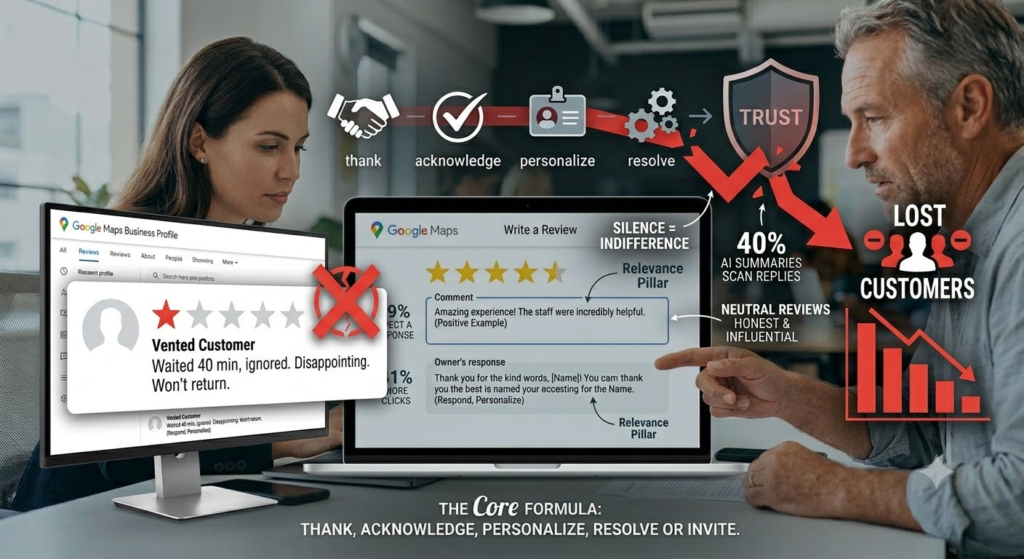
Negative and neutral reviews require more care than positive ones. The goal is not to win the argument. It shows future customers that your business takes feedback seriously and handles problems.
Apology and Empathy
“Hi [Name], thank you for sharing your experience. We are sorry your visit did not meet our standards. Your feedback is important to us and we are taking it seriously.”
“Hello [Name], we appreciate you taking the time to leave this feedback. We are sorry to hear your experience fell short of your expectations. This is not the standard we strive for and we want to make it right.”
“Hi [Name], thank you for being honest with us. We are sorry your experience was not what it should have been. We hear you and we are working to do better.”
Resolution-Focused
“Hi [Name], thank you for bringing this to our attention. We have looked into the issue you raised regarding [specific problem] and have addressed it with our team to ensure it does not happen again. We value your business and hope you will give us another opportunity to serve you.”
“Hello [Name], we apologize for the inconvenience caused by [specific issue]. We have flagged this with our [relevant team or department] and taken steps to prevent a recurrence. We would love the chance to make this right for you.”
De-escalation and Moving Offline
“Hi [Name], we are sorry for the frustration this has caused. Please reach out to us directly at [phone or email] so we can resolve this properly.”
“Hello [Name], we take situations like this seriously and would prefer to address this with you personally. Please contact our manager at [contact details] at your convenience.”
“Hi [Name], we hear your frustration and we are sorry your experience did not reflect our standards. Please get in touch with us at [phone or email] so we can make this right for you directly.”
How to Handle Difficult or Fake Reviews
How to handle Google reviews that are fake, abusive, or clearly from a competitor requires a different approach from genuine feedback. Not every negative review reflects a real customer experience.
Fake reviews follow identifiable patterns: vague language with no specific details, accounts with little or no review history, and multiple one-star reviews appearing within a short window of time. Two or more of these signals together is a strong indicator of fraudulent activity.
When you encounter a suspected fake review, respond to the Google review first and report second. A brief, calm public response signals transparency to everyone reading. Something like “We have no record of this interaction. Please contact us directly at [contact details]” is enough. Then flag the review through Google Business Profile under the appropriate violation category such as spam or conflict of interest.
Abusive reviews require the same composure. Respond once, briefly and professionally, then report it to Google for policy violation. Do not engage beyond one response. Every additional reply gives the content more visibility and signals that the business is reactive rather than composed.
The most effective long-term protection is a high volume of genuine positive feedback. One bad review among 200 authentic ones carries almost no weight. The same review among 12 carries significant damage.
How to Reply to a Google Review as a Customer
How to reply to a Google review as a customer is a question that comes up when customers want to update their feedback or respond to a business’s reply. Customers can edit their original review at any time through Google Maps. They can also respond to a business reply directly in the review thread. Businesses cannot control this, but a well-written reply often prompts customers to update their rating or add a follow-up comment — especially when they feel heard.
This is why replying to Google reviews quickly and personally matters. Customers who feel acknowledged sometimes become advocates. Customers who feel ignored rarely come back.
How Review Responses Improve SEO
Most businesses treat google review responses as customer service. They are also an SEO tool, and most are not using them that way. Google’s local ranking algorithm relies on three pillars: relevance, distance, and prominence. Prominence improves with a high response rate and strong star ratings. Relevance improves when responses naturally include service-specific and location-based language.
A business with 50 reviews and consistent responses will often outrank a competitor with 200 reviews and none. When a Chicago dental clinic mentions services like “root canal” while responding to a review on Google, it helps Google connect that business with those search terms. Natural and specific is all it needs to be.
40% of consumers now use generative AI tools like Google’s AI Overview, ChatGPT, and Perplexity to research local businesses. These tools scan google review responses to build summaries. A clear message about your business, location, and customer care helps future customers find and understand you.
How to Manage Review Responses at Scale
Managing replying to Google reviews across a growing business becomes unmanageable without a clear system. The quality of individual responses means little if the process behind them is inconsistent.
Start by assigning clear responsibility. In a small business, one person should own review responses. In large operations, each location has its own manager for responses. A central team monitors quality. Local managers reply for their specific sites. The Manager role in Google Business Profile allows response access. It does not allow sensitive account changes.
Brand voice consistency is the biggest challenge at scale. A response written by a store manager in one city should sound like it came from the same company as one written by a marketing coordinator in another.It doesn’t have to be lengthy. It needs to be clear enough that anyone on the team can follow it without supervision.
Track performance with three metrics: response time, response rate, and sentiment trends. Aim for a response time under 48 hours and a response rate of 100%. Sentiment trends show if changes are improving customer experience. If the same complaint keeps appearing across locations, it is a process problem, not a review problem.
Tools to Manage and Automate Review Responses
Managing reviews manually works at low volume. Once it grows, a dedicated tool becomes necessary to maintain quality, speed, and consistency in how you respond to reviews on Google.
Birdeye, Podium, and BrightLocal centralize feedback from Google, Yelp, and Facebook into a single dashboard. Birdeye suits multi-location enterprises with AI-powered response management at scale. Podium works best for service-based small businesses focused on SMS review requests. BrightLocal helps agencies manage reviews, citations, and ranking data. For smaller budgets, CommentAssist offers AI-crafted responses at a low cost.
Manual responses offer the highest personalization but become unsustainable at scale. Automated responses handle volume but risk sounding generic. Copy-pasted replies put off 50% of consumers. The best tools generate AI drafts from each review for human approval, keeping a personal tone without extra effort.
Birdeye and Chatmeter allow centralized control of multi-location reviews with local reply customization. “After adopting a centralized review management platform across 300+ locations, Moss & Company increased reviews by 62% and boosted response volume by 141% .
Common Mistakes to Avoid When Replying to Google Reviews
Most review response mistakes come from lack of system, training, and awareness of public perception. The errors below are the most common ones businesses make when how do you respond to Google reviews is not a defined process.
Generic copy-paste replies are the most common mistake and one of the most damaging. Template and impersonal responses put off 50% of consumers.
Ignoring negative reviews is a silent reputation killer. 59% of customers who left a negative review and received no response say they will not return.
Emotional responses are the fastest way to turn a manageable situation into a public relations problem. A defensive reply to a Google review does more damage than the original review ever could.
Slow replies signal inattention. 32% of consumers expect a response within a week. Waiting a week or longer tells customers that reviews are not a priority.
Overpromising in a public response carries its own risk. Offering refunds or free services publicly can attract bad-faith complaints. If a resolution requires a commitment, move the conversation offline first.
Real Examples of Effective Review Responses
Seeing the difference between a weak and a strong response makes the principles in this guide concrete. The examples below cover the three situations every business encounters when responding to Google reviews.
Positive Examples
Review: “Amazing experience from start to finish. The staff were incredibly helpful and the whole process was seamless.”
Response: “Thank you so much for the kind words, [Name]. We are thrilled to hear the process felt seamless for you. Our team works hard to make every interaction straightforward and stress-free, so this really means a lot. We look forward to working with you again.”
Review: “Best service I have had in a long time. Will definitely be coming back.”
Response: “We really appreciate that, [Name]. Knowing you had a great experience and plan to return is exactly the kind of feedback that keeps our team motivated. We look forward to seeing you again soon.”
Negative (Before vs. After)
Review: “Waited over 40 minutes and nobody acknowledged me. Very disappointing.”
Before (Ineffective): “We are sorry you felt that way. We are always trying to improve.”
This response is vague, passive, and impersonal. It fails to address the specific complaint or provide any resolution to the customer or future readers.
After (Effective): “Hi [Name], thank you for letting us know about this. A 40-minute wait with no acknowledgement is not the experience we want, and we apologize. We have raised this directly with our team to ensure it does not happen again. Please reach out to us at [contact details] so we can make this right.”
This response acknowledges the issue, takes ownership, offers a solution, and builds trust for future customers.
High-Converting Responses
High-converting responses are specific, human, and build trust for future customers.
Review: “The physiotherapy sessions helped me recover from my knee injury much faster than I expected.”
Response: “Thank you, [Name]. Hearing that your recovery exceeded your expectations is exactly why our physiotherapy team does what they do. We are glad we could support your knee rehabilitation and we are here whenever you need us.”
Review: “I have tried a few plumbers in Houston and these guys are by far the most reliable.”
Response: “That means a great deal to us, [Name]. Our Houston plumbing team treats reliability as essential on every job, and your feedback reflects that. Thank you for trusting us and we look forward to being your go-to whenever you need us.”
FAQs
What is the ideal time to respond to a Google review?
Within 24 to 48 hours. 19% of consumers expect a same-day response and 32% expect one within two to three days. Delayed responses signal inattention.
Should I respond to every Google review including positive ones?
Yes, Customers choose businesses that respond to Google reviews 41% more often than competitors that stay silent. Positive reviews deserve acknowledgement just as much as negative ones.
What happens if I ignore negative Google reviews?
51% of customers who received no response say they will not return. Every future customer who reads an unanswered complaint draws the same conclusion: this business does not care.
Can I delete a Google review I do not like?
No, Google only removes reviews that violate its content policies such as spam or fake engagement. Flag violating reviews through Google Business Profile for removal consideration.
Can I ask a customer to change or remove their review?
No, This violates Google’s policies. Invite the customer to contact you directly, which may lead them to update their review.
Conclusion
Responding to Google reviews is one of the highest-return habits a business can build. Every reply to a Google review is a trust signal, an SEO input, and a direct influence on the next customer’s decision.
The principles are simple. Follow the Thank, Acknowledge, Personalize, Resolve or Invite formula. Reply to reviews on Google within 24 to 48 hours. Do not argue publicly. Keep google review responses between 50 and 150 words. Include your service and location in each reply. And always write as if a future customer is reading it because one always is.
The gap between businesses that respond to Google reviews well and those that do not is visible to every customer who searches for them. Start with your oldest unanswered review. Apply the formula. Build the habit from there.


10 June 2026