

Remove Fake Google Reviews as 30% of reviews are fake, and Google won’t remove one just because you ask. That is the reality thousands of small business owners face every day. A fake review sits on your profile, hurting your ranking and driving customers away. You flagged it. Google said no policy violation. Now you are stuck, and your reputation is bleeding.
This guide shows you exactly how to fix it. Learn to identify fake reviews, report them, escalate to Google, respond, and protect your business. Follow these steps, and you need no technical knowledge.
What Are Fake Google Reviews and Why Do They Matter?
Fake Google reviews come from people with no real experience with your business. They are not unhappy customers. People create fake reviews to harm your reputation, boost competitors, or manipulate search rankings.
The scale is significant. Around 30% of all online reviews are fake, and 82% of consumers say they encountered one in the past 12 months. For a small business competing in local search, that is a direct threat to visibility and revenue.
The problem is accelerating. Since late 2023, AI-generated fake reviews have grown 80% month over month. These are not obvious fakes. They use industry language and mimic real customers, making them harder to spot and remove.
The Different Types of Fake Reviews
Not all fake reviews work the same way. Each has a different origin and requires a different removal approach.
Fake Engagement reviews come from bots or paid services like offshore click farms. They flood your profile with generic ratings like “great place!” or “terrible service” , no details, no real experience.
Conflict of Interest reviews come from people with an agenda. This includes fired employees, competitors, or people in personal disputes with the owner.
Incentivized Reviews happen when someone exchanges a rating for something of value: a discount, free product, or gift card. This violates Google’s policy whether your business does it or a competitor does.
Review Bombing is a coordinated attack. Dozens or hundreds of 1-star reviews hit your profile in a short window. These campaigns are usually organized on Reddit, Facebook Groups, or Discord servers. They are socially motivated not based on real experiences.
Extortion Scams are the most underreported type. A scammer posts a damaging review. They contact you and demand payment in Bitcoin or Monero to remove it. This is not only a policy violation. It is a criminal act.
AI-Generated Fakes are the newest and most dangerous. Language models write detailed fake reviews with specific services, scenarios, and fictional staff. In 2024, apps using AI-powered fake reviews tripled year over year. They often bypass Google’s filters because they read like real human writing.
How Fake Reviews Damage Your Rankings, Trust, and Revenue
Fake negative reviews on Google hurt your business in three ways: your revenue drops, your Google ranking falls, and customers stop trusting you. A targeted attack with fake bad reviews on Google can reduce local search visibility and cut direct traffic and conversions. Around 93% of customers read reviews before buying, even a few fake entries can cost you real customers fast.
How to Tell If a Google Review Is Actually Fake
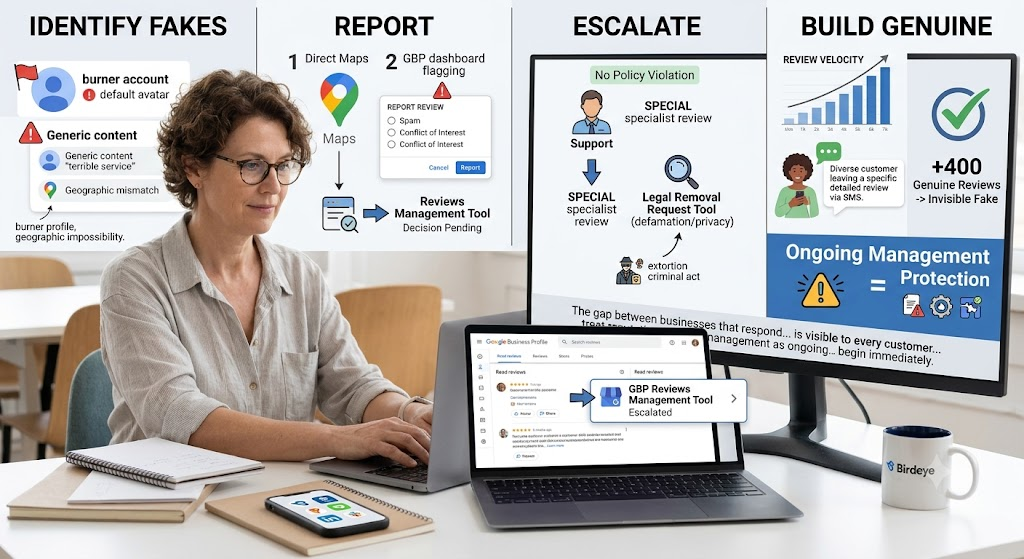
Before you report, confirm the review actually violates Google’s policy. Google does not remove reviews because you dislike them. They act only on documented violations and a weak report gets rejected fast. Using a fake Google review checker approach systematically cross-referencing the reviewer’s profile, content, and your internal records gives your report the strongest foundation.
Red Flags in the Reviewer’s Profile
Check the reviewer’s Google account before anything else. Fake accounts follow clear patterns:
- No profile photo, default avatar, or random string as a name. Classic signs of a burner account created to leave a review.
- Only one review — yours. Real customers build review history across multiple places over time.
- All 1-star or all 5-star ratings with no variety. This signals an incentivized or automated account.
- Geographic impossibility. Reviewing a plumber in Miami, a dentist in Chicago, and a contractor in Seattle all on the same day is click farm behavior, not a real customer.
Red Flags in the Review Content
Read the fake review itself carefully. These signs are usually obvious once you know what to look for:
- Vague language with zero specifics. No staff name, no service, no verifiable detail. The most common fake review pattern.
- Details that don’t match your business. AI fakes often mention services you don’t offer or staff members who don’t exist.
- Identical phrasing across multiple reviews. Even from different accounts, this signals coordinated spam using a shared template.
- The reviewer admits it. Phrases like “I heard from a friend” or “I never actually went in but” are direct admissions of no real experience.
Can You Trace Who Left a Fake Google Review?
Google does not reveal reviewer identities. But your own business records can build a strong case. Cross-reference the review date with your CRM, appointment logs, or POS data. A screenshot showing no records for that reviewer and date is strong evidence, stronger than claiming the review feels fake.
If a review matches a former employee or competitor grievance, document it and flag it as a conflict of interest. The more specific your evidence, the stronger your removal case.
Does Google Automatically Detect Fake Reviews?
Yes , but not reliably enough to depend on. Between January and July 2025, Google’s AI detection rate for suspicious reviews surged 600%. It monitors behavioral patterns, content anomalies, and unusual review spikes.
But it makes costly mistakes. In 2025, 2% of monitored businesses had a legitimate review deleted and 38% of those removals were 5-star ratings. Google’s system is now so cautious it flags genuine positive reviews as suspicious.
Do not wait for Google to clean up your profile. Monitor on a regular basis, report manually, and keep records of all reviews, including those that disappear. What happens when you report fake reviews on Google is an automated check first ; a human review only follows if you escalate.
Does the Review Violate Google’s Policy? (Check This Before You Report)
Not every suspicious review qualifies for removal. Understanding the Google review removal policy before you submit is essential. Reporting without understanding that line wastes time and gets your request rejected.
Reviews Google Will Remove
Google removes reviews that fall into specific violation categories. These include spam and fake content, reviews without real experience, conflicts of interest from employees or competitors, harassment of owners or staff, private information, off-topic content, profanity, and extortion.
Reviews Google Will Not Remove
Google does not act as a dispute mediator. A customer can post a harsh opinion like “the food was cold and the service was slow” and it stays protected even if it feels unfair. Removing an unfair Google review that expresses a genuine or even exaggerated opinion is not possible through standard reporting.
Google protects opinions and only removes content that breaks a specific rule. If the review does not qualify for removal, the best path forward is to respond professionally and focus on building genuine reviews.
How to Remove Fake Google Reviews Step by Step
Follow this process in order and do not skip steps. Most removal requests fail due to wrong categories or early escalation.
Method 1 : Flag the Review Directly on Google Maps
How to remove reviews on Google Maps starts here. Open Google Maps, search for your business, and go to the Reviews tab. Find the fake review, click the three-dot menu, and select Report review. Choose the violation type that best matches Spam, Conflict of Interest, Off-Topic, Profanity, or Harassment and submit. Google performs an initial assessment within 3 business days.
Method 2 :Report the Review Through Your Google Business Profile Dashboard
Log in at business.google.com, select Read reviews, find the target review, click the three-dot menu, and select Flag as inappropriate. Choose the violation reason and submit.
Before you flag if you have already left a public response, remove it first. A public response signals to Google that you accept the review, which lowers removal chances.
How the Process Differs on Mobile vs Desktop
On desktop, the GBP dashboard gives you more detailed input fields and makes it easier to attach screenshots during an appeal. Desktop is the better option for escalations.
On mobile, you can report the reviewer’s entire profile directly. Tap the reviewer’s name, hit More, and report the account for privacy concerns or legal issues not only the individual review. Useful when the profile shows fake activity across multiple businesses.
What Happens After You Report a Fake Review?
Track your report status through the Reviews Management Tool in your GBP dashboard. Decision Pending means Google is still evaluating, so wait 3 business days before following up. No Policy Violation Found means the automated review found no breach, but you can still file a one-time appeal with new evidence. Escalated means a specialist is reviewing your case, so monitor your email for updates. Removed means the review is gone, so document it and update your records.
How Long Does Google Take to Remove a Fake Review?
The initial automated review completes within 72 hours. If rejected and you file an appeal, a manual specialist review takes an additional 7 to 10 business days. Will Google remove reviews that are clearly fake? Yes, but only if the violation is properly documented and the right category is selected.
How Do You Remove a Bad Review on Google When Google Says No?
How do you remove a bad review on Google after a rejected report? A single rejection is not the end. It usually means wrong violation category, weak evidence, or no follow-up.
Re-Report With a More Specific Violation Reason
Selecting the wrong category is the most common reason requests fail. If Google rejects your spam report, re-report the review as a conflict of interest and include proof of identity. If a review exposes staff personal information, report it under privacy for a higher removal success rate than spam.
Contact Google Small Business Support Directly
Go to Support in your GBP dashboard and select Review removal request rejected. State that you request escalation to a human specialist and include your original Case ID. This moves your case out of the automated system and into human hands.
Use the Google Business Profile Complaint Tool
Escalate to the Google Business Profile Community Forum if direct support fails. Post your business name, review URL, Case ID, and policy violation documentation. Product Experts monitor this forum and can escalate directly to Google employees. Keep it professional and factual; they respond faster to structured cases.
How to Collect and Submit Evidence That Supports Your Case
Gather full-page screenshots of the review with the reviewer’s name and timestamp. Capture the reviewer’s profile history showing patterns like repeated 1-star ratings or multiple-city reviews on the same day. Pull internal records showing no match for the visit date. Quote Google policy exactly, such as conflict of interest rules for current or former employees.
How to respond when multiple fake reviews appear at once
Treat it as a security incident, not a customer service problem. Large spikes often trigger Google’s spam filters within a week on their own. Report each review as spam or fake engagement. If the attack is severe, contact Google Support and say “targeted review attack” to raise priority.. Check Reddit, Facebook groups, and local forums for organized attacks and document the sources as evidence.
Can companies remove Google reviews?
Only Google can remove a review from your profile. No third-party service has direct access to Google’s review system. Companies that remove Google reviews or claim to typically do one of two things: they file reports on your behalf using the same public tools you have access to, or they attempt reputation suppression by pushing positive content above the negative.
Review removal experts and GBP removal services online can be useful if you lack the time to manage escalations yourself, but vet them carefully. Fake GBP removal services operating as scams are common. They charge fees, do nothing, and disappear. Legitimate services help you organize evidence, draft escalation requests, and monitor outcomes. They do not have a back channel to Google. If a service promises guaranteed removal, that is a red flag.
How to get rid of a bad Google review when removal is not possible?
You still have options. How to hide bad reviews on Google is not a direct feature Google offers, but you can dilute their impact. A profile with 400 genuine reviews makes a single fake 1-star nearly invisible in the rating calculation. Build review volume consistently and the math works in your favor. How to stop Google reviews entirely or disable
Google reviews is not possible for most business categories. Google does not allow businesses to turn off the review feature. The only path is management: respond, report violations, and build a strong genuine base.
How to Respond to a Fake Review in a Professional way
Responding to a fake review is not about the reviewer, it is about every potential customer reading it. Your public response is your only active defense while the removal request is being processed.
What to Say and What to Never Say
97% of consumers read business responses. How you respond shapes their impression more than the review itself. Never get defensive, argue, or use emotional language. Never threaten the reviewer or pay an extortionist; it encourages more attacks. Never ignore the review while it sits visible to new customers.
Always stay calm and professional. Acknowledge the feedback without confirming false claims and offer to continue offline via phone or email.
A Simple Response Template for Business Owners
For a suspected fake review: “Hello, we take all feedback seriously. However, we have no record of your visit or interaction with our business under this name. Please contact us at [phone/email] so we can look into this directly.”
For a coordinated attack: “We are currently experiencing a coordinated fake review campaign and have reported these entries to Google. These do not reflect genuine customer experiences.”
When a Fake Review Becomes a Legal Issue
Most fake reviews are a policy problem but some cross into legal territory. When a review makes a false factual claim that causes documented harm, you have options beyond Google’s reporting system.
Are Fake Google Reviews Illegal?
In many jurisdictions, yes. A review stating false facts like “they use expired ingredients” can qualify as defamation and grounds for a lawsuit.. In the US, the FTC prohibits buying or selling fake reviews as an unfair commercial practice. In the UK, the Digital Markets, Competition and Consumers Act 2025 bans fake reviews and allows fines of up to 10% of global annual turnover.
How to File a Legal Removal Request With Google
Use Google’s Legal Removal Request Tool and select Google Business Profile or Maps, then choose Defamation or Privacy and Personal Data as the legal basis. Provide the review URL and explain why the content violates local law. If you have a court order declaring the review defamatory, include it. Google treats court orders as conclusive. It processes them faster than standard reporting.
When You Should Consult a Lawyer
Privacy: If a review exposes personal information like a staff member’s home address, use the legal privacy route. It is faster than standard reporting.
Extortion: If someone demands payment in cash or Bitcoin to remove a review, it is extortion. Document every threat. Report it to Google and law enforcement.. Remove the malicious Google review through the legal channel, not by paying.
Competitor: If a competitor runs a malicious review campaign, send a cease and desist letter. It can stop the activity faster than Google reporting.
How to Protect Your Business From Fake Reviews Going Forward
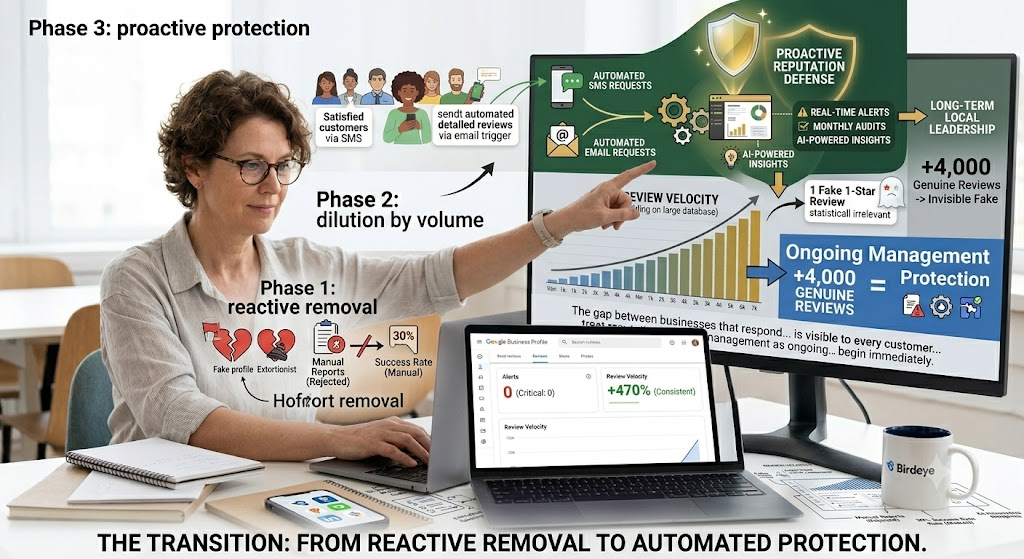
The best defense is a profile strong enough that a handful of fakes cannot move the needle. Removal is reactive. Protection is proactive.
Build a Genuine Review Base That Absorbs the Impact of Fakes
Get rid of bad Google reviews’ damaging effect by making them statistically irrelevant. A business with 500 genuine reviews is far more resilient than one with 15. A single fake 1-star review on a profile with 400 reviews has little impact on the rating. The same review on a profile with 10 is devastating.
Focus on review velocity, a steady, natural stream over time rather than 50 in one week and none for two months. Sudden spikes trigger Google’s spam filters even when reviews are real. Encourage customers to be specific, mentioning the exact service, a staff member’s name, or a product detail. Detailed reviews carry more ranking weight and strengthen credibility with Google and customers.
What Is Review Gating and Why It Can Get You Penalized
Review gating pre-screens customers before they reach Google. It directs satisfied customers to leave reviews. It sends dissatisfied customers to a private feedback form.
Google considers this selective solicitation and a direct policy violation. The penalty is severe permanent suspension of your Google Business Profile and deletion of every review you have collected. It is not worth the short-term rating boost.
Set Up Monitoring So You Catch Fake Reviews Early
In 2026, the industry standard for responding to negative reviews is 15 to 30 minutes. Catching a fake review early gives you more time to report it and limit its visibility before potential customers see it.
Set up Google Alerts for your business name. Use a reputation management platform like Birdeye, BrightLocal, or Podium for real-time alerts. Run a monthly audit of your review data. Check for filtered or removed reviews. Include legitimate reviews removed by Google’s automated system
Best Tools to Help You Monitor and Manage Google Reviews
Manual review management gets hard fast. The right tool depends on your business size and what you need most. For small businesses, Google Alerts and the built-in Reviews Management Tool inside GBP are free and good enough to start. Podium works well for SMS-focused businesses that want to turn customer texts into review requests. NiceJob keeps it simple by automatically sharing positive reviews on social media.
BrightLocal helps growing local businesses and agencies with local SEO. It tracks citations and runs ranking audits. Synup lets you manage your presence across 120+ platforms from one dashboard. Rebuild your reputation after removing fake reviews.
Rebuild your reputation after removing fake reviews
Reach out to recent customers and request honest reviews. Steady feedback over weeks carries more ranking weight than a sudden spike. Audit your listings on Yelp, Facebook, and directories. Keep your name, address, and phone number consistent everywhere. Inconsistencies weaken your local SEO signal directly.
How to remove bad reviews from Google local listings long-term is less about individual removals and more about building a profile where fakes cannot gain traction. In 2025, 45% of consumers will use AI tools like ChatGPT or Gemini to research businesses. These tools pull from your GBP, website, review platforms, and community sources like Reddit. Keep your GBP updated, respond to reviews, and engage in relevant online communities so AI tools describe your business accurately. Set up real-time alerts, run monthly audits, and treat reputation management as ongoing not a one-time fix.
FAQs
Can a competitor leave fake reviews on my Google profile?
Yes, and it violates Google’s Conflict of Interest policy. Report the fake Google review under Conflict of Interest and include evidence linking the review to the competing business.
How long does Google take to remove a fake review?
72 hours for the initial review. An appeal adds 7 to 10 business days. After that, escalate through Google Support or the GBP Community Forum.
What happens if I ignore a fake review?
It stays visible, damages your star rating, hurts your local ranking, and drives potential customers away. Ignoring it has a direct cost over time.
Can I delete a Google review myself?
No, You can only report reviews posted by others. Google decides whether to remove them.
What is the strongest evidence for a fake review appeal?
Internal records showing no customer by that name on the alleged date. Support it with the reviewer’s profile history, policy citations, and any link to a competitor or former employee.
What happens if Google keeps rejecting my removal requests?
Escalate to Google Small Business Support, post in the GBP Community Forum, and request a human specialist review. For defamatory content, use Google’s Legal Removal Request Tool or get a court order.
Conclusion:
Fake Google reviews are manageable. Identify the review, confirm it breaks Google’s policy, and report it correctly. Escalate if Google ignores you. Respond in a professional way while you wait. If the review is defamatory, use the Legal Removal Request Tool or consult a lawyer. After removal, build genuine reviews, and monitor your profile.
The businesses that recover fastest treat reputation management as ongoing not a one-time fix. If a fake review is harming your business, begin immediately. If a fake review harms your business, act immediately. Flag the review, document all details, and follow the escalation process until removal.

11 June 2026
How to Respond to Google Reviews (With Templates)

11 June 2026